Your cart
There are no more items in your cart
The anatomy of a Japanese kitchen knife
.jpg "Anatomie d'un couteau de cuisine japonais")
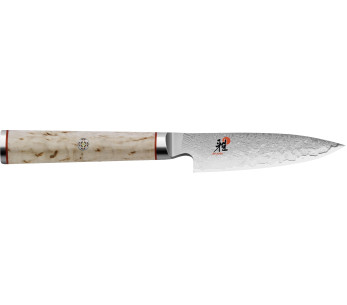
Japanese knives are highly prized for their precision, performance and authentic craftsmanship. Behind their elegant appearance lies a multitude of materials and manufacturing techniques that contribute to their excellence! KnifeLeader explains all about the anatomy of a Japanese knife, breaking down its various parts and explaining their role.
The composition of a Japanese knife blade
The blade is the heart of the Japanese knife! It is generally forged from high-quality steel, such as carbon steel or stainless steel, and can have a variety of features depending on the type of knife. Here are some of the main parts of the blade, from top to bottom:
- The " mune "back : This is the part opposite the cutting edge, which is thicker and provides stability and balance to your kitchen knife. This part tapers progressively towards the tip, and its thickness can vary from one knife to another.
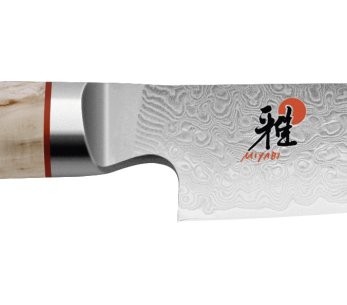
- The Japanese blacksmith 'slogo or signature in the form of "kanji": these are the Japanese characters used for writing. They add cachet and certify the authenticity of your handcrafted knife. They can be engraved by hand or laser.
- The flat part of the blade "hira": This is the upper part of the blade that is considered flat, just before reaching the shinogi.
- The middle line of the blade "shinogi": This is the line between the hira and the kireha. It is formed where the flat body of the blade and the emouture meet.
- The" kireha": This is the bottom of the blade that begins to be sharpened to form the cutting edge. This part generally measures around 1cm or 1.5cm. This is the part that tapers to the hasaki, which is the cutting edge. Different shapes are available, for example, to give a convex or flat cutting edge.
- The "hasaki" cutting edge: this is the part of the blade, from the heel to the tip, that is sharpened to cut food. Japanese knives are renowned for their remarkable cutting edge, which is often sharpened at a sharper angle than that of Western knives, giving them a precise, clean cut.
- The " kissaki" point : The point is where the back of the blade and the cutting edge meet. It is mainly used for precision tasks and must be handled with care to avoid damage (if this happens, use a suitable whetstone to repair it!).
- The " hamoto "heel : This is the angle close to the handle that can also be used as a point on certain foods. For example, with a yanagiba knife, a cut should be made from the heel to the tip to use the entire cutting edge for perfect slices of fish.
- The " ago" guard : This is the curve created between the handle and the heel of the blade. It is usually polished, as some chefs place their fingers on it to add strength to their cuts.
- The transition between handle and blade "machi": This part is often hidden inside the handle. In the Sakai region, the tradition is to leave the machi visible, which lends optimal balance to your Japanese kitchen knife.
- The " nagako" tang : This is the part inserted into the handle to finish off the blade. For traditional Japanese knives, the tang is usually thinner than for Western knives. This allows the balance to be centered on the tip of the knife, for lighter handling.
The handle of a traditional Japanese knife
The handle of a handcrafted Japanese knife is often made from precious woods, such as Japanese oak or magnolia, or from high-quality composite materials. Here are the components of the handle:
- The " kakumaki" bolster : This is the part that connects the blade to the handle and offers greater stability. On Japanese handles (called "wa"), it is frequently made of natural materials, while on Western-style handles (called "yo") it is made of metal.
- The " e" handle : This is the body of the handle, which can take a variety of shapes. It offers a secure, comfortable grip, which is essential for prolonged, fatigue-free use!
- The "ejiri "base : This is the part at the end of the handle, sometimes engraved with a kanji for added authenticity.
Japanese knives are works of art, with every component carefully designed for optimum performance! By understanding the different parts that make up a handcrafted Japanese knife, you can better appreciate the expertise that goes into their manufacture. Equipping yourself with a quality Japanese kitchen knife can transform your experience in the kitchen, enabling you to make precise, optimal cuts!
Discover many exceptional Japanese knives on KnifeLeader.eu!