
Your cart
There are no more items in your cart
Which whisk to choose?
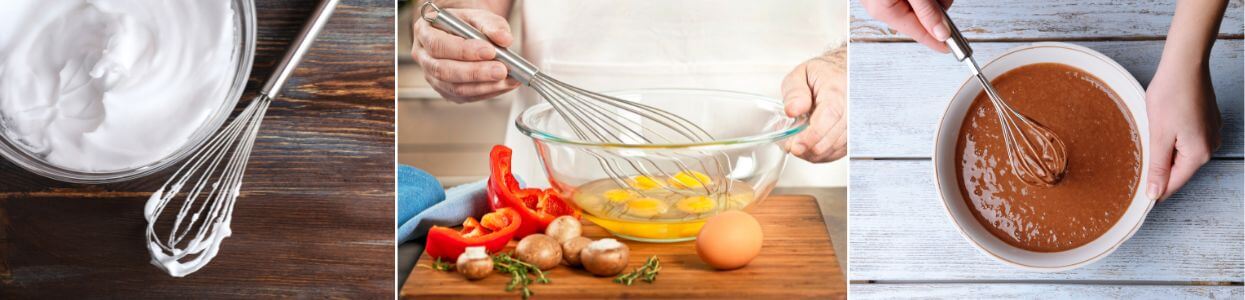
A whisk is a must-have kitchen utensil. Whether in the kitchen or in pastry-making, it helps to mix ingredients while incorporating air to produce homogeneous, airy preparations. Beating, whipping and emulsifying are all part of the cooking whisk's mission! But did you know that there are different shapes of whisk? Yes, a classic whisk won't necessarily have the same function as a less standard whisk. Let's take a look at the different types of whisk and their uses!
The different types of whisk
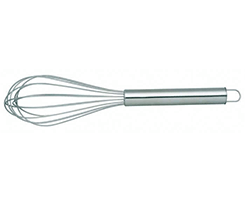
The French whisk
The classic kitchen whisk. Its elongated, straight shape makes it extremely versatile. With it, you can beat omelettes, whisk egg whites, mix cake batter or emulsify vinaigrette.
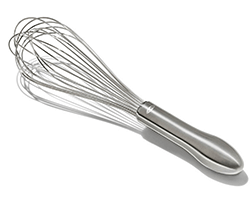
The balloon whisk
This is a cooking whisk with more rounded wire ends than the classic whisk. The purpose of this shape is to integrate even more air into preparations, making them airy. This whisk is ideal for pastry-making: use it to whip egg whites or whipped cream.
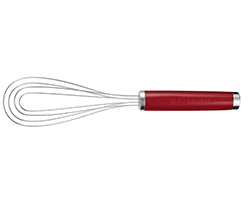
The flat whisk
The flat whisk has no tangled wires. It's ideal for mixing preparations such as sauces and omelettes in low containers, as it can reach into their nooks and crannies. What's more, its flat shape makes it space-saving and easy to store.
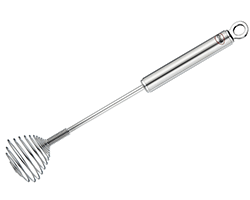
The spiral whisk
This kitchen whisk has a long handle and its distinctive feature is its short, spiral-shaped wires. It is ideal for making a wide range of creams and sauces, such as crème anglaise or béchamel sauce.
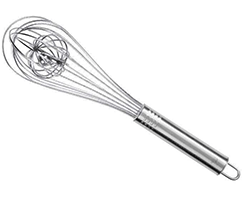
The ball whisk
The ball whisk is similar to the French whisk, except that it contains a stainless steel ball enclosed in a sphere. This ball moves as you use the whisk, making it even more efficient. Its purpose is also to incorporate more air into your preparation, and its ball prevents it from getting stuck in the whisk wires.
How to choose the right whisk?
Think ergonomics
It's important to choose a hand-held whisk that feels good in your hand. Beating, mixing and emulsifying are gestures that can quickly tire you out if you don't have the right whisk. Choose a whisk that's the right size for your hand.
Wire spacing and handle thickness are also important criteria. Whisks with thick handles and narrow wires are perfectly suited to thick preparations. On the other hand, a whisk with a thin handle and widely spaced wires is more suitable for liquid preparations.


The question of material
Stainless steel or silicone whisk? These are the two most popular materials for kitchen whisks.
Stainless steel is a robust material that resists corrosion, ensuring a solid, long-lasting whisk. Stainless steel wires have the advantage of not deforming with use, especially for thick preparations. As a result, you can use a stainless steel whisk for both hot and cold preparations with complete peace of mind. Finally, stainless steel whisks are easy to wash, as they are often dishwasher-safe.
Silicone is a healthy synthetic material, less expensive than stainless steel, which is ideal for using a whisk in a non-stick bowl. Silicone whisks won't scratch the bottom of your containers. Like the stainless steel whisk, the silicone whisk can be cleaned in the dishwasher. However, it may tend to deform slightly when in contact with thick preparations.
Find all kitchen whisks on KnifeLeader.eu!


