The different blade structures of Japanese knives
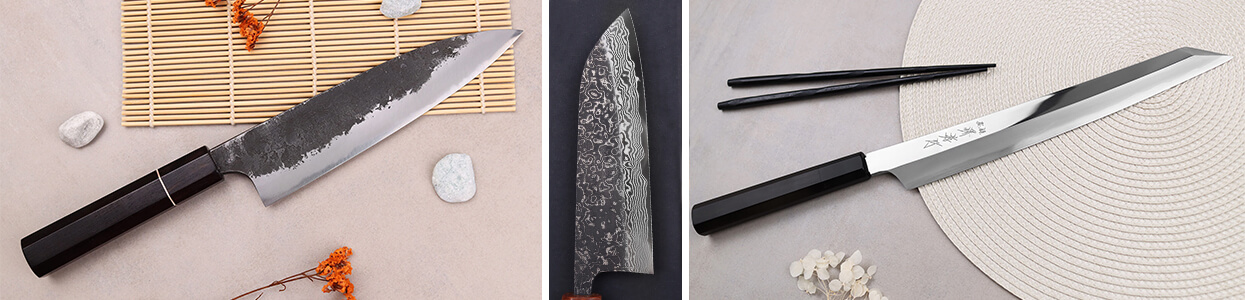
Japanese kitchen knives are renowned for their finesse, remarkable sharpness and refined aesthetics! The performance of these knives depends largely on the structure of their blade.
Damascus is certainly the best-known structure. It's appreciated for its unique wavy pattern, the result of a complex layering and forging technique. Indeed, damascus involves forging a rigid steel core which is then surrounded by several layers of softer steel. This protects the core of a Japanese knife, while giving it greater flexibility.
With this structure, the cutting edge of the damascus knife is powerful, for clean, precise cuts. It also gives the blade excellent edge retention, for a longer-lasting cutting edge. It is sharpened with a whetstone, more or less easily depending on the steel used for the core of your knife.
As mentioned above, the composition of several layers of steel offers a remarkable aesthetic that makes it so distinctive. Over the entire surface of the blade, you can observe the superimposition of the different layers of steel, which form fine, random waves, making your handcrafted knife a unique piece. Depending on the Japanese blacksmith, the damascene patterns can be pronounced or extremely fine, for added elegance.

San Maï blades: refined and high-performance
San Maï is another blade structure that is very common among Japanese kitchen knives. It can be considered a simplified damascus, since it consists of just 3 layers. Like a damascus knife, the San Maï (which literally means "3 layers" in Japanese) consists of a hard steel core, surrounded by a softer steel layer that folds in on itself to form the remaining 2 layers.
Like damascus, san maï knives offer a balanced combination of strength, performance and edge durability. This typically Japanese structure is maintained with a whetstone.
Aesthetically, you can see a fine wave of random patterning running the length of the cutting edge: it's formed by the superimposition of different layers of steel.
To continue the comparison with damascus, there are no structures that perform better than the other, depending on the type of steel used for forging. One difference, however, is in price: a San Maï blade will generally be less expensive than a damascus blade, due to the amount of steel used.

Coreless damascus structure: an unusual damascus pattern
In contrast to damascus and san maï, coreless is distinguished by its absence of a core. As its name suggests ("coreless" literally means "without a core"), this structure is composed of several superimposed layers of steel, without surrounding a core. This means that the outer layers are not soft steel layers protecting a core, but are used directly in alternation to form the blade.
This structure offers a number of advantages! Firstly, in terms of aesthetics, a Coreless blade features elegant damask patterns formed by the superimposition of the layers.
Secondly, the capacities of the steels used are directly present on the surface of the blade, since there is no softer layer to protect them. For example, a so-called "pure" micro-structure will extend its benefits to the whole blade, not just the core.
This can also be seen as a disadvantage, as the blade has no core to protect. What's more, it's a structure that's rarely made for this reason, so it's hard to find.
The honyaki blade embodies the pinnacle of Japanese craftsmanship! Let's start with a quick history: Honyaki blades were originally used to make the famous Japanese katanas, carried by samurai in the service of their lord. The katana is considered to be the most accomplished sword of all civilizations! It reached its apogee between 1600 and 1800, but eventually disappeared when Japan's modernization led to a ban on the carrying of weapons. To preserve this heritage, the Honyaki technique was used to forge other types of blade, including Japanese kitchen knives.
A Honyaki knife is made from a single block of high-grade steel, requiring exceptional craftsmanship by an experienced Japanese blacksmith. It involves a complex forging and tempering process in various stages that few blacksmiths can carry out.
This technique gives these knives a very clean cutting edge and excellent edge retention. Honyaki blades are reserved for connoisseurs and collectors in search of exceptional pieces! They are therefore quite rare and, due to the rarity of this know-how, very expensive.

In conclusion, the variety of blade structures on Japanese kitchen knives offers several options, each bringing its own unique advantages. Whether you're drawn to the beauty of damascus, the balance of san maï, or the excellence of the honyaki blade, each choice reflects personal preferences and specific needs. Opt for Japanese quality!
Discover many handcrafted Japanese knives on KnifeLeader.eu!


10 Years


