
Your cart
There are no more items in your cart
The special features of a Japanese knife: what you need to know
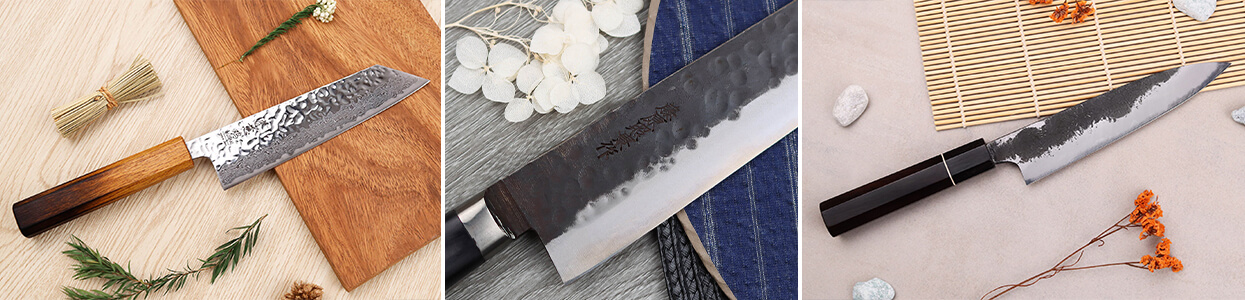
Handcrafted Japanese knives are handmade by highly skilled blacksmiths, right in their own workshops! Each Japanese knife is therefore unique and may have its own special features, which give them their charm and authenticity. Here we explain the different aspects to consider when buying a Japanese knife, and what can vary from one handcrafted knife to another.
Possible changes to a handcrafted Japanese knife
Slightly different finishes
As a handcrafted knife is handmade, it is possible for certain finishes to differ from one knife to another, even if it is made by the same Japanese blacksmith. Because of the artisanal process, each knife is unique and may present variations in finishing details; for example, hammering will never be the same, just as a knife's damask pattern will always differ. The cutting quality and functionality of your handcrafted Japanese knife remain unchanged: in fact, a slightly more pronounced hammering stroke or a small punch mark in excess are no problem!
These singularities add a touch of character and authenticity to your collection. In fact, some blacksmiths, like Teruyasu Fujiwara knives, are adept at "wabi sabi" blade finishing: a Japanese concept that celebrates imperfections through authenticity and the beauty of the passing of time.
Unique veining on wooden handle knives
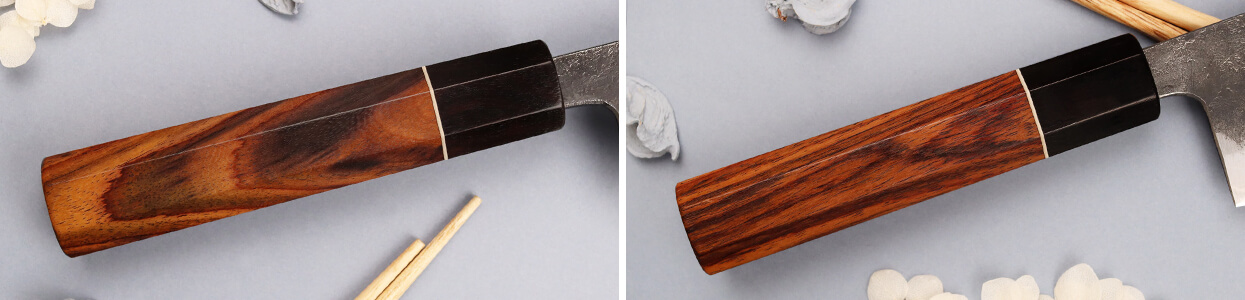
Wooden handles are highly appreciated for the traditional look they lend to Japanese knives! The woods used are carefully selected by the Japanese blacksmith. However, wood is a living material, which is why the grain on a knife handle can vary.
This visual feature adds a touch of authenticity and uniqueness to your handcrafted Japanese knife!
Features of handcrafted Japanese knives
A carbon knife that evolves over time
Handcrafted Japanese knives are generally made from high-quality steels, giving you a remarkably sharp blade! These are alloys with varying degrees of carbon content, and it is this element that is sensitive to humidity.
As a general rule, we recommend never putting your Japanese knife in the dishwasher, even with a lower carbon content. This is even more the case for a carbon knife! They require very careful maintenance to preserve the appearance of the blade.
Even with ideal care, your blade may change color slightly: this is normal! This is a reaction of the carbon, which can be caused by the acidity of the food you're cutting, or by the humidity in the air. Rest assured, this change has no impact on the use of your Japanese knife! It's simply the passage of time that marks your knife by its experience, in the manner of the wabi sabi philosophy.
We tell you everything you need to know to look after your Japanese knife!
A Japanese knife with a slightly warped blade
Note that Japanese knives can sometimes have a warped blade. This may be due to the nature of the artisan forging process or the tempering of your knife. This is a slight distortion that generally does not affect the knife's performance. In fact, some people consider that it adds character to a Japanese kitchen knife, giving it a unique appearance without compromising its effectiveness.
If the warped blade is too pronounced upon receipt, you can call on our super customer service to find you a solution!
Kaiseki on the blade of a Japanese knife
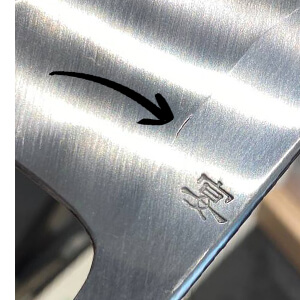
On some Japanese kitchen knives, you'll find what's known as the "kaiseki" on the back of the blade or the "aike" on the front. This is a small gap that can be created during the forging of your knife. This is quite rare!
More precisely, it occurs at the moment of forging between the iron and the steel. Indeed, if the forging temperature is not high enough, a small gap can form, a sort of line. To prevent this at the manufacturing stage, the heating temperature should be increased. However, if the temperature is too high, the steel may become too brittle, making the knife unusable. For this reason, manufacturers keep the temperature within a certain balanced range, to limit the appearance of kaiseki, while preserving the strength of the steel.
This in no way prevents the use of a kitchen knife! You just need to be careful where the kaiseki is located, as it becomes more susceptible to corrosion, given that water is more likely to get trapped there. Once again, this feature is quite rare for a Japanese knife, and the knife is not considered defective!
Japanese craftsmanship: sought-after and in demand
A long lead time for certain handcrafted knives
Japanese craftsmanship, with its meticulous attention to detail, often means longer lead times for production. Japanese knives are created with care, sometimes on demand, which can mean longer waits for enthusiasts. However, this extended lead time guarantees the quality and uniqueness of each knife, making each piece a work of art in its own right!
We invite you to be alerted by e-mail when a knife you're interested in is back in stock. If you place an order for a knife with the "on request" lead time noted on the product sheet, you'll need to be patient, and we'll keep you regularly informed of how long it will take to receive your order! It may seem like a long wait, but a top-of-the-range handmade Japanese knife is well worth it! These are rare pieces that enthusiasts are willing to wait to add to their collection!
Kitchen knife boxes may change color
Another detail is the occasional variation in the color of your Japanese knife boxes. This change can occur due to a variety of factors, such as the manufacturer's preferences or the shortage of a particular paper used to design the boxes. It's a minor detail that once again underlines the handcrafted nature of your Japanese kitchen knife. Don't hesitate to let us know!
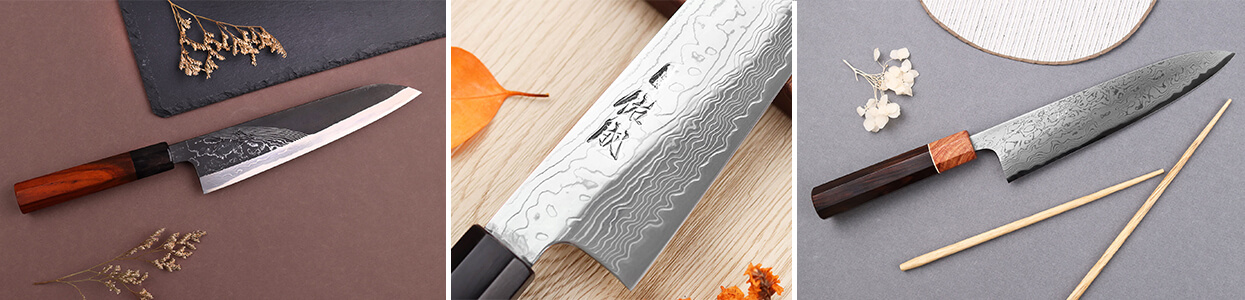
Japanese knives, though admired for their superior quality, sometimes present imperfections that shouldn't frighten away any cooking enthusiast. On the contrary, they don't interfere with the use of your handcrafted knife and even add authenticity to these unique pieces! To appreciate Japanese knives is to honor the beauty of craftsmanship, with all its nuances and singularities!
Find a wide range of handcrafted Japanese knives on KnifeLeader.eu!


