
Your cart
There are no more items in your cart
6 tips to remove rust from your knives
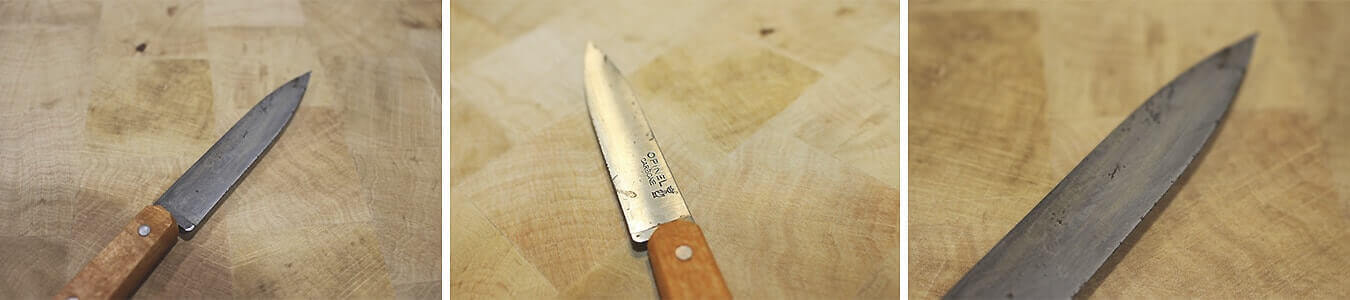
Our anti-rust tips :
1 - Rust remover
This little stone removes superficial rust stains from your finest knives in a matter of seconds! In fact, it can quickly become indispensable for owners of carbon steel Japanese knives who want to preserve the color of the steel. This rust remover works on all types of steel objects. To use it, simply wet it and rub it over the oxidized part of your knife: you'll see the rust disappear in seconds! We advise you to use it sparingly, as the stone removes a little material with each use.
2 - Potatoes
This is the simplest tip: simply use a potato cut in half to rub the blade of your kitchen knife (but be careful with your fingers).
The starch contained in the potato will act as a rust inhibitor on the steel of your blade. Then rinse the knife and dry it with a soft cloth. This economical tip is ultra-natural, and will remove the small rust stains that are beginning to sting your knife.
3 - White vinegar and coarse salt
Mmmmmmmh white vinegar, you too remember its... peculiar smell! A household product par excellence for all our grandmothers, its virtues are manifold. In our case, you can use it slightly warm. Soak a cloth in the vinegar and rub the blade, and your knife should look as good as new...
White vinegar can also be prepared as a mixture with coarse salt. Once you've prepared the potion, soak your blade in it. A chemical reaction will produce a gaseous formation on the blade. Once this is visible, take your knife and rub it gently with a soft sponge. Rinse and dry - that should help!
4 - Turpentine oil
If you have turpentine at home, you can use it in exactly the same way as white vinegar (without heating it), for even better results!
5 - A cap and make-up remover
Here's another little trick that doesn't require much equipment. All you need is a cork (found, for example, on wine bottles - drink in moderation, folks, we see you coming) and some mild make-up remover milk. Gently rub the milk with the cork, directly onto the blade.
6 - Lemon
And finally, here's one last natural tip that's easy to reproduce yet effective! Soak a clean cloth in pure lemon juice and rub lightly over rust stains. If they prove very stubborn, you can also add a little salt. Leave for 2 or 3 minutes, but no longer (be careful!), as citric acid can be (a little too) effective and damage your blade if left on for too long. So be sure to rinse your knife thoroughly once you've removed the stains, so that it retains all its shine!
We hope you find these tips useful. So don't worry too much if your knives get a few rust spots over time. It's a normal phenomenon that doesn't affect the quality of your blades! And what's more, with all these tips, you can easily give them a new lease of life!
Find all our products for maintaining your blades and removing rust on KnifeLeader.eu!
Some important explanations about rust:
And yes, it's ugly, but rust can appear on your favorite kitchen knife!
Rust is a natural phenomenon that is accentuated every time you wash your knives, especially if you put them in the dishwasher, which, by the way, we don't recommend. The ideal way to wash your knives is by hand, with the knife wiped dry immediately afterwards. Of course, you shouldn't leave your knife to soak in the sink forever, as this is very bad, and you shouldn't let it air-dry either, especially on a stainless steel sink.
However, even if you maintain your knives by hand and wipe them dry immediately, it's still possible for rust to appear one day.
Knives are made of an alloy that reacts more or less well to humidity, but every knife can rust (at more or less advanced stages). For example, despite its name, stainless steel is not totally immune to rust, although it is fairly resistant to it. You must therefore always give it the care it deserves to avoid accentuating the phenomenon.
Secondly, carbon steels are more sensitive than stainless steels, but you just have to be a little careful and all will be well. You can take a look at our special article on carbon steel to become a pro in this field! It's important to note, however, that carbon steel can vary in color over time, and this is not abnormal. In fact, despite proper maintenance, a carbon steel blade will react more quickly to its environment (humidity level) or to the acidity of the food you're cutting.
Is rust on a knife synonymous with poor quality?
We've already heard this from several customers, and the answer is no. Rust is not linked to a defect in the alloy, but to its composition, as mentioned above. An alloy is composed of several elements that give it its properties. For example, it may be more or less enriched with chromium (which gives it its rust-proof properties), or carbon (which enables it to retain its sharpness over time, but also makes it less resistant to corrosion).
To give you a telling example, consider Japanese knives. Many of them have a blade with a high carbon content (up to 1.5% carbon, whereas the average Western knife is around 0.5%). This high carbon content makes Japanese knives much more susceptible to corrosion. Is this a sign of poor quality? Quite the contrary! Japanese knives are renowned the world over for their efficiency, and it's precisely this high carbon content (among other things) that makes them so coveted. They are more susceptible to corrosion, but aside from that, they hold their edge for a long time and are easy to sharpen.
Another important point: when their knife starts to rust, some customers compare it with knives bought in supermarkets, which have not rusted despite a lower price. This is not a good basis for comparison, because as we said earlier, it depends on the alloy, and supermarket knives are often packed with chromium, which makes them less susceptible to corrosion, but far less efficient and easier to sharpen.
Why does a knife rust?
It's sometimes hard to realize how easy it is to rust a knife, despite good maintenance. In fact, it doesn't take much: a damp environment, for example, can cause rust. A single drop of water can also cause rust to move from one point to another. It's also important to note that the slightest impact on a blade (not visible to the naked eye) can damage the blade's structure and expose the alloy (the protective chromium oxide layer being damaged). So, even if you can't see it, the alloy is exposed and rust can set in much more easily. Note that you don't necessarily need an impact to damage the alloy's protective layer. Sometimes, a simple detergent or a highly acidic foodstuff will suffice.
It's also worth noting that sharpening your knife from time to time helps protect its edge from rust, as you remove the material, allowing it to be cleaned.
You should also make sure that those around you who use your knife take every precaution when using and washing it.
Is rust a health hazard?
Not at all ! We've always heard that you shouldn't use rusty knives or utensils, but rest assured, rust is in no way toxic. Rust is iron oxide, and iron is not harmful to health - on the contrary, our bodies need it!
You can continue to cook with rusty knives and even drink the yellow water from a rusty teapot, without any impact on your health. Sometimes rust can give certain foods a metallic taste or even turn them black, but again, no risk of illness.
Rust will become harmful when the rusty tool is in contact with soil or soiled ground over a long period of time, but normally maintained kitchen knives are not affected!
To avoid all these rust problems, we have a few nice little products to recommend, to help you maintain your blades over the long term!


