Your cart
There are no more items in your cart
Are you looking for a versatile knife to cut just about anything? Go for a chef's knife! There are so many chef's knives to choose from, it's easy to get confused. What criteria should you take into account to make the right choice? Here are our explanations of the essential points to guide your choice!
What is a chef's knife?
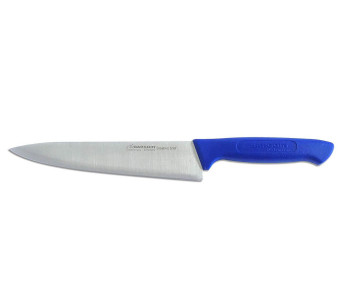
A chef's knife is a large, versatile knife designed to cut most types of food. Most knives have a 20 cm blade, and the height of the blade varies between 4 and 5 cm. This blade height allows you to position the food to be cut against the blade, simplifying knife use and optimizing speed and precision.
Generally speaking, a chef's knife will enable you to cut vegetables as well as meat and fish. Cutting, chopping and chiseling are all functions fulfilled by chef's knives.
Choosing your chef's knife according to what you're cutting
Tell me what you're cutting, and I'll tell you which chef's knife to choose!
While a chef's knife can cut any type of food, it's still important to determine the nature of the food you're most likely to cut, in order to choose a chef's knife whose cutting resistance will be adapted to these foods. In fact, if you like to cut foods with a hard skin or crust, you'll need to choose a chef's knife whose structure can withstand the cutting of these foods, as the rigidity of what you're cutting may present a risk of damaging your knife if it isn't strong enough for this.
For peace of mind, and to be able to cut whatever you want with a chef's knife, it's best to opt for a forged or full tang chef's knife, which ensures that the blade runs the full length of the handle and therefore enjoys a solid structure that will stand up well to the pressures inflicted on it.
Blade steel: hard or soft?
Choosing the right steel for our chef's knife is not necessarily the easiest thing to do. It's probably a good idea to take into account the environment in which it will be used (professional or domestic), as well as the type of food to be cut.
Soft steels are often used for professional chef's knives that will be used intensively in professional kitchens. Soft steels easily resist impact and torsion. They are ideal for cutting slightly harder foods, and are also resistant to the blade meeting a bone when cutting meat.
On the other hand, hard steel is less likely to be recommended in a professional environment, as it requires good maintenance and clean use. We tend to prefer chef's knives to hard steels for domestic use, in an environment where we're generally not pressed for time and can therefore work carefully and efficiently without risking damaging the knife. Indeed, hard steel will guarantee superior cutting quality, but it will also make the knife more fragile. This is also why it's best not to use hard steel for cutting foods with a hard skin or rind (such as squash, pumpkin, hard cheese, etc.).
To conclude on the choice of steel, opt for a soft or intermediate steel if you work in a professional environment, and choose what you prefer for domestic use, since there are no real contraindications when you're at home.
Wooden or synthetic handle?
Like all knives, chef's knives are made with handles that can be either wooden (there are many types) or synthetic or laminated (POM, Micarta, etc.).
Ideally, the choice of handle material should also depend on the environment in which the knife will be used. A wooden handle will inevitably be more sensitive to moisture and food residues than a synthetic or laminated handle, which will be easier to clean. In professional kitchens, splashes of juice, fat or water are frequent, and it's particularly complicated to prevent knives from being touched. It is therefore more difficult to maintain a knife with a wooden handle in a professional environment. That's why we recommend opting for a knife with a synthetic or laminated handle, which will also guarantee better compliance with hygiene standards.
As wood is a living material, care should always be taken with a knife with a wooden handle to avoid tarnishing. It's always easier to look after your knife when you're cooking at home!
Is weight important?
It's up to each individual to choose what they prefer most in terms of the weight of their chef's knife. Some like to have a heavy knife in their hands, as it gives them a good feel for the knife and stability when holding it. Others, on the contrary, prefer to use a lighter knife, which will enable them to handle the knife better. It's important to note, however, that in general, the heaviest chef's knives are also the most shock-resistant, allowing them to cut tougher food thanks to their structure and integrity.