How to choose your fish knife?
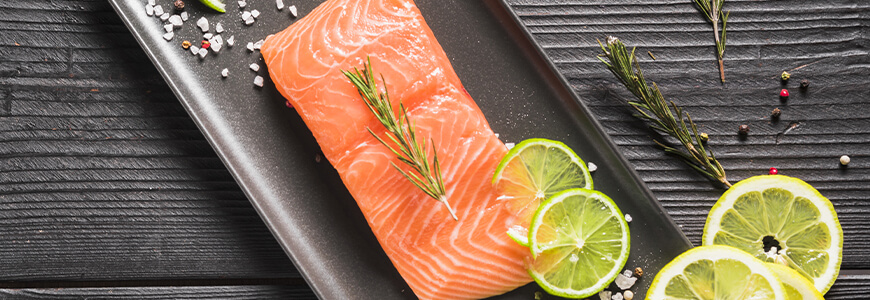
Fish is a food enjoyed by many people, and cooking it is a true art! Whether you are a sushi lover or a fan of French cuisine, this guide will help you make the best choice to find the perfect fish knife to enhance your favorite fish dishes.
Having the right kitchen knives is essential for preparing delicious meals. Fish have a delicate texture and tender flesh that require precise, clean cuts to preserve their flavor and appearance. That is why there are many different kitchen knives perfectly suited to the cuts you may need to make: filleting fish, slicing it thinly or removing the skin... here is everything you need to know about the functions of a yanagiba knife or a salmon knife!
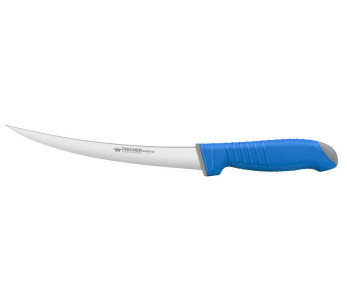
The fillet knife
 Fillet knives on KnifeLeader.eu!" src="https://knifeleader.eu/img/cms/filet%20de%20sole_4.jpg" alt="Mac Japanese fillet knife" width="250" height="150" style="float: left;" />The fillet knife is versatile when it comes to cutting fish: it lets you fillet fish precisely, remove the skin and make thin slices. It has a long, thin, pointed and flexible blade to adapt to the size of the fish you are cutting. The flexibility of the blade allows you to make a clean cut as close as possible to the backbone. It is perfect for preparing sole, pollock or salmon, and you can even use it on cured ham or cuts of meat!
The yanagiba knife
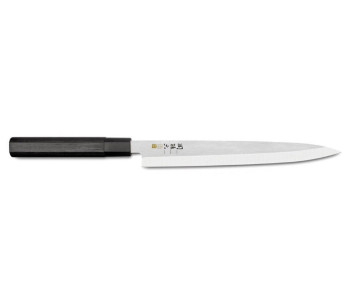
 Yanagiba knives on KnifeLeader.eu!" src="https://knifeleader.eu/img/cms/yanagiba_2.jpg" alt="Japanese yanagiba knife" width="250" height="150" style="float: left;" />Also called a sushi knife or sashimi knife, the yanagiba knife is ideal for lovers of Japanese cuisine. This Japanese fish knife is similar to the Western fillet knife and allows you to make precise and clean cuts. Unlike the fillet knife, this Japanese kitchen knife has a rigid, asymmetrical blade to prevent food from sticking to the sides while producing smooth cuts that do not damage the fish flesh. It is mainly intended for right-handed users, although left-handed versions also exist. It is a fish knife that requires a certain level of skill to use properly. Discover our tips for sharpening an asymmetrical blade!
The salmon knife
 Salmon knives on KnifeLeader.eu!" src="https://knifeleader.eu/img/cms/couteau%20saumon_1.jpg" alt="Victorinox salmon knife" width="250" height="100" style="float: left;" />Salmon is one of the most popular fish, which is why it has its own dedicated kitchen knife: the salmon knife! Its long, thin and flexible blade allows you to make even slices precisely in a single movement. It is a blade that is generally granton edged, creating air pockets that keep food from sticking to the surface, which is very practical and saves time. With it, you can slice salmon whether it is raw, cooked or smoked, and even ham.
The deba knife
 Let us go back to Japan with the deba knife. It has a very tall and heavy blade that is, most of the time, beveled. With this Japanese knife, you can fillet fish, but it is especially suited to heavier cutting tasks. The size of the blade is useful for cutting off fish heads, cutting through the backbone or trimming the tail cleanly. As it is a heavy and rigid blade, you can also crack shellfish shells or break small bones.
The serrated fish knife
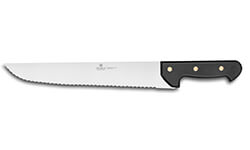 This is mainly a knife for professionals, but it can also be used by home cooks. This serrated fish knife has a large blade that is wide and toothed, allowing you to cut very large fish such as tuna. It is therefore a sturdy blade with which you can cut steaks and the toughest skins. Its serration allows you to saw cleanly through scales and flesh: the micro-serrations are perfect for precision work, while the large teeth are ideal for cutting the head or fins.
The oyster knife
 Oyster knives on KnifeLeader.eu!" src="https://knifeleader.eu/img/cms/couteau%20huitres.jpg" alt="Wusthof oyster knife" width="250" height="100" style="float: left;" />We have not forgotten seafood lovers! The oyster knife helps you open oyster shells without injuring yourself and without damaging the flesh. With it, it is easy to cut the muscle of this mollusk so you can enjoy it during a delicious meal.
In conclusion, choosing a fish knife suited to your needs is an essential step in improving your cooking and making fish preparation easier.
Do not forget that regularly maintaining your fish knife is just as important as the initial choice: sharpen it regularly with a sharpening stone! It is also essential to work on a cutting board suited to the size of your fish in order to preserve your blade (and your worktop!).
Discover all our fish knives on KnifeLeader.eu!
Endless

Endless