
Your cart
There are no more items in your cart
Japanese cutlery is about more than just an extremely sharp blade. At its highest level, it becomes a true medium for expression where centuries-old traditions, cutting-edge metallurgy, and aesthetic exploration converge.
Some knives impress with their steel, others with their construction, their finish, or simply the emotion they evoke when held in the hand. Modern powdered steel thus stands alongside the famous Japanese carbon steels, while ancestral techniques such as San Mai, hammering, or Damascus steel continue to be used by artisans who sometimes carry on techniques passed down through several generations.
And then there are all those details you might not necessarily notice at first glance: a handle crafted from precious wood, a completely hand-forged Damascus blade, an exceptionally fine grind, kanji characters engraved on the blade, or a finish that requires hours of work.
So we decided not to simply rank the most expensive Japanese knives. Instead, here are 10 Japanese knives, each of which possesses something exceptional—whether in terms of their beauty, their design, or the performance they deliver.
The most beautiful mirror finish: the Kanetsugu Zuiun SPG2 18cm santoku knife
What immediately stands out about the Kanetsugu Zuiun is the quality of its finish.
Its 18cm blade features an SPG2 powdered steel core, surrounded by numerous layers of steel. But beyond its construction, it’s the blade’s exceptionally clean and luminous finish that really catches the eye. The polished surfaces catch the light with great elegance and give the knife a particularly refined appearance.
This nearly mirror-like finish highlights the blade’s lines and reinforces its high-end positioning, without sacrificing performance. SPG2 steel results in a hard, thin, and durable blade capable of maintaining a very precise edge.
The pakkawood handle, with its unique shape, perfectly complements this modern and sophisticated aesthetic.
What makes it exceptional? Its exceptionally meticulous mirror finish, which gives the blade an elegance reminiscent of fine jewelry.


The Finest Damascus: The Masashi Yamamoto SLD Kuro Damascus 21cm Gyuto Knife
On this Masashi Yamamoto gyuto, the Damascus pattern is clearly more than just decoration.
Hand-forged, this 21cm knife features a core of Japanese SLD steel, prized for its high hardness and ability to maintain a sharp edge. Surrounding this core is a particularly expressive Damascus pattern, whose irregular lines lend the blade great depth.
The contrast between the different layers of steel and the darker upper section further accentuates the pattern’s visual impact. Depending on the light, the Damascus steel seems to almost shift in texture, revealing the full richness of the craftsmanship.
This aesthetic—deliberately less uniform than that of an industrial blade—is precisely part of its charm: every detail serves as a reminder that this is a knife crafted with genuine visual artistry.
The dark wooden handle complements the overall design without distracting from the blade, which remains the clear centerpiece.
Why is it exceptional? For its deep, contrasting, and vibrant Damascus pattern, which particularly highlights the craftsmanship of Masashi Yamamoto.


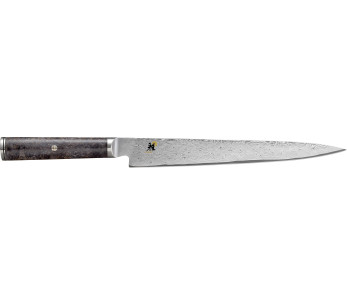
The Hardest Blade: The Miyabi 5000MCD67 24cm Sujihiki Knife – 66 HRC!
In the world of Japanese knives, exceeding 65 HRC is already considered remarkable. The Miyabi 5000MCD67 goes even further with a stated hardness of 66 HRC.
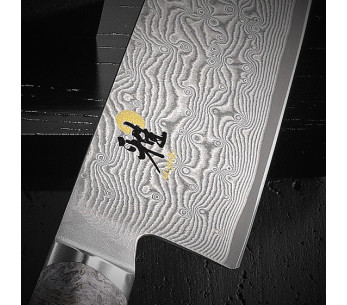
At the center of its 24cm blade lies a very high-end microcarbon steel, surrounded by a spectacular damask pattern composed of 132 layers.
This level of hardness results in an exceptionally sharp edge that, above all, remains effective for a very long time. On the other hand, this type of blade requires careful handling: twisting, impacts, and overly hard surfaces should be avoided.
Visually, the knife lives up to its technical specifications. The numerous layers of Damascus steel form an extremely fine pattern, while the Japanese handle adds a more traditional touch.
Why is it exceptional? Because its 66 HRC hardness perfectly illustrates just how far modern metallurgy can push the performance of a Japanese knife.
The heir to the Japanese sword: the Masashi Yamamoto WS2 27cm Sakimaru Takohiki knife
It’s hard to look at this knife without immediately thinking of a Japanese sword.
With its long, narrow 27-cm blade ending in a characteristic rounded tip, the Sakimaru Takohiki is probably one of the kitchen knives whose silhouette most directly evokes the katana.
The blade, crafted by Masashi Yamamoto, features a traditional San Mai construction, with a core of Japanese Shirogami #2 carbon steel, also known as White Steel #2.
The takohiki is historically intended for very precise cuts of fish and ingredients used in sashimi. The Sakimaru version further accentuates its traditional look with this tip inspired by ancient Japanese blades.
It is a knife that is as much a pleasure to admire as it is to use with precision.
What makes it exceptional? Its spectacular silhouette, directly inspired by the imagery of the Japanese sword.


The most beautiful handle: the Sukenari SG2 San Mai 16.5 cm utility knife
An exceptional blade sometimes deserves that we momentarily look away from the steel to admire its handle.
On this handcrafted Sukenari knife, the handle is crafted from superb rosewood and features a traditional Japanese octagonal shape. Its natural hues and dark grain make each handle a slightly unique piece.
The wood extends into a dark bolster, creating an elegant contrast and reinforcing the overall impression of quality.
The blade, of course, lives up to expectations: San Mai construction, an SG2 powdered steel core, high hardness, and a particularly meticulous finish.
The knife manages to be sophisticated without being extravagant.
Why is it exceptional? Because of the particularly well-balanced combination of precious wood, traditional Japanese geometry, and high-end details.


SG2 San Maï
16,5cm Sukenari SG2 San Maï japanese craft utility knife with rosewood handle
Out of stock
The most beautiful hammered finish: the Kai Shun Premier Tim Mälzer Legend tanto knife
Japanese hammered finish, or tsuchime, is both decorative and functional: the irregularities created on the blade’s surface can help reduce food from sticking.
But rarely does a hammered finish play such a central role in a knife’s visual identity.
The Kai Shun Premier Tim Mälzer Legend features a long 25.5 cm tanto blade, combining a high-performance core, highly visible Damascus steel, and a hand-hammered upper section.
This interplay of textures gives the blade a striking depth, while the tanto shape further accentuates its spectacular character.
Its dark wooden handle and metallic finishes perfectly complement this meticulously crafted aesthetic.
What makes it exceptional? Its spectacular, instantly recognizable hand-hammered finish, combined with a particularly striking tanto silhouette.


Shun Premier Tim Mälzer
Kai Shun Premier Tim Mälzer Japanese tanto knife 25,5cm Legend limited edition
In stock
The most original: the Glestain K Series 18cm utility knife
It’s impossible to mistake a Glestain for any other knife.
Its blade features large dimples distributed across its surface. These serve a functional purpose: they reduce the contact area between the blade and certain foods to minimize sticking during repetitive cutting.
This very distinctive design gives the knife an almost futuristic look.
Another distinctive feature: the back of the blade has a very pronounced curve, further emphasizing its unconventional design. The black pakka wood handle, more in line with Western standards, creates an interesting contrast with this extremely original blade.
Why is it exceptional? Because it dares to feature a radically different design. You can recognize a Glestain in a matter of seconds.


Glestain K Series
Glestain K Series 18cm Japanese Utility knife with granton edge curved back
In stock
The most beautiful San Mai structure: the Hado Ginsan 15cm utility knife
San Mai is one of the iconic constructions in Japanese cutlery. Its principle is relatively simple: a hard steel core forming the center and edge of the blade is surrounded by two layers of softer steel.
On this Hado knife, this construction also serves as a true aesthetic element.
The 15cm blade features a core of Japanese Ginsan steel, integrated into a three-layer structure. The line separating the core from the outer layers remains clearly visible on the blade and forms an irregular undulation just above the cutting edge.
Unlike Damascus steel, which deliberately multiplies layers and patterns, San Mai here showcases the simplicity of its construction.
It is precisely this understated elegance that makes it so intriguing: it almost allows you to “read” the way the blade was designed.
Why is it exceptional? Because its San Mai construction remains visible and becomes an integral part of the blade’s pattern.


The Most Western-Style: The Takamura SGR SPG2 21cm Gyuto Chef’s Knife
A Japanese knife doesn’t have to have an octagonal handle made of exotic wood or a kurouchi finish to be remarkable.
The Takamura SGR is a fine example of this.
This handcrafted 21cm gyuto features a silhouette very similar to that of a Western chef’s knife: a riveted handle, familiar ergonomics, and a fairly classic overall design.
Yet behind this apparent simplicity lies a distinctly Japanese design, featuring a very thin blade and an SPG2 powdered steel core that delivers an extremely precise cutting edge.
It is precisely this contrast that makes it so appealing: visually accessible to someone accustomed to Western knives, yet equipped with technical characteristics typical of high-end Japanese knives.
Why is it exceptional? Because it likely strikes one of the best balances between Western ergonomics and Japanese cutting precision.


The most professional: the Global G16 24cm chef’s knife
No Damascus steel, no precious wood, and no spectacular handcrafted finish.
And yet, it’s hard to talk about professional Japanese cutlery without mentioning Global.
The G16 features a 24cm blade made of CROMOVA 18 stainless steel, the brand’s signature alloy. Its all-metal construction makes it instantly recognizable.
Its standout feature is its one-piece design, with a hollow handle textured with its characteristic black dots. The knife is designed to be sturdy, hygienic, well-balanced, and easy to use every day.
It is precisely this no-frills efficiency that explains why Global knives have become a staple in many professional kitchens.
Why is it exceptional? Because it proves that a great Japanese knife can become a true professional icon without relying on the traditional conventions of artisanal cutlery.


Spotlight on an Exceptional Craftsman: Kisuke Manaka
To understand the full potential of artisanal Japanese cutlery, one must sometimes step away from industrial logic and turn directly to the blacksmith.
Kisuke Manaka belongs to that category of artisans whose knives immediately bear the mark of handcrafted work.
His 24-cm Enn sujihiki is a superb example. Its blade is made of high-carbon Japanese steel, but the knife’s true distinction lies above all in its Damascus pattern and its handcrafted finishes.
The raised patterns, surface variations, and engravings visible on the blade give each piece its own unique character. Here, these subtle differences are not flaws—they are, in fact, the artisan’s signature.
The handle takes this pursuit of uniqueness even further with exquisite quince wood, a traditional octagonal shape, and details that enhance its exquisite appearance.
The result goes far beyond a mere pursuit of performance. It is closer to a piece that one might preserve, pass down, and admire as much as use.
This is probably where the line between a tool and a work of art becomes the hardest to draw.


Kisuke Manaka
Kisuke Manaka Enn 24cm Japanese sujihiki knife in quince wood with 3 rings
Out of stock
How to Choose a High-End Japanese Knife?
When buying your first Japanese knife, the criteria are often practical: type of knife, blade length, steel, hardness, ease of maintenance, or budget.
With a high-end Japanese knife, these factors remain important… but they’re no longer always enough to explain the choice.
At this level, one might prefer a knife for a blacksmith’s signature, its history, its Damascus pattern, its finish, the type of wood, or simply a shape that appeals to us more than another.
Two knives capable of delivering exceptional cutting performance can provide completely different experiences.
The best high-end Japanese knife is therefore not necessarily the one with the hardest steel, the most layers of Damascus steel, or the highest price. It’s the one that combines the performance you need with the style, elegance, and history that make you want to pick it up.
And that may be precisely what sets a beautiful blade apart from a truly exceptional knife.


