
Your cart
There are no more items in your cart
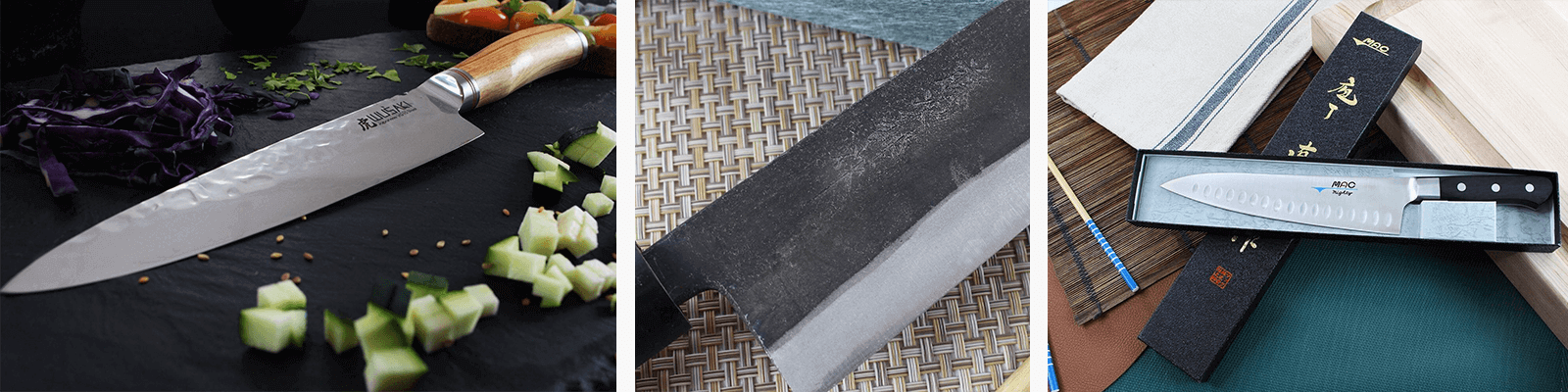
Do you want a multi-purpose knife for a wide range of cuts? Choose a chef's knife ! There are so many models to choose from that it is easy to get confused. What are the criteria to consider in making the right choice? Here are our explanations of the essentials to help you make the right choice!
What is a chef's knife?
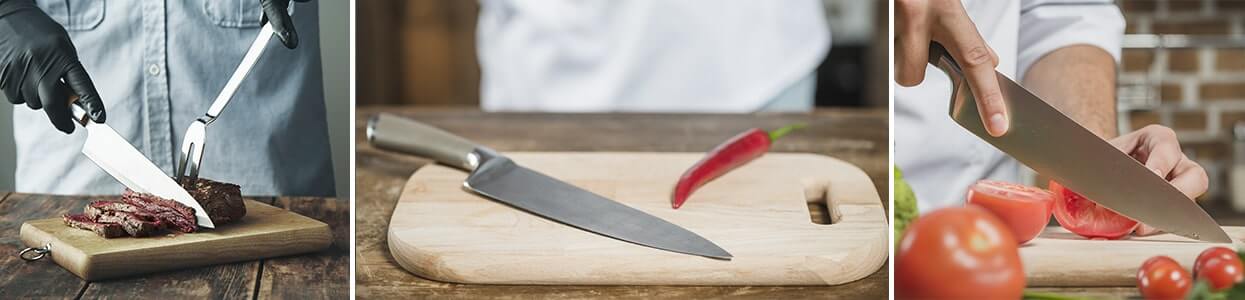
A chef 's knife is a large and versatile knife for cutting most foods. In most cases, this knife has a 20 cm blade and a height of 4 to 5 cm. The height of the blade ensures that the food to be cut is well placed against the blade, making it easy to use the knife for optimal speed and precision.
In general, you can use it to cut vegetables, meat and fish. Cutting, chopping and chiseling are just some of the functions performed by chef's knives!
Diagram of a chef's knife
Illustration of the different blade sections of a Wüsthof chef's knife:

1. The middle or center section is used for chopping both soft and hard materials. The chef's knife has a convex (angled) blade, which is ideal for chopping leeks, parsley, etc.
2. The front part of the blade: this is ideal for slicing onions, carrots, peppers, garlic and other small vegetables. This area of the blade should be used for all small cuts.
3. The back part of the blade: due to its solidity, it is possible to break small bones, open the shells of shellfish, etc.
4. The back part of the blade, near the guard: a professional chef's knife has no guard because it prevents chopping foods. The back of the blade is perfect for chopping foods that offer great resistance, as this is where the most force can be exerted.
5. Its wide blade can be used for flattening (garlic, fillets, etc.), lifting and handling foods to be cut.
Choose your chef's knife based on what you need to cut
Although a chef's knife can cut all types of food, it is still important to determine the type of food you cut the most, so that you can choose a chef's knife with the right strength for the food. If you like to cut foods with skin or hard crust, you will need to choose a chef's knife with a structure that can withstand cutting these foods, because the rigidity of what you are cutting could damage your knife if it is not strong enough.
To be on the safe side and to be able to cut whatever you want with a chef's knife, it is best to opt for a forged or full tang chef's knife. This way, the blade runs the length of the handle, giving your chef's knife a solid structure!
Blade steel: harder or softer?
To choose the right steel for you, you should take into account the food you will be cutting and the environment in which you will be using it: in a professional kitchen or for home use.
Soft steels are often used for professional chef's knives that will be used extensively in a professional kitchen. Softer steels are more resistant to impact and twisting. Professional knives are ideal for cutting slightly harder foods and are resistant to the risk of the blade hitting a bone when cutting meat (but this is best avoided!).
On the other hand, hard steel is less suitable for professional use, as it requires careful maintenance and specific use. We tend to prefer hard steel chef's knives for home use, in an environment where you are generally not in a hurry! This way, you can work meticulously and efficiently without risking damage to your Japanese chef's knife. Hard steel provides superior cutting quality to your knife, but it also makes it more brittle. That's why it's best not to use hard steel when cutting foods with hard skins or rinds (such as pumpkin, squash, hard cheese, etc.).
To conclude on the choice of steel, opt for a soft or intermediate steel if you work in a professional environment and choose the steel best suited to you for home use!




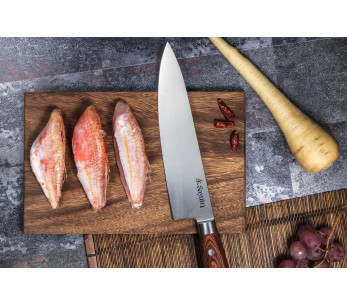

A chef's knife with a wooden or synthetic handle?
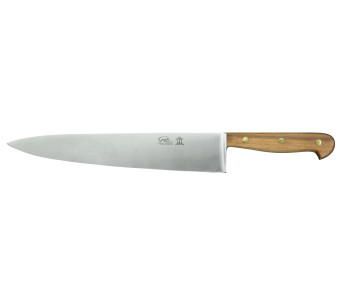
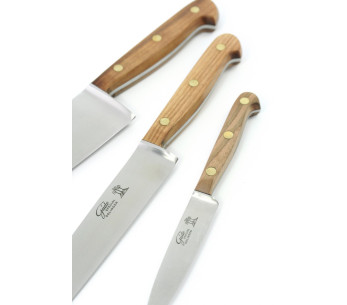
Like all knives, chef's knives have a handle that can be made of wood (there are many types) or synthetic or laminated (POM, Micarta, etc.).
The choice of handle material also depends on the environment in which the knife will be used. A wooden handle will inevitably be more sensitive to moisture and food residue than a synthetic or laminated handle, which is easier to clean. In professional kitchens, juices, grease and water are often splashed on knives, making it difficult to keep them from being touched. It is therefore more difficult to maintain a knife with a wooden handle in a professional environment. For this reason, it is recommended to opt for a professional chef's knife with a synthetic or laminated handle, which ensures greater compliance with hygiene standards.
Since wood is a living material, you should always pay attention to a knife with a wooden handle to prevent it from tarnishing. It is easier to take care of your kitchen knife when you are at home!
The ergonomics of your chef's knife
Kitchen knife handles come in different shapes, so you have to choose the one that suits you best! Oval or octagonal shapes are the most universal and are practical because they lend themselves to ambidextrous use. For more specific uses, you can opt for a right-handed knife or one designed for left-handed use. Some steel knives have a Western shape with a finger rest, ideal for extended use!
Opt for a knife that offers perfect handling and comfort!
As for weight, it is up to you to choose the one you prefer for your chef's knife! Some people prefer to have a heavier knife in their hands to have a good feeling of handling and stability when holding it. Others, however, prefer to use a lighter knife, which allows them to handle the knife better. It is important to note, however, that in general, heavier chef's knives are the ones that withstand shocks better and are more resistant to cutting food due to their good structure and integrity.
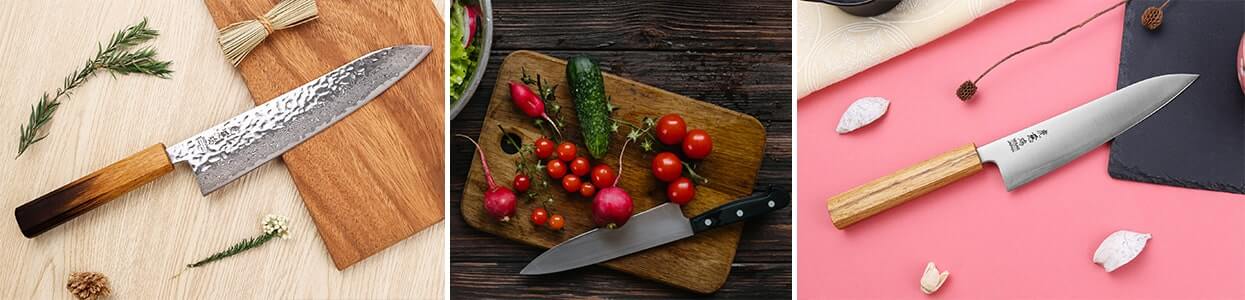
Bottom line:
Chef's knives are versatile models with a wide variety of designs! In order to make the best use of them, choose the one that best suits you in terms of shape, materials and sturdiness, but also the one that best suits your needs. Whether you are looking for a professional chef's knife or a Japanese chef's knife, find out all our tips forusing a chef's knife!
To use your chef's knife without damaging it, find a wide range of cutting boards at KnifeLeader.eu!


