
Your cart
There are no more items in your cart
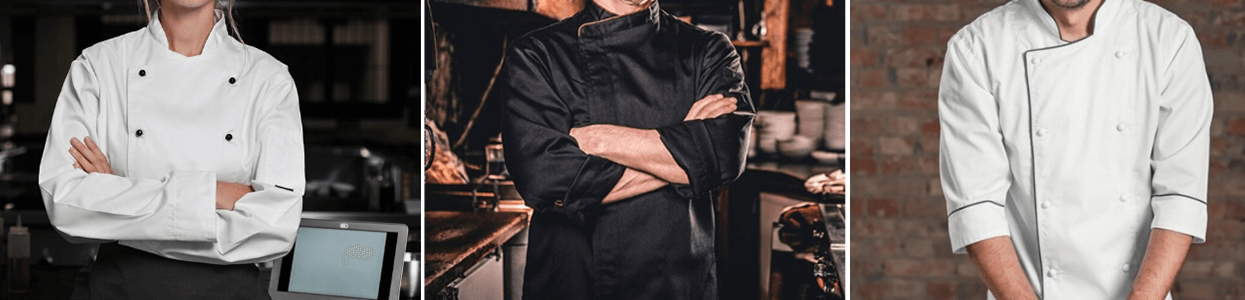
The chef's jacket is an essential piece of professional clothing. Chefs, caterers, butchers and apprentices all wear them. It's an integral part of the professional kitchen outfit, complementing kitchen pants and safety shoes. But how do you choose the right kitchen jacket? The KnifeLeader team can help you make the right choice, based on fabric, position and style.
What is the purpose of a kitchen jacket?
The kitchen jacket must protect me
This is the main function of a professional kitchen jacket. The jacket must prevent you from staining or burning yourself. Whatever your job, it must also guarantee perfect hygiene, so that your clothes don't transmit germs to the food.
A professional kitchen jacket must be comfortable
As a piece of everyday work clothing, you need to be comfortable in it. You need good mobility to be efficient, and therefore productive. A loose fit is ideal.
A cook's jacket must be durable
A quality jacket will last you a long time. That's why it's important to choose a jacket with a high fabric weight, which is synonymous with a solid jacket that wears slowly. Fabric weight should be between 200 and 240g/m².
What fabric should I choose for my kitchen jacket?
The pro kitchen jacket is available in a range of fabrics to suit everyone's needs, whatever their workstation.
Cotton
A natural, plant-based fiber, cotton is synonymous with comfort par excellence. The cotton kitchen jacket is hypoallergenic, soft and supple. It also lets the skin breathe and is easy to clean. Highly hygienic, cotton can withstand boiling, enabling you to sterilize your jacket.
Polyester
Polyester is a strong synthetic fiber that won't fade or shrink. Polyester wrinkles very little, if at all, so you don't have to iron your kitchen jacket. The polyester kitchen jacket is also very light, making it ideal for summer work. A slightly elastic fabric, polyester is comfortable to wear.
Microfiber
Microfiber is also a synthetic fiber. Compared to polyester, it is even softer, lighter and more robust. It also resists abrasion and moisture while absorbing water, making your jacket durable with the utmost care.
Which sleeve length to choose?
The length of the sleeves on your kitchen jacket will depend not only on your workstation, but also on the season.
Long-sleeved jackets
In the kitchen, workstations dedicated to cooking, such as frying, require extra protection to avoid injury during service. That's why it's best to opt for a long-sleeved cooking jacket. Your arms are protected from splashes and burns.
The long-sleeved jacket is also ideal to wear in winter for all shifts, hot or cold. As temperatures cool, it's important to be warm enough to work efficiently.
Short-sleeved jackets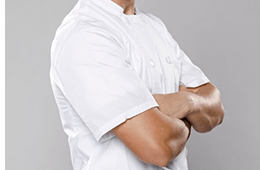
Professionals working in cold environments can opt for a short-sleeved kitchen jacket. The risk of splashes is not non-existent, but reduced, depending on the type of task.
Short-sleeved jackets are also perfect for summer work, when temperatures rise and mix with ambient kitchen temperatures.
Which jacket size should I choose?
The size to choose for your top-of-the-range kitchen jacket depends on your measurements:
Chest circumference
Waist circumference
Pelvis circumference
To measure, simply use a tape measure and position it loosely around the area to be measured. These measurements are taken in the same way, regardless of gender.
Each brand also gives indications on the size/measurement correspondence of its jackets, as they may cut differently.
Egochef: the brand offers its jackets in Italian sizes, where a French S corresponds to an Italian M, for example. Egochef kitchen jackets fit rather large.
What style of jacket should I choose?
Over the years, professional kitchen jackets have diversified into a variety of styles. Whether it's color, collar or pockets, these details can make all the difference.
Different collars
The V-neck: this modernizes the kitchen jacket by breaking up its strict appearance, and doesn't restrict movement.
Officier collar: this collar gives the jacket a contemporary, elegant look. It leaves the throat free for maximum comfort.
The kimono collar: this Japanese-inspired style is very much in vogue, particularly in sushi restaurants. Your movements are fluid.
 The different buttons
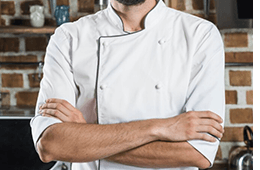
Your jacket can be fastened with either snaps or studs.
Snap fasteners ensure your jacket closes securely, so it doesn't open in use.
Tail buttons are generally arranged in two rows for effective closure. This double row brings a very formal style to the kitchen jacket.
Pockets
Do you need pockets on your kitchen jacket? If so, how many do you need? Here again, your workstation is the determining factor.
Pockets are essential if you need to carry your pen, a small notebook or a dishcloth.
Pocket positioning is also important. They can be on the chest, at hand level or on the sleeves.
Jacket color
Traditionally, the kitchen jacket is white, but more and more kitchen jackets today are black, plain, printed or embroidered. Add a touch of originality to your workwear!
All in all, the kitchen jacket offers many possibilities to suit all professionals. It's important to choose a quality jacket that meets the needs of your tasks, while being functional and comfortable. Now it's up to you!
Find all our kitchenwear on our website!


Egochef kitchen clothing
Egochef Leonardo Japanese characters 100% cotton short-sleeved unisex Chef's jacket
In stock


Egochef kitchen clothing
Egochef Ottavio Air Plus black 100% microfiber long-sleeve unisex Chef's jacket

On request


Egochef kitchen clothing
Egochef Leonardo white 100% cotton short-sleeved unisex Chef's jacket
In stock


