
Your cart
There are no more items in your cart
Kanetsugu: a century of history at the service of cutting
Kanetsugu was founded in 1918 by Matsujiro Kawamura, a descendant of the famous Japanese sword-maker of the same name. Based in Seki, a city emblematic of Japanese cutlery, the brand is a direct descendant of the tradition of sword smiths.
For over a century, Kanetsugu has perpetuated this heritage by adapting it to contemporary needs. The Zuiun range was created to celebrate the company's 100th anniversary. Its name means "auspicious cloud", a symbol of prosperity and excellence. It embodies the synthesis of cutlery tradition and modern metallurgical innovation, with particular attention paid to cutting geometry, heat treatment and finishes.


A high-end damascened blade around a SPG2 powder-coated steel core
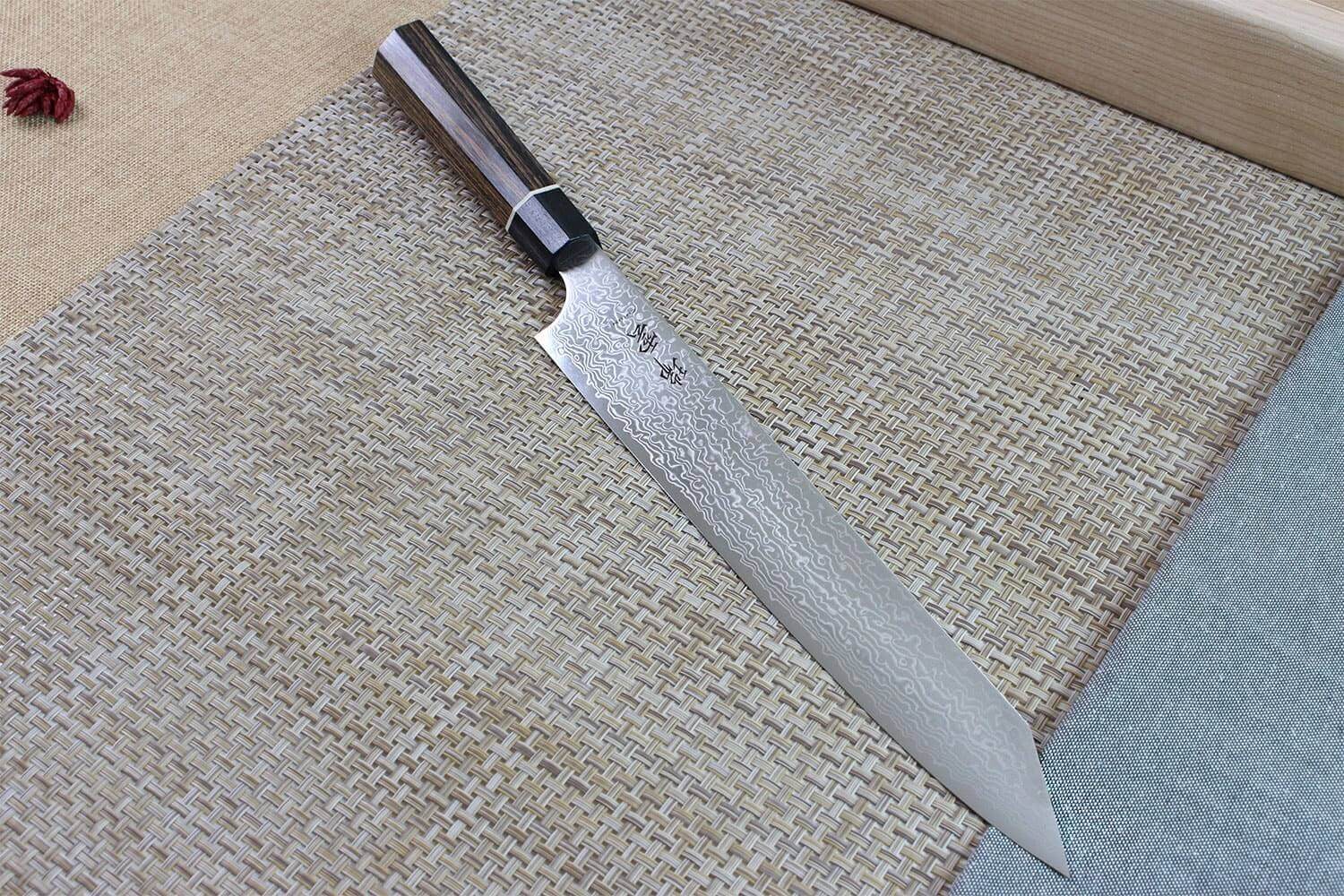
This 24 cm sujihiki is designed for slicing large pieces of meat or fish with finesse and regularity. Its length enables long cuts to be made in a single, fluid movement, which limits crushing of fibers and favors clean, even slices.
The blade has a core of powder-metallurgy SPG2 steel. More technical than conventional rolled steel, this process produces a highly homogeneous structure, with particles and carbides more evenly distributed. As a result, the cutting edge becomes more stable, wear resistance improves, and stone sharpening remains precise when required.
With around 1.3% carbon, the core achieves a hardness of around 63 HRC on the Rockwell scale. This high level of hardness means that sharpening can be pushed to aim for a very fine, long-lasting and effective cutting edge on a daily basis, while maintaining excellent cutting precision on food.
Around this core, Kanetsugu adds layers of softer steels to create a damask. This multi-layer construction protects the core, provides better mechanical balance and limits the brittle feel that very hard steel can sometimes present. It also offers a unique visual effect, with damascened waves intertwining on the cutting surface and varying from knife to knife.
The blade also benefits from a Sub-Zero treatment. After heating, the blade is rapidly cooled to a very low temperature, to stabilize the structure of the steel and optimize edge retention over time. Finally, the cutting edge features a Hamaguri-ba finish, inspired by Japanese swords, with a slightly convex geometry that improves penetration into the food and reinforces the strength of the wire.
A precise, comfortable 7-facet handle in the spirit of Japanese blades
The handle is made of Pakkawood, a composite material obtained by hot compression of laminated wood and resin. It combines the natural look of wood with excellent stability and resistance to humidity in normal kitchen use.
The signature of the Zuiun range is its 7-faceted shape. This geometry provides natural finger placement and much-appreciated directional control, particularly for the long, regular cuts a sujihiki is called upon to make. A mosaic rivet adorned with the logo adds a signature touch, while a black bolster provides a transition to the blade and contributes to the knife's overall balance.
The knife comes in a light, elegant paulownia wood box, perfect for gift-giving or to protect the piece during storage.
Care and maintenance
To preserve the cutting qualities and finish of the damascus, wash the knife exclusively by hand with a soft sponge and a mild detergent. Wipe dry immediately after washing, then store in a dry place. Dishwashing and prolonged soaking in the sink are to be avoided to preserve the blade, handle and balance of the piece over time.


