A perfectly sharpened knife completely changes your comfort in the kitchen. However, when several knives need regular maintenance, manual sharpening on a whetstone can take time and require a certain amount of skill. That's where the Tormek electric knife sharpener comes in! The Swedish brand offers machines capable of providing precise and consistent sharpening while limiting the amount of steel removed.
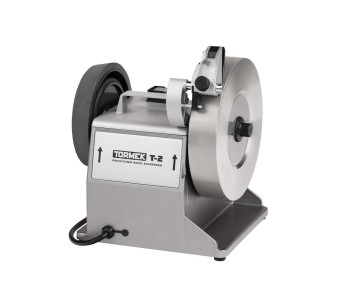
Among Tormek electric knife sharpeners, two models stand out: the Tormek T-1, primarily designed for home use, and the Tormek T-2, developed for professional kitchens. But what are the actual differences between them? Which model should you choose? And above all, how do you use a Tormek sharpener correctly? We'll explain everything!
Tormek: the Swedish sharpening specialist
The story of Tormek began in Sweden in the 1970s with Torgny Jansson, an engineer with a passion for woodworking. Looking for an effective way to sharpen his tools, he developed his own system inspired by traditional Swedish water-cooled grindstones. Tormek AB was officially founded in 1973.
More than 50 years later, the brand has become a true reference in the field of sharpening. The development, engineering and production of its machines are still carried out in Lindesberg, Sweden.
For kitchen knives, Tormek has developed a particularly effective method: a slow-rotating diamond grinding wheel works on the blade's bevel, while a second wheel removes the burr and polishes the cutting edge. Unlike a honing steel, which is mainly used to maintain or realign the edge, the machine actually allows you to recreate the knife's bevel.
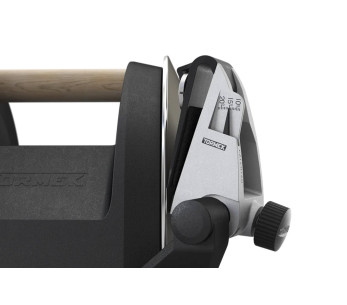
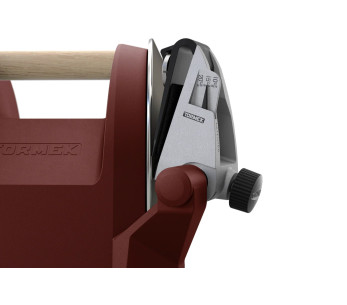
Another advantage is that the sharpening angle can be precisely adjusted using the machine's guide. This allows you to adapt the sharpening to the knife you are working on, whether it is a European chef's knife, a santoku or many other kitchen knives.
The slow rotation of the grinding wheel also limits heat build-up in the blade and removes only the necessary amount of steel. A real advantage when you want to maintain high-quality knives for many years.
Tormek T-1 or T-2: which electric knife sharpener should you choose?
The Tormek T-1 and Tormek T-2 are based on a similar concept, but they are not designed for exactly the same type of user.
Tormek T-1: the electric knife sharpener for home use
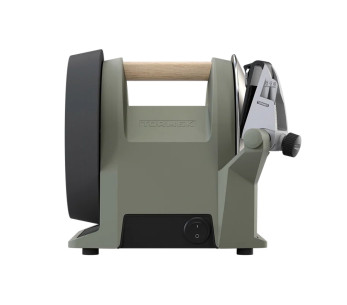
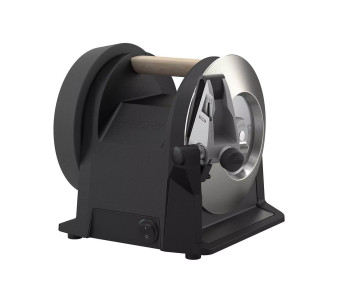
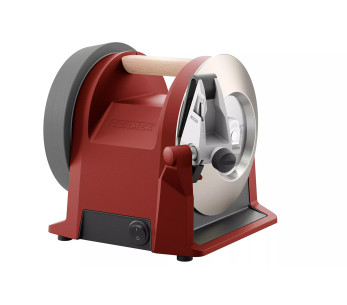
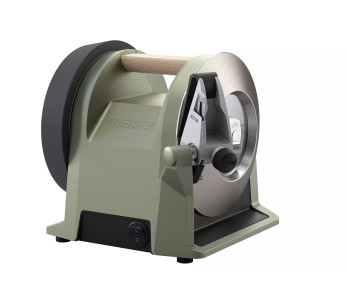
The Tormek T-1 has been designed to allow home cooks and cooking enthusiasts to achieve precise sharpening directly at home. Compact and particularly quiet, with a stated noise level of only 45 dB, it can easily find its place in a kitchen.
It is equipped with a 150mm DF-150 diamond grinding wheel with 600 grit. Its slow rotation speed of 150 rpm gradually works the bevel while limiting heat build-up and material removal.
Its patented guide allows you to freely select an angle between 8° and 22° per side. It accepts blades measuring between 12 and 60mm in height and up to 5mm thick, with no limitation on blade length.
Once the bevel has been formed on the diamond grinding wheel, the knife is passed over the PW-160 composite honing wheel. It contains a polishing agent and simultaneously removes the burr and finishes the cutting edge.
The T-1 is therefore particularly suitable if you want to regularly maintain your kitchen knives at home, including high-end knives, without having to master whetstone sharpening.

8 ans
Tormek electric knife sharpener
5 years
Tormek electric knife sharpener
5 years
Affûteuses et accessoires Tormek
5 years
Tormek electric knife sharpener
Tormek T-2: the electric knife sharpener for professionals
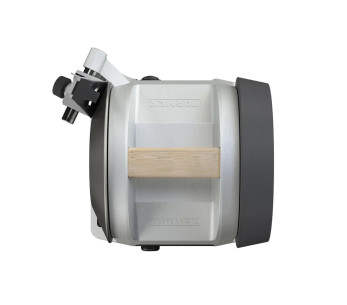
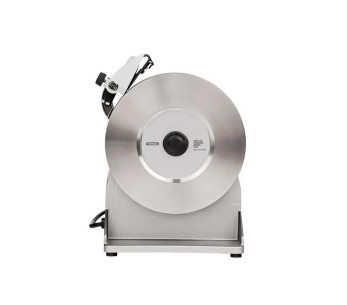
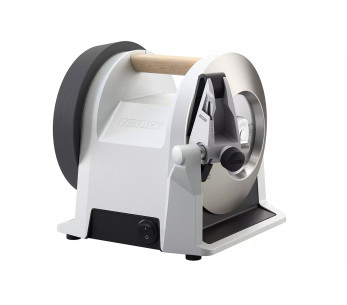
The Tormek T-2 Pro Kitchen Knife Sharpener uses the same principle in a machine designed for professional use. Restaurants, professional kitchens and other users who need to maintain numerous knives regularly benefit from a robust system that is quick and easy to use.
The T-2 uses a 200mm DWF-200 Fine diamond grinding wheel combined with an industrial motor designed for continuous operation. The grinding wheel rotates at only 120 rpm and the machine delivers 8.4Nm of torque.
As with the T-1, a guide allows the sharpening angle to be precisely adjusted. A magnet collects some of the metal particles produced during sharpening, while protective felt integrated into the guide helps protect the blades against scratches.
The PW-160 composite honing wheel then removes the burr and polishes the bevel. For professionals with more specific requirements, the system can also accommodate other Tormek diamond grinding wheels, including a coarser version for faster repair of damaged blades and an extra-fine version for a particularly refined finish.
The choice between the two is therefore quite straightforward: the T-1 focuses on compactness and home use, while the T-2 is designed to withstand the demands of a professional environment and more intensive use.
| Feature |
Tormek T-1 |
Tormek T-2 |
| Use |
Home cooks / enthusiasts |
Professionals |
| Diamond grinding wheel |
DF-150 Fine Ø150mm |
DWF-200 Fine Ø200mm |
| Speed |
150 rpm |
120 rpm |
| Torque |
2Nm |
8.4Nm |
| Honing / polishing |
PW-160 composite honing wheel |
PW-160 composite honing wheel |
| Intensive use |
No |
Yes |
FAQ: everything you need to know about Tormek electric knife sharpeners
How do you use a Tormek electric knife sharpener?
Sharpening is carried out in two stages. Start by setting the desired angle on the guide, then pass each side of the blade against the diamond grinding wheel until an even burr has formed. There is no need to apply heavy pressure: simply guide the blade smoothly and consistently. Then pass the knife over the composite honing wheel to remove the burr and polish the bevel. Your knife is ready to get back to work!
What angle should you choose to sharpen your knife?
The angle depends on the knife and how it is used. A lower angle generally produces a finer cutting edge, while a higher angle favours durability and edge strength. If you simply want to maintain your knife, it is generally best to retain its original sharpening angle.
Which knives can be sharpened with a Tormek knife sharpener?
Tormek sharpeners are suitable for many European and Japanese kitchen knives, provided their dimensions are compatible with the machine's guide. The diamond grinding wheel can sharpen many types of steel, including the hard steels found on certain Japanese knives.
Can you sharpen a Japanese knife with a Tormek?
Yes. Precise angle adjustment is particularly useful for Japanese knives, which often have a more acute sharpening angle than Western knives. It is advisable to retain the blade's original angle as closely as possible in order to respect its geometry.
Can you sharpen a ceramic knife with the Tormek T-1?
Yes, the Tormek T-1 diamond grinding wheel can also sharpen ceramic knives. As these blades are more brittle than steel blades, however, they should be handled with greater care during sharpening.
Sharpening involves working on the blade's bevel to recreate a sharp cutting edge. This operation generally creates a small metal residue known as a burr. Honing then removes this burr and finishes the cutting edge. This is why Tormek sharpeners use a diamond grinding wheel for sharpening and a composite honing wheel for burr removal and polishing.
Do you need to use water with a Tormek T-1 or T-2?
No. Unlike some Tormek sharpening systems that use a water-cooled grinding wheel, the Tormek T-1 and T-2 use their diamond grinding wheels dry. The low rotation speed also helps limit heat build-up in the blade during sharpening.
How often should you sharpen your knives with a Tormek?
There is no universal frequency: it depends on the knife's steel, how often it is used and how it is maintained. There is no need to systematically use the diamond grinding wheel as soon as the edge becomes slightly less effective. Sharpening is mainly necessary when the cutting edge can no longer be properly maintained.
Maintaining a Tormek sharpener is relatively straightforward. Keep the machine, its guide and its various surfaces clean, and regularly remove sharpening residue. The diamond grinding wheel should also be used in accordance with the manufacturer's recommendations. As the main sharpening components are replaceable, there is no need to replace the entire machine when they become worn.
Can the Tormek T-1 replace a whetstone?
For many users, yes. A whetstone offers great freedom and allows very precise work on the cutting edge, but it requires more practice to maintain a consistent angle. The Tormek makes this step easier thanks to its angle guide and makes it easier to achieve consistent results. It is therefore an interesting alternative for anyone looking for a precise and easy-to-use electric knife sharpener.