
Your cart
There are no more items in your cart
Knife sharpening is one of the most important steps in maintaining the cutting edge of your kitchen blades! But how do you sharpen a knife ? There are several ways to do this :
- Sharpening stones are perfect for Japanese knives;
- Sharpening guns, for an ultra-fast solution in professional kitchens, for example;
- Manual or electric sharpeners to save time and effort...
In short, you have a wide choice of ways to maintain your favorite blades, to suit all tastes and budgets.
However, we're talking here about smooth blades, like a chef's knife, paring knife or boning knife. But what about serrated knives, like the famous bread knives? These are ultra-practical for penetrating all the crusts of your farmhouse loaves or brioches. However, once you've got to sharpen them, the next problem arises: how do you get all those little teeth sharp again?
Not to worry! Your bread knife isn't destined to get all slick after a few uses! What's more, it's important to know that, in general, a bread knife wears out less quickly than a knife with a smooth blade. In fact, with a chef's knife, it's the cutting edge that's used for cutting, its straight edge. With a bread knife, it's different! It's the numerous teeth that serve to saw through the bread, so wear is not the same, but slower.
Here's a short list (not yet exhaustive) to help you understand how to sharpen all your serrated knives!

Sharpening with a ceramic sharpening steel
First of all, bread knives can only be sharpened on one side. In fact, if you take a closer look at the blade of a bread knife, you'll see that it has one side with teeth, which is sharpened, and a smooth, flat side. This side doesn't need sharpening - only the toothed side does!
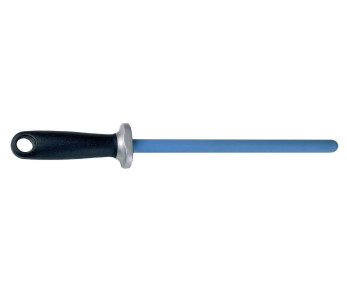
The method is somewhat time-consuming, as you have to sharpen all the teeth 1 by 1 (and a bread knife has many, as we all know). You'll need a fine-grain ceramic sharpening steel (often used for blade polishing and finishing), which enables you to sharpen the gap between each tooth as best you can, given their narrowness and the delicacy this requires (for example, an overly abrasive steel would damage fine teeth).
Be careful, too, to use a rifle whose diameter more or less corresponds to the size of your teeth, as a bit that's too wide or the wrong shape (e.g. flat) won't reach all the way into the hollow of a tooth, and the sharpening won't be complete.
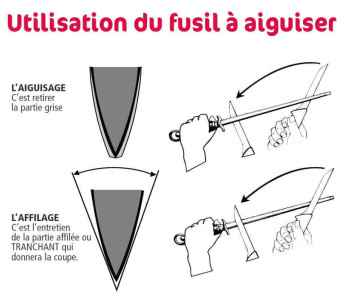
The method is time-consuming but simple: simply move the rifle back and forth over each tooth. After a few minutes' effort, your knife will have regained its full sharpness. The maneuver is a little tricky. It's best to place the knife on a flat surface, such as the edge of a table or worktop. This way, you'll be more stable, and the process will be safer! Sharpening will also be more consistent.


Sharpening with specialized utensils:
Of course, while we believe that manual work is always more efficient and long-lasting, we also have specialized appliances for sharpening serrated blades. You'll find good products from Kitchen IQ, for example, or the famous Worksharp, also suitable for outdoor knives and utensils.
The advantage of these machines is that they have slots that establish a pre-defined angle for sharpening this type of blade. It's quick and easy, for those who don't want to waste any time!
As you can see, your favorite bread knife isn't just for one use :) take care of it as soon as you feel it's losing its edge!
If you have any questions, please don't hesitate to contact us ;)


