
Your cart
There are no more items in your cart
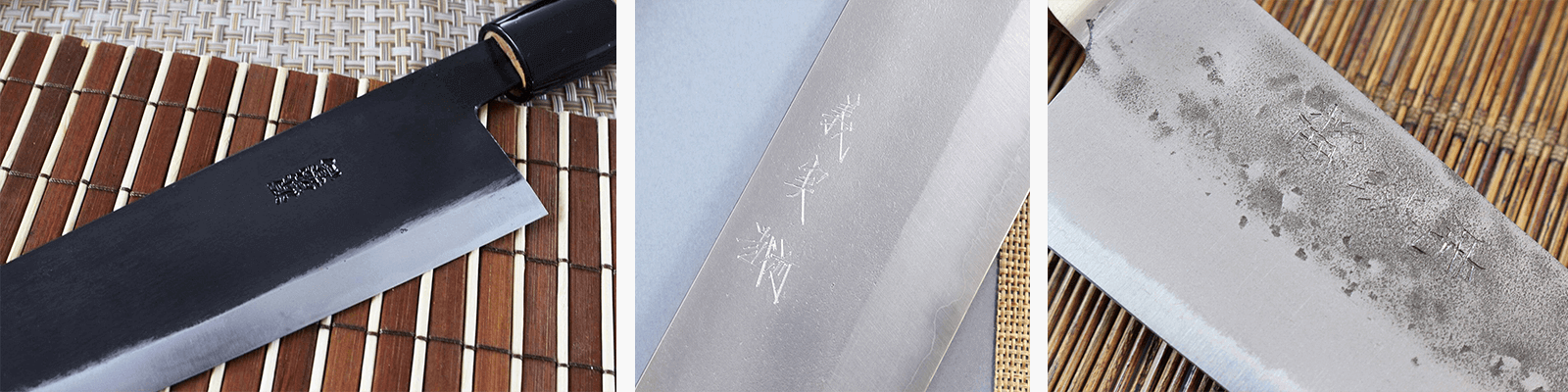
That's the question every cook asks himself! Yes, because while most steel knives feature a stainless alloy (which is not invincible against corrosion either, let's face it), some have a marked concentration of carbon.
Why is this? Well, no, young novice, it's not because manufacturers want you to panic about the risks associated with carbon, but rather because it has technical characteristics that are very useful in the kitchen.
Why use carbon steel?
A blade enriched with carbon will be harder than its stainless steel compatriot. As a result of this greater hardness, the blade has a stronger, more robust cutting edge. As a result, once sharpened, the knife retains its cutting edge much longer than a standard blade! This is very practical when the knife is used intensively, as in professional kitchens. You won't have to sharpen it as often, which saves time. When the time comes, however, you'll need the right utensil, such as a fine-sharpening whetstone or, better still, a whetstone.
Some cooks prefer carbon steel because of the cutting quality it confers, enabling them to make cleaner, effortless cuts.
However, despite the fact that the knife is very sharp and easy to maintain in terms of sharpening, carbon requires special care that must be taken into account when purchasing a carbon-enriched knife.
.jpg "Comment nettoyer son couteau en acier carbone ?")
Carbon steel: what are the risks?
To put it simply, here's what happens to your carbon knife if you don't take proper care of it(please note that no Opinel knife has been mistreated for the purposes of this article):
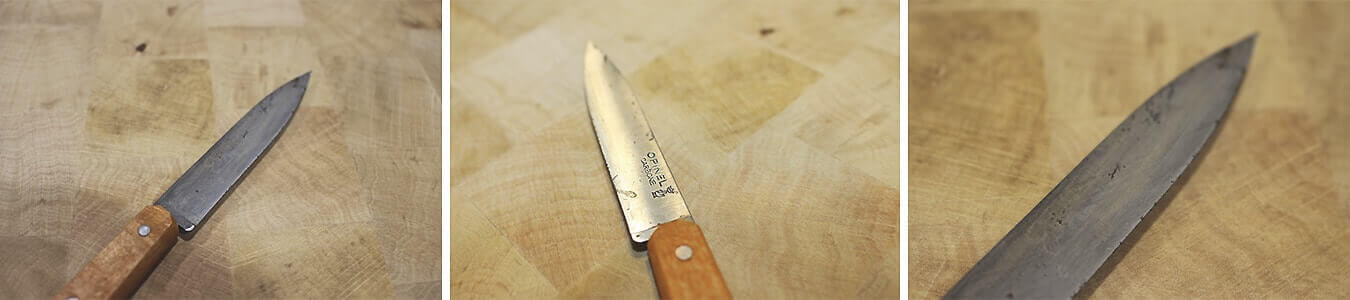
Here's the result: disparate oxidation stains appear over the entire surface of the blade. We can clearly see the scattered rust stains, caused by water drops that have not been properly wiped off.
But don't worry! We've summarized for you the pros and cons of having a carbon knife... and you can see that the pros far outweigh the cons!
Now that you know all about carbon steel knives and what the result of poor care looks like, it's time to help you look after them...
The right gestures for your carbon steel knives :
It's a normal reaction of its alloy to contact with food, air, water for washing... But this tint will be uniform, often a little darker, as if with a patina or grayish hue. So there's no need to rub for hours to get it off, understand? And that's part of the charm of the carbon knife, which is totally original!
However, our aim here is to avoid rust-like stains, which are the result of poor maintenance. Become an expert on the subject by reading our tips for removing rust!.jpg "Avantages et inconvénients d'un couteau en acier carbone")
Forget the dishwasher, which is too aggressive for carbon steel. Continuous contact with water and high temperatures are really not good for your knife. Also, don't leave your dirty knife too long. In fact, many foods contain water, such as vegetables, and prolonged contact is again not recommended. It's simple, once you've finished using it: wash it!
Gentle hand washing is recommended. And don't forget your knife to soak in the sink...
Once you've finished using it, run it under lukewarm water and clean it with a mild detergent and a soft sponge. Then, once washed, ABSOLUTELY wipe it dry so that no trace of water remains on its surface. This step is imperative.
The knife should be stored in a dry place, away from any source of moistureThen, to give it a new lease of life and, above all, to protect it from possible aggression, you can putoil on the blade from time to time, as the fat will protect its surface.
With these precautions, you should have a rust-free knife! It would be a pity to deprive yourself of the efficiency of carbon knives just because maintenance is different from stainless steel knives. They're great knives, and as we've said, they cut beautifully! You just have to be careful and admit that, despite all this care, the knife will naturally develop a patina!
Come on, now that you're a chef, you can opt for carbon knives without any worries!


