
Your cart
There are no more items in your cart
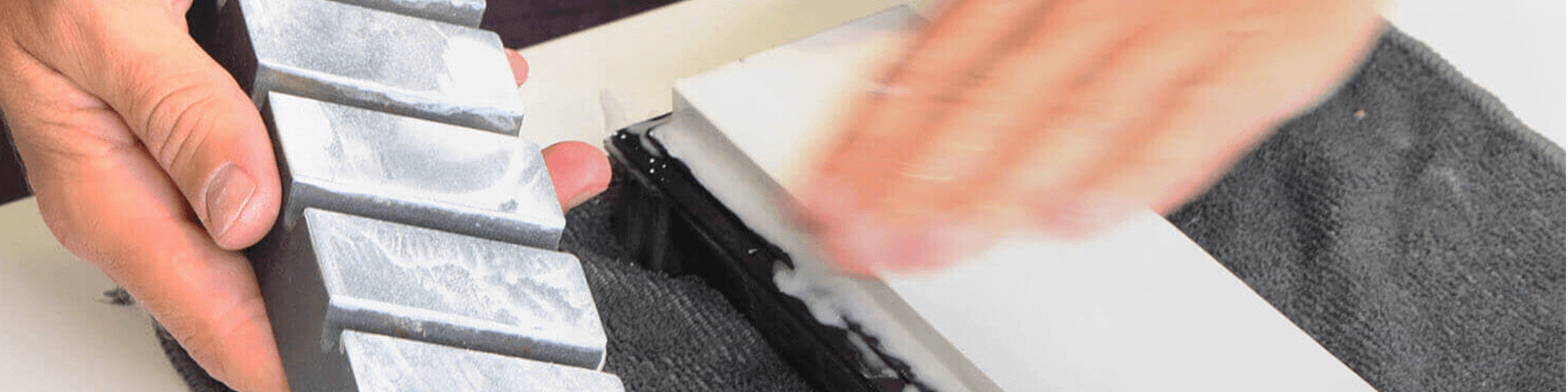
Kitchen knives are serious business. When a budding cook takes care of his blades, he uses a whetstone. With time and wear, your whetstone will become hollow. Disconcerted, you swear never to press so hard again and you weep over the grain of the little paving stone. But don't panic! This phenomenon can be treated. It's called stone straightening. Let's take a look at how to dress a whetstone!
What's a whetstone for?
First and foremost, it's important to remember the purpose of a whetstone. For those who play with their knives at the back and don't listen, a whetstone is an indispensable tool. In cutlery, it's a complement that enables you to sharpen dull or blunt blades over time. The result is razor-sharp, ready-to-use kitchen tools. The stone is the best sharpening tool we know. It is precise, adapts to different steels and gives long-lasting results.
Why does a whetstone dig in?
A whetstone is designed to withstand continuous friction from steel. But like all working materials, it wears out with use. When you sharpen a knife on a stone, you move the blade back and forth, creating a "sludge" on the surface. This sludge simply comes from the stone, which is why it wears over time.
We tend to use the central part of the stone, which is normal, as it's the most convenient way to make large movements and sharpen a knife comfortably. In this way, the stone is hollowed out in the center, and virtually untouched at the ends.
Note that the thicker the grain of the stone (120-600), the faster it hollows out. A fine-grain stone (e.g. 8000 grain), on the other hand, will hollow out much less quickly.
How do I dress a whetstone?

To level out your stone, which is beginning to show its age, you'll need a levelling stone. This complementary tool is very similar to a whetstone. Logic dictates that your straightening stone should be more abrasive than your whetstone. In other words, its grain should be smaller. With both stones in hand, proceed as follows:
Soak your whetstone and straightening stone in water for about 15 minutes;
Place the whetstone on a perfectly flat surface;
Turn its working surface upwards;
Draw a grid on the stone using a grey pencil (1);
Take your filing stone and straighten the stone, starting by rounding the edges (2);
Move back and forth, gradually filing the whetstone (3);
When all the squares have disappeared, the stone is flat (4);
Visualize the result by looking across the width of the stone.


Why set up a whetstone?
Just as a blade loses interest if it's brittle, a stone makes sharpening difficult if it's not flat. You don't ride with cracked brake hoses, do you? It's the same here!
Sharpening with a stone whose surface is not flat will cause several problems:
It will be difficult to maintain a good sharpening angle (although it's easier when it's flat!).
You run the risk ofdamaging the edge, as the cutting edge will try to cut the stone in places. Then you'll just have to start all over again!
Protruding edges will damage the knife edge.
Sharpening will be very uncomfortable.
You'll scratch your blade, because when the stone rises, the angle between the blade and the stone will immediately be very shallow, as if your knife were flat.
A flat stone, with rounded edges, will save you a lot of time, and make your sharpening much more efficient.
How do I straighten a whetstone? With the right tool! Give your material a second lease of life to make your knives even more beautiful and efficient. See our range of whetstone maintenance products!


