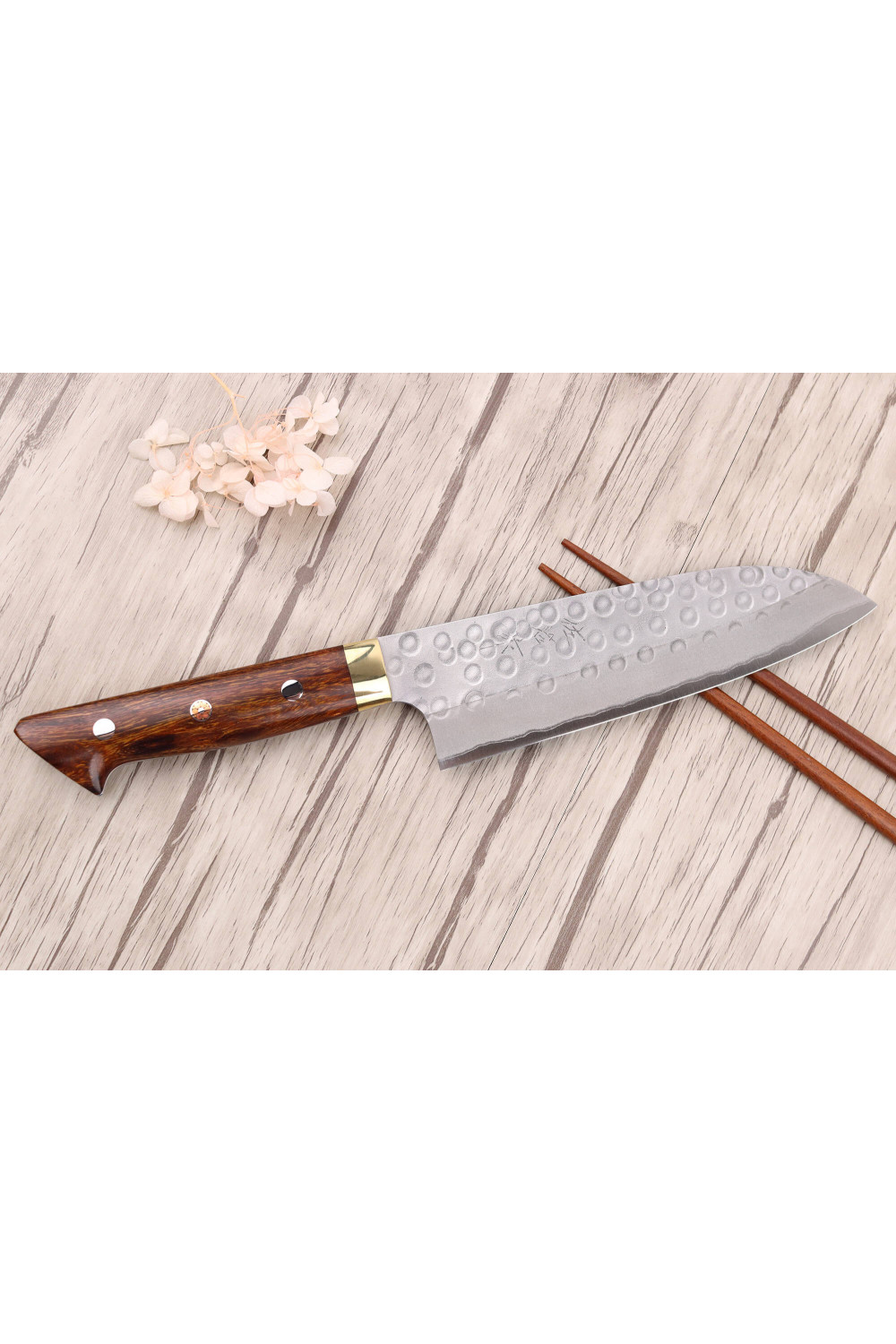
Masakage Zero knives are the fruit of the expertise of Japanese master blacksmith Takeshi Saji, an emblematic figure in the world of artisan cutlery. Known for his talent and attention to detail, he creates pieces that are both elegant and innovative, blending traditional forging techniques with unique, contemporary designs!
Since the 1990s, Takeshi Saji has held the title of Traditional Master Craftsman, a certification awarded by the Japanese government. He practises his art in the famous Takefu Cutlery Village, a benchmark for kitchen knife making in Japan. Here, renowned craftsmen share their expertise, materials and passion to pass on Japanese traditions to the next generation.
A handcrafted Japanese knife with a hammered blade
This santoku knife, designed by Takeshi Saji, is distinguished by its blade manufactured using the San Maï technique, a typically Japanese forging method. This structure combines a hard steel core with a layer of softer steel folded around it, offering strength and protection. For the core of this handcrafted Japanese knife, Takeshi Saji has opted for Japanese Aogami Super(Blue Super Steel), produced by the prestigious Hitachi steelmaker, internationally renowned for its top-of-the-range alloys.
Aogami Super steel, with a high carbon content of around 1.5%, exceeds Western standards by around 0.5%, which greatly increases the steel's hardness. This composition gives it a hardness of 65HRC on the Rockwell scale, guaranteeing this Japanese kitchen knife long-lasting sharpness and outstanding performance, ideal for demanding cuts, especially on fibrous foods.
Despite this high hardness, Aogami Super steel remains easy to stone-sharpen, making it easy to maintain your handcrafted Japanese knife for years of optimal use. What's more, the grind is flat and thin (flat grind) for greater strength and elegant aesthetics. What's more, this type of grind is practical because it reproduces easily during your sharpening sessions!
To complete the San Maï structure, the hard steel core is wrapped in two outer layers of softer stainless steel. This combination ensures effective protection of the blade's core, while guaranteeing an ideal balance between rigidity and flexibility to reduce the risk of breakage during use.
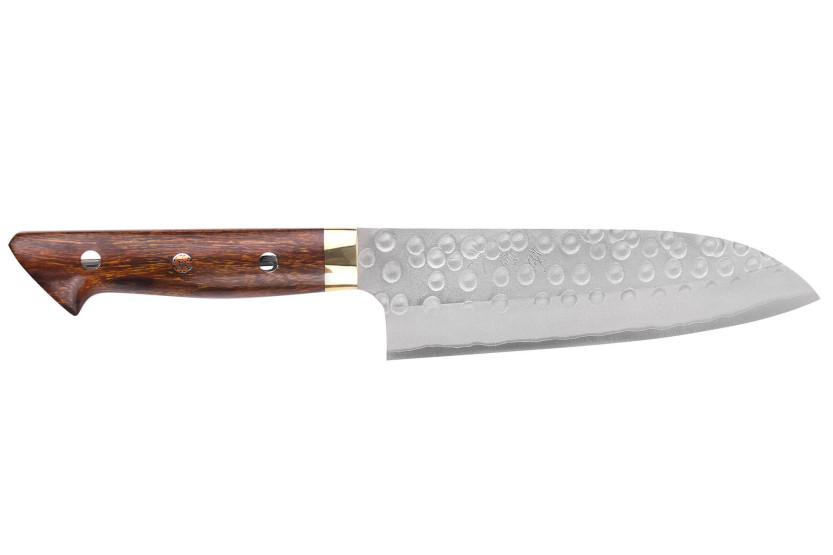
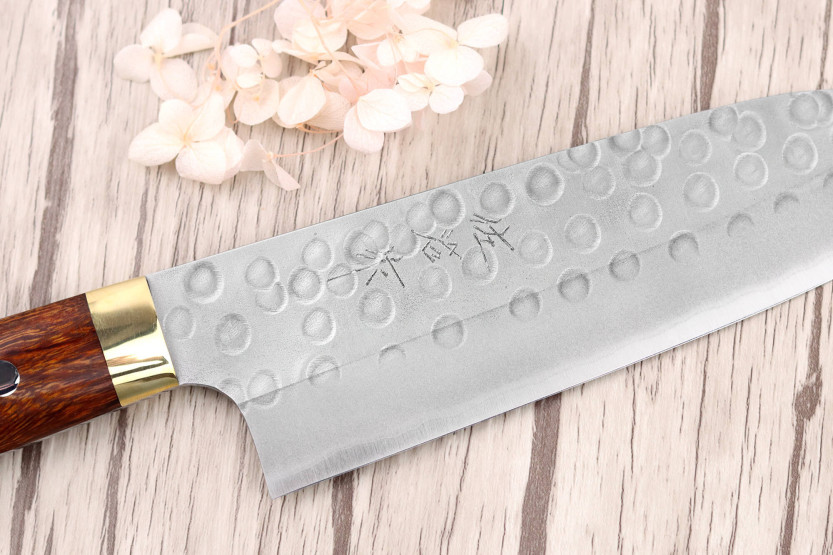
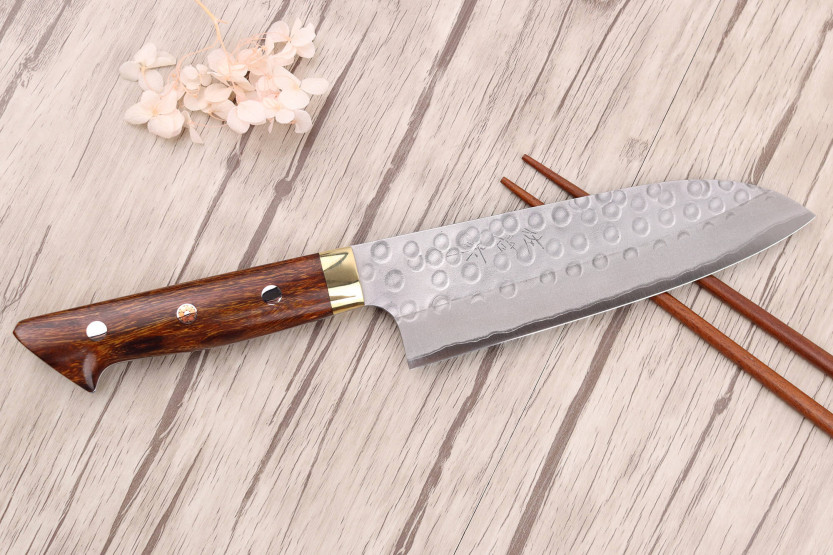
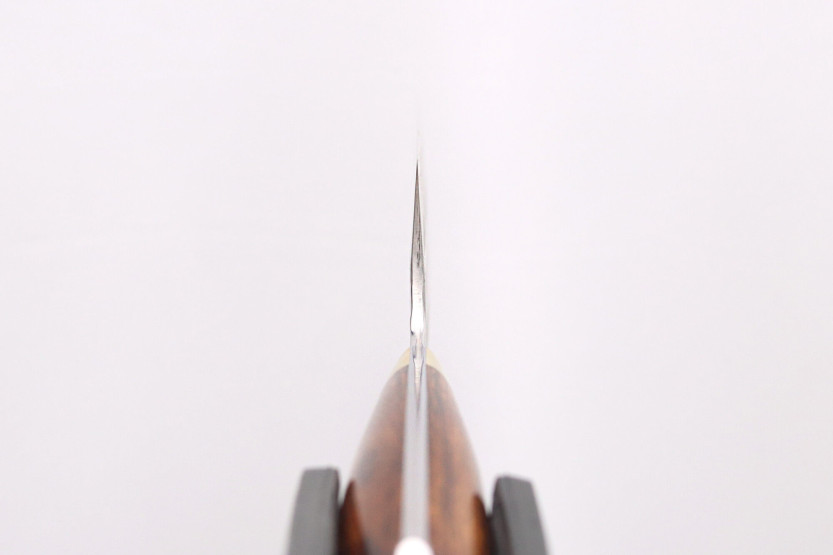
The blade of this Japanese kitchen knife is distinguished by its raw, unpolished finish , enhanced by a unique round hammering. This detail lends a rustic, authentic aesthetic that reflects traditional Japanese craftsmanship.
A Western-style handle for this santoku
The handle is crafted from ironwood, a material known for its density and strength. Its warm hues and natural variations make it a unique piece, where each handle displays a distinct charm thanks to the light and dark nuances of the wood.
The full tang blade is securely fastened to the handle with three rivets, guaranteeing unfailing strength and stability. The central rivet, adorned with a mosaic motif, adds an original touch that contrasts elegantly with the dark tones of the wood.
A gilded stainless steel bolster harmoniously links the blade and handle, reinforcing the durability of the whole. Thanks to its Western-style shape, this Japanese santoku knife ensures a comfortable, ergonomic grip, perfectly suited to both right- and left-handed users!
Care and maintenance of a Masakage knife
To care for your Masakage knife, it should be washed only by hand with a sponge and a mild detergent, avoiding wetting the handle. Once cleaned, you should dry it with a clean cloth to remove all moisture and store it in a dry place. Don't put your craft knife in the dishwasher, or leave it to soak in the sink.
Over time, the color of your blade may change slightly: this is normal! This is a natural reaction of the carbon to the humidity in the air and the acidity of the food you're cutting. This in no way affects the use of your Masakage Zero knife!
Discover other Japanese knives forged by Takeshi Saji on Knifeleader.eu!







 By buying this product you can collect up to