
Your cart
There are no more items in your cart
Damascus steel knives

Current definition of damascus knife
A damascus knife is a knife with a multi-layer blade. It is generally made up of a hard core, on which alternating layers of hard and soft steel are superimposed. This technique originated in ancestral forges, at a time when swords were being made. It's a method that requires skill and patience, and leaves unique and elegant patterns on the cutting surface of your kitchen knife.
Damascus knife: a little history
There are two types of steel commonly known as Damascus:
The 1st was a steel developed in India, and more generally in the Middle East, many centuries ago. Renowned for its high quality, it is characterized by distinctive moiré patterns. This steel is mainly used to make swords. It is also known as Damascus Wootz. The patterns on Wootz blades are the result of crystallization of the metal (notably the carbon present in the alloy).
As a result, the patterns are unique and cannot be controlled, as they are the result of a chemical transformation.
The 2nd refers to all heterogeneous steels with different layers welded together. This is wrought Damascus ( it takes its name from the first category, given the similarity of the patterns created on the blades). This process is used in many countries, but it's fair to say that Japan is its worthy representative. This steel has the advantage of being "visually controllable". In fact, the superimposition of layers is carried out by the blacksmith, so it's an intentional maneuver, and patterns can be created according to particular desires and the know-how of the producer.
As the 1st (and original) type of damascus has virtually disappeared, the term damascus now refers to the second category, by abuse of language. Here, we refer only to this steel, which is also the one used today for knife design.
Damascus knives: a real advantage?
A damascus steel offers the ideal combination of advantages derived from the steels of which it is composed. A multitude of damasks are possible, since the mixtures that can be made are infinitely variable. However, the most common combination is a highly carbon-enriched core and chromium-enriched protective layers.
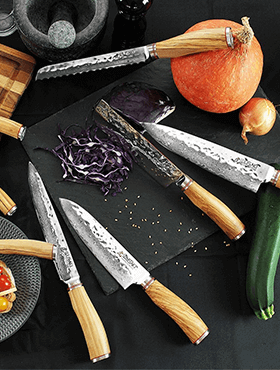 Carbon is an essential element for increasing steel hardness, but it is also sensitive to corrosion. Chromium, on the other hand, is essential for the blade's corrosion resistance and elasticity. Put end to end, these two elements complement each other perfectly. The carbon core ensures a hard, durable cutting edge for excellent sharpness, while the chromium layers provide some protection against corrosion.
It showcases a unique and highly specific know-how. Indeed, a certain dexterity is required to master the process of creating a damascus blade. For a handcrafted damascus blade, different steels are welded together at high temperature using a hammer or press, to obtain a uniform mass. The blacksmith then heats this block again, so that it can be stretched and then folded back on itself, and shaped as desired. It's the smith who decides how many times he wants to repeat the operation, and this is what creates the surprising patterns on the blade that give damascus its unique character. To reveal these patterns, the blacksmith uses the "sand blasting " method. To do this, he sprays very fine sand onto the blade at high speed, which has an abrasive effect and reveals the steel layers. Another method for revealing damascus is to soak the blade in an acid-based solution, which nibbles the steels differently according to their composition, thus revealing their interlacing. There is also a type of damascus known as "industrial", i.e. machined. Its patterns are often visually simpler, and even if it can be seen as less authentic, it has the advantage of being less expensive and presenting no micro-defects (unlike a handcrafted blade, but it's up to each individual to decide which charm he or she prefers :D).
Opting for this type of blade is therefore an essential step if you want to have a unique style (and strut your stuff in front of your colleagues at the same time).
Note that damascus really improves blade strength. Indeed, since the steel is stretched and bent back on itself a good number of times in succession, any imperfections in the alloy are spread over the entire surface of the blade, and are therefore much less significant, since they are diluted. This characteristic is also useful when it comes to corrosion resistance: while a single steel is more likely to rust, the combination of several steels considerably reduces the phenomenon.
Damascus steel strengthens your blades. It homogenizes the capacities of the steels in the knife blade and gives it an authentic aesthetic. An excellent compromise between style and efficiency!


Wusaki Fujiko 10Cr
Set of 2 Wusaki Fujiko 10CR damascus Chef + Paring knives
In stock
124,90€
€177.90


Fukito Ébène Damas VG10
Knife set of 2 Fukito Ebony Damascus VG10 Chef + paring knives
In stock
123,90€
€144.90
How to care for your damascus blade
Every day
Thanks to its original multi-layer composition, a damascus knife is far more resistant to corrosion than a carbon knife, even though its core is also enriched with carbon. This is due to the chromium-enriched layers that surround and protect it. A damascened blade will therefore be resistant to humidity, with normal care and use of course.
Wash it by hand, and forget the dishwasher, which is too aggressive (all the more so as, in most cases, damask knives also feature a beautiful wooden handle, which is not at all designed for such washing). This allows you to handle it with care and precision, and wash it gently with a soft sponge (not an abrasive surface, which could scratch the steel). You can wash it with a little washing-up liquid and lukewarm water.
Once washed, wipe with a soft cloth and store in a dry place away from direct light. Don't leave it to soak indefinitely in water before washing.
Tip: all these tips apply to all your kitchen knives, to preserve them over time, even if they're made of stainless steel :).
For sharpening
Given their composition, the best accessory for sharpening damascus knives is a whetstone. However, the hardness of damascus knives varies according to range and brand. As a result, it is difficult to recommend a particular stone for the care of all damascus knives. To give you an idea, we recommend that you read our articles on the subject, to help you make the right choice. Here you'll find our recommendations for choosing the right whetstone to match the hardness of your knife, and you can also visit our special article on how to sharpen your knife with a whetstone.
Which brands? Which knives? Which prices?
Damascus steel has been mastered for centuries. Today, the world's greatest experts are in Japan, crafting sumptuous knives by hand. In this guide, you'll find a selection of the knives you'll find on KnifeLeader.eu!
Wusaki damascus knives
Wusaki designs damask knives that are both high-performance and aesthetically pleasing. They are available from 49.90€ each and up to 249.90€ depending on the model. Boxes are also available for quicker purchase.
Several ranges are available:
Wusaki Damascus 10CR knives
Wusaki Damascus 10CR knives feature a core of 10CR Japanese stainless steel coated with 67 layers of damascus. The upper part of the blade is hammered to enhance its non-stick properties. The handle, meanwhile, is made of olive wood with a stainless steel base engraved with the brand sign ("Tiger" in Japanese).
Fujiko VG10 Wusaki knives
Wusaki Fujiko VG10 knives are made of VG10 steel with 67 damascus layers to protect the blade. The handle is also made of olive wood. There is, however, no hammering on the blade, which differentiates Fujiko VG10 from Damas VG10.
Wusaki Koshiro AUS10 knives
Wusaki's Koshiro AUS10 range features an AUS10 steel blade with 45 damascus layers. The handle is made of pakkawood, a tough, antibacterial composite material.
Wusaki Unagi AUS10 knives
Wusaki Unagi AUS10 knives feature an AUS10 steel core covered with several layers of nickel damascus in the shape of circles. The octagonal handle is made of black lacquered oak. These knives are handcrafted in Japan by the Tsunehisa knifemaker.
Wusaki Yaketa AUS10 knives
Yaketa AUS10 knives are made of AUS10 Japanese steel coated with several layers of damascus. The surface is delicately hammered to enhance authenticity and non-stick properties. The handle is highly original, made from partly burnt oak wood. This gives it a graded color and greater resistance.
Kai Damascus knives
The famous Kai brand offers several ranges with damascened blades. Here's an overview:
Kai Tim Malzer knives
Kai Shun Premier Tim Malzer knives feature a VG10 core, embellished with 32 alternating layers of damascus. Their Rockwell strength is 60/61 HRC. They have a beautiful domed walnut handle, and the damascus has been completed with original hammering.
For a Kai Shun Premier Tim Malzer knife, you can expect to pay from around a hundred euros each, to around 200 euros for the largest.
Kai Shun Damascus knives
This emblematic range features a VGMAX core surrounded by 32 folded layers. The handle is made of pakkawood, a composite material resistant to temperature variations or humidity, for example. The cutting edge is very sharp! Prices range from 90 to 200 euros.
Fukito damascus knives
Fukito Rosewood Damascus knives
Fukito Rosewood Damascus knives feature a 10Cr15CoMoV steel core blade with 1.05% chromium and 15% chrome. The blade core is coated with 67 layers of damascus. The blade is then hammered, providing a beautiful contrast with the damascus part. The handle, meanwhile, is in beautifully nuanced rosewood, and the bolster is in stainless steel.
Fukito Olive Damascus knives
Fukito Olive Damascus knives are made from top-quality 14Cr14V3MoNb powder-coated steel , covered with 73 layers of damascus. Blade hardness reaches 64 HRC on the Rockwell scale. The handle is made of uniquely grained olive wood with a steel base.
Fukito Desert Damascus knives
Fukito Desert Damascus knives feature a 10Cr15CoMoV stainless steel blade (hardness up to 60 HRC). The core is then coated with 67 layers of damascus. The damascus has a special shape, with a highly original serpentine effect. The octagonal handle is made of Arizona desert ironwood mixed with G10. Four gold edgings complete the design.
Jikko damask knives
Jikko Mahogani Tsuchime knives
Mahogani knives are beautiful pieces, with both damascened and hammered blades for an exemplary finish. They feature a VG10 core and a final hardness of 61 HRC, with 33 highly visual damascus layers. Prices range from 100 to 250 euros.
VG10 Damascus knives
With its typically traditional look, this Jikko knife features a VG10 core and a beautiful 17-layer damascus with matte sheen. A choice piece of equipment, handcrafted to boot! This small range is currently available at a single price of almost 200 euros.
Miyabi damask japanese knives
5000FCD knives
The knives in Miyabi's 5000FCD range are well worth a look! Priced from 100 to 200 euros, they feature a core blade in FC61, a hard steel coated with 48 layers of damascus. They are particularly twisted at the bottom of the blade. Combined with a Pakkawood handle, this blade guarantees efficient cutting.
Miyabi Knives 5000MCD67
Don't miss these superb knives: with their MC66 microcarbide core and 132 layers of damascus, they're quite exceptional in their genre! The Damascus pattern covers the entire cutting surface, for a unique look. This is reflected in the knife's hardness: 66 HRC on the Rockwell scale! You should expect to pay at least 400 euros for one.
Takeshi Saji damascus knives
R2 Damascus Japanese craft knives
Handcrafted in Japan by Takeshi Saji san, Takeshi Saji R2 Damascus knives feature an R2 Japanese powdered steel blade (also known as SG2). The core is then coated with several layers of steel to increase the blade's strength (and give it an undeniable aesthetic edge). The handle is made of sandalwood, while the bolster is in dark pakkawood.
R2 Damascus Mosaic Japanese craft knives
Takeshi Saji's R2 Damascus Mosaic Japanese knives are made of powder-metallurgy-coated R2 damascus steel. They reach a hardness of 63 HRC on the Rockwell scale. The handle is made of ironwood and completed by a stainless steel bolster. 3 rivets are added to the handle, including one (the middle one) with a sublime mosaic motif.
VG10 Rainbow Japanese craft knives
Takeshi Saji VG10 Rainbow Japanese knives feature a core of VG10 Japanese steel coated with several layers of damascus. By the way! This one has a slightly coppery hue! The handle is rosewood with a white pakkawood bolster and is octagonal in shape.
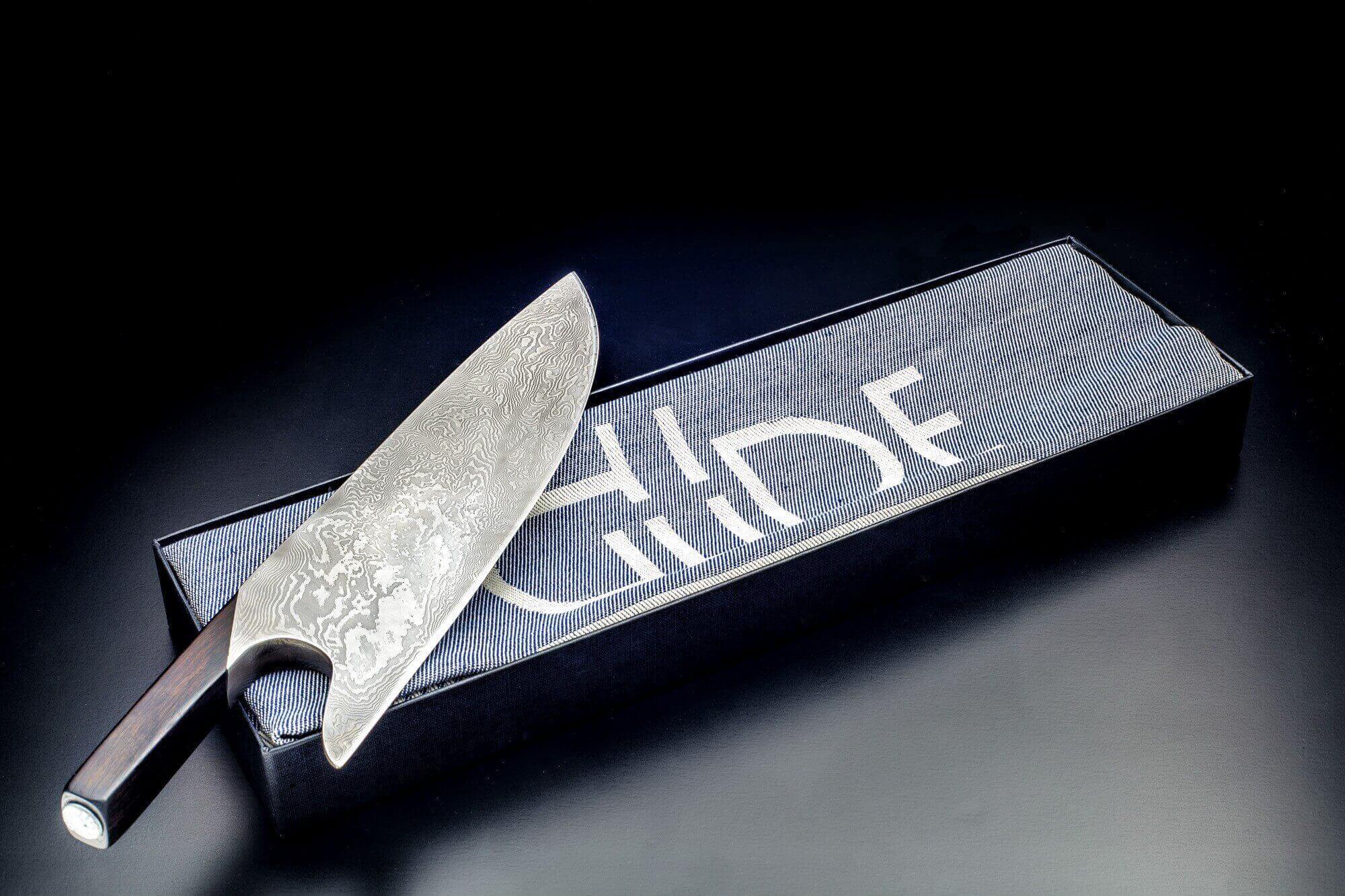
Finally, you shouldn't miss this exceptional piece: the Güde chef's knife entitled THE KNIFE. Its Damascus is 300 layers thick, a feat for such a wide blade. It's simply magnificent, and could make a great gift for a seasoned chef! For this little gem, you'll need to set aside just over 2000 euros. Take a look at this beauty!
You've already got plenty to choose from, but there's a good deal more we haven't mentioned yet! Yaxell, for example, offers many impressive damask ranges, such as the sumptuous Super Gou! The same goes for Tojiro, where you'll be spoilt for choice... All the major brands have their own damascened knife options, so it's up to you to make the right choice for your budget!
Good to know: damascus knives can also be found in folding knives: the Mcusta brand uses its know-how to design knives with 66 layers of damascus, i.e. a Rockwell resistance of 60HRC. These folding knives are worth approximately 150€!
So, we hope we've answered all your questions about our prestigious damascus knives, and if you have any others, you know who to contact :)


