
Your cart
There are no more items in your cart
Ceramic knives
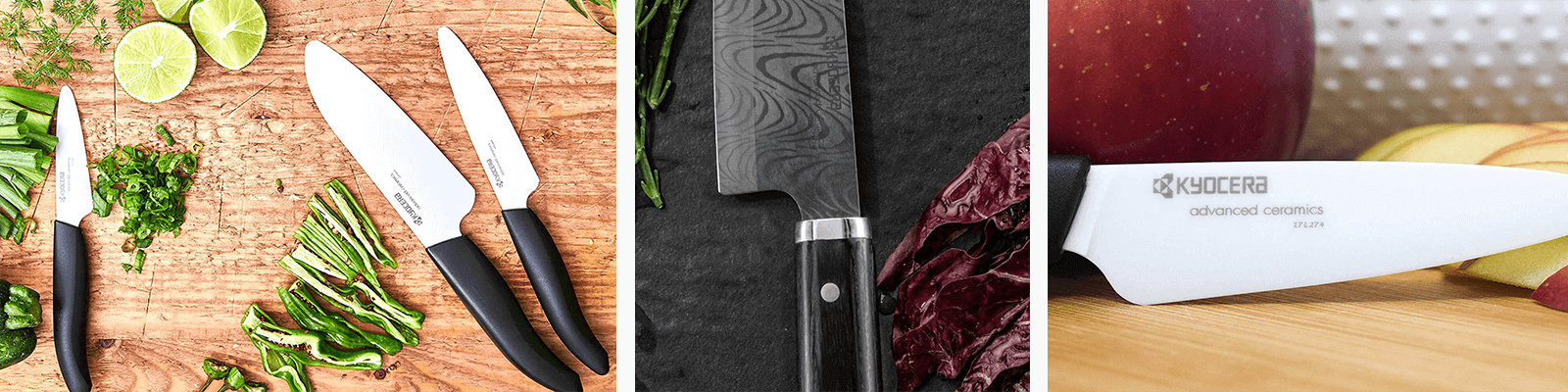
Ceramic knives were developed by the Japanese brand Kyocera. Initially used in the aeronautics industry for space shuttles, this technology has been adapted for the kitchen to take advantage of the extraordinary qualities of this material.
How it's made
Zirconium oxide and yttrium oxide-based powder is compressed by a press developing a pressure of almost 10,000 tons/m², then fired at over 1,500°c. The result is an extremely strong ceramic, capable of reaching 8.5 on the Mohs scale of material hardness, compared with 5-6 for steel blades and 10 for diamond, the hardest material in the world.
Why choose a ceramic knife?
Ceramic kn ives are extremely sharp, and can retain their cutting edge for a very (very) long time. Last but not least, ceramic contains no metal ions, never rusts, resists the acidity of food, does not alter its odor and is extremely light.
Advantages: Exceptional cutting edge / Long-lasting cutting edge / Does not rust / Healthy alternative / Lightweight knife
Disadvantages : Many "low-end" ceramic knives are fragile and brittle / Difficult to resharpen / Not suitable for all uses
Our recommendations for use
Ceramic knives are ideal for precise cutting of fruit, vegetables, sausages, boneless meats and fish. Always use them on a plastic or wooden cutting board, never on a hard surface such as marble or a plate. Do not use them for deboning or slicing frozen foods. Do not use for leverage, breaking garlic or any other purpose other than cutting.
To wash a ceramic knife, rinse it in hot water with a little soap, or put it in the dishwasher (away from other cutlery!).


Kyocera
Knife set of 3 Kyocera ceramic santoku + paring knife + petit paring knife knives

Shipped within 15 days


