
Your cart
There are no more items in your cart
Choosing the right knife shape: Our tips
In the kitchen, the variety of foods and their preparation requires numerous tools that need to be increasingly adapted. For this reason, the different brands present in the knife industry offer a wide range of kitchen knives. Here they are:
The most common knives
The chef's knife

The chef's knife is the indispensable knife par excellence. But what are its qualities? It is a perfectly balanced knife for chopping and slicing meat, fish, fruit and vegetables. It is the all-purpose knife of the kitchen. The shape of its blade allows a pleasant and efficient rocking motion to chop your food.
The larding knife

The paring knife is also one of the indispensable knives in the kitchen. It is a small, versatile knife with a thin, semi-tip blade and a smooth cutting edge. For cutting onions and herbs. Also useful for preparing vegetables. It makes a variety of things possible, are you ready? It peels, stalks, cores, slices, twists, pares your fruit and vegetables and helps you to remove the unpleasant parts of your meat (skin, tendons and fat).
The carving knife

The carving knife is very often included in a knife block. It is often very useful as a supplement to the knives you use most often. Its blade is long and thin, which produces nice, even slices. You can use it to cut up pieces of meat, slice sausage or terrines, lift fish fillets, chop meat ( e.g. to make a tartare), finely chop fruit and vegetables.
The steak knife

Do we really need to explain what it is used for? Thanks to its super-sharp blade, it's the right knife for cutting steaks (yes, yes, yes), but not only - it's a must-have for all meat dishes. The length of its blade is similar to that of a table knife, the difference lies mainly in the tip. The steak knife is pointed and very sharp, so you don't have to use force when cutting your meat, and it preserves the flavor better.
The universal knife

Again, the name of the knife says it all. It is a mixture of office and chef's knife (as is its blade, by the way). It is suitable for cutting vegetables, fruit, meat (boneless), fish (boneless), cheese and herbs.
The bird's beak knife

A strange name for a knife, don't you think? The bird's beak refers to the curvature of the blade. It is a small, handy knife with a curved blade, a smooth cutting edge and a sturdy tip. The bird's beak shape of the blade adapts to the shape of the vegetable. It is often used for turning fruit and vegetables. It is also called a turning knife (yes, just like us, knives sometimes have several names). It is also suitable for peeling, boning and carving your food.
Japanese knives
The Santoku knife

The Santoku knife has a pretty cool meaning, it means "3 virtues" in Japanese. Do you know why? Quite simply, it has three main functions: Cutting, chopping and chiseling. Does that sound familiar? The chef's knife, isn't it? It can be used to cut fruit, vegetables, meat (boneless), fish (boneless) and herbs. The main difference from the chef's knife is its shape, the size of the blade is smaller, so it will cut less large food. But its handiness makes it a very popular knife in Japan (and increasingly in the West).
The Yanagiba knife

Do you like fish? Then you will love the Yanagiba knife! This knife is a must-have for all fish lovers. It is also known as a sashimi knife. Its blade is long and single-sided, so it is only sharpened on one side and has a beveled edge. Please note that it is intended for right-handed people (or left-handed people who cut with their right hand). It can be used to lift fillets without waste, remove the skin from fillets, cut maki and sushi, cut sashimi while preventing the meat from tearing, and cut thin strips of fish and meat (e.g. for a carpaccio).
The Nakiri knife

The Japanese nakiri knife is used for cutting fruit and vegetables. Does its shape look familiar? It is true that the rectangular shape of this knife is somewhat reminiscent of a butcher's cleaver. But the blade has this shape to make cutting easier and to prevent the chef from hitting the cutting board with his hand. The blade is between 14 and 18 cm long and has a slightly rounded tip so that even those who like the pendulum motion can work with it. The nakiri is used to chop and carve fruit and vegetables. It can also chop herbs and move food (and yes, its surface area is large, so you can use it too).
The Kiritsuke knife

It's very similar to the European chef's knife and has a tip reminiscent of Japanese swords. Also, you probably know that all Japanese people tend to cut like right-handed people (even if they are left-handed) because most knives are made for right-handed people. The Kiritsuke knife, on the other hand, can be used by left-handed people (or right-handed people who cut with their left hand, we don't judge). It is suitable for cutting raw fish, chopping vegetables, slicing fruit, carving meat and cutting herbs (like the western chef's knife).
The Sujihiki knife

The sujihiki is the Japanese version of the carving knife (or slicing knife). Its blade is usually between 20 and 31 cm long. The Sujihiki knife is often confused with the Yanagiba knife, which is sharpened on one side, which is not the case with the Sujihiki knife. It can be used to cut pieces of meat, carve terrines or sausages, lift fish fillets, finely slice fruit and vegetables, cut into cubes or strips, but also chop meat and fish (e.g. to make tartare).
The Bunka knife

Bunka is the Japanese word for "culture" and refers to its use in the preparation of traditional Japanese dishes. It is quite similar to the Santoku knife, the difference being the shape of its tip, which resembles that of a katana. The bunka knife is just as versatile as the santoku or chef's knife. You can use it to cut herbs, chop fruit and vegetables, slice terrine, mince meat and fish or crush a clove of garlic.
The Deba knife

The Deba knife can be translated from Japanese as "knife with a protruding blade". It was originally developed for cutting fish. Today it can also be used for cutting meat, especially for making tartare. Very useful for lifting fish fillets, cutting fish heads, bones and tails, making sushi or breaking open shellfish. It has a one-sided grind and is therefore rarely suitable for left-handers (unless they cut with their right hand).
The sushi knife

The sushi knife is ideal for cutting sashimi and sushi and is a Japanese slicing knife. It has a long, sturdy blade that allows you to glide the knife over the fish without effort. You can use it to cut sashimi slices, slice sushi, lift fish fillets and also make thin slices of meat. The blade is asymmetrical to allow a clean cut without damaging the flesh of the fish. This knife is not suitable for left-handed users.
The Japanese chef's knife ( Gyuto knife)

The Gyuto knife is the Japanese version of the western chef's knife. The shape of the blade makes it possible to chop and cut all types of food. The difference between the Gyuto and the western chef's knife lies in the sharpening angle. It is very versatile and makes it possible to cut fruit, vegetables, meat (boneless), fish (boneless), herbs, break the small bones of poultry and crack the shells of shellfish. The sharpening angle is less than that of a chef's knife, 15-18°, which requires a harder steel.
The Pankiri knife

The Pankiri knife is the Japanese bread knife. As the name suggests, it cuts bread, but not only bread! It is perfect for cutting bread, brioches, sponge cake, yeast dough cakes, roasts and other stewed meat ... but also hard vegetables such as butternut squash, for example. Its blade is between 20 and 25 cm long to ensure easy and precise cutting.
Butcher's knives
The butcher's knife

The butcher's knife is the most commonly used knife in the profession. It is wide and very stiff, the length of the blade varies between 16 and 40 cm. This knife is designed for cutting large pieces of meat, breaking small bones and chopping meat and fish. Thanks to its strong cutting edge, it can also cut into muscle mass.
The carving knife

The carving knife is one of the must-haves of a perfect butcher. It is very versatile. It can be used to cut all types of meat: Ham, poultry, roasts ... The only restriction? You must not try to cut the bones. The handle and blade are designed to make it easier for the butcher to use.
The skinning knife

You can easily remove the tendons from your meat with the skinning knife. The blade of the knife is between 13 and 23 cm long. It is very similar to the sole fillet knife. It is designed to remove the tendons and nerves of your pieces of meat, cut off excess fat, lift fish fillets and make fish slices. They are available with more or less flexible blades to make this cutting work more comfortable.
The boning knife
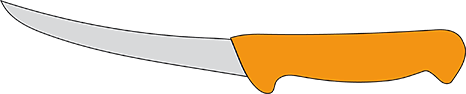
The boning knife is also one of the most commonly used knives in butchers' shops and by chefs to prepare their cuts of meat. However, its name is misleading as it does not cut bones, at least not the large ones. It can be used to scrape the meat off the bone to produce less waste, cut very small bones, skin poultry and game, slice pieces of meat and parry them by removing fat, nerves and tendons. There are different types of boning knives, straight blades, curved blades, soft blades and stiff blades.
The boning knife

The bleeding knife is indispensable for butchers, butchers and in slaughterhouses. Its blade is usually small, between 10 and 15 cm long, and its tip is very sharp to bleed the animal. Bleeding out an animal causes its death by exsanguination. So that the animal does not suffer from the bloodletting, this may only be carried out after anaesthetization.
The Tranchelard knife

Originally intended for cutting bacon (hence the name), it is also known as the "carving knife". It is the carving knife par excellence. Roasts, meat, ham - raw or cooked - always cut to the right thickness. With this knife you can cut pieces of meat, carve terrines, lift fish fillets, prepare tartare, cut meat and fish into thin slices, finely slice fruit and vegetables or cut them into cubes or strips. It is a middle ground between a chef's knife and a Yanagiba knife.
The tripe knife

An indispensable knife for all professional butchers. Its blade is usually between 15 and 20 cm long. This knife is used for skinning your meat. Its tip is a protective ball that prevents the animal's entrails from being punctured. Its handle is non-slip and has no gaps to prevent pieces of meat from slipping in. The blade can have two different shapes: There are straight and curved blades.
The cleaver
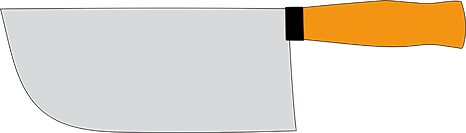
The cleaver, developed for meat professionals, is a stiff knife that is indispensable for every good butcher and butcher to easily cut the carcasses. Do you know why they call it a cleaver? Because its shape and size is reminiscent of an A5-sized sheet of paper (yes, that's big!). The cleaver can be used to cut through large, bony pieces of meat, joints and tendons, break open carcasses, flatten the meat and chop it. Be careful with your fingers (your hand and the rest of your body hein!).
The butcher's saw
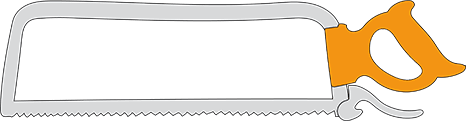
Sometimes the cleaver is not enough to cut up large animal carcasses. Then the butcher's saw steps in and does the job perfectly. The butcher's saw can be used to saw off large bones that the cleaver cannot cut through. There are two types of saws: the American saw, which has a fairly thin blade that penetrates the bone faster but is more fragile; and the Parisian saw, which has a thicker and taller blade that can cut through all kinds of bones and still holds its shape.
The fish knives
The serrated knife

The serrated fish knife is a must for every professional fishmonger. Its blade is between 33 and 42 cm long and is particularly suitable for large fish. The wide blade makes it more resistant and can cut through even the toughest steaks and fish skins. It is suitable for lifting fish fillets, cutting off heads, fins and bones and for cutting fish into darnes.
The sole fillet knife

An indispensable knife for the delicate cutting of fish. With its flexible blade, fish and meat fillets can be cut into wafer-thin slices. The high elasticity and thin blade also ensure a very precise cut.
The oyster knife
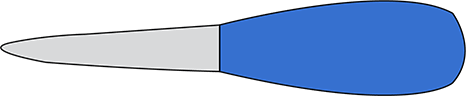
The oyster knife is a small, indispensable utensil designed to open oysters quickly without damaging them or cutting your fingers. It has a short, thick and pointed blade that can be easily inserted into the seam of the shell.
The salmon knife

The ultimate knife, specially designed for delicately slicing thin slices of fish. Its blade is long, narrow and flexible and makes it possible to cut raw, cooked or smoked salmon with extreme precision. The tip of its blade is rounded to lift the fillets without damaging the flesh. Originally designed for cutting fish, it can also be used for cutting smoked ham.
The freezer knife

The freezer knife is the only knife with a blade that can cut frozen products that have the particularity of having hard, clumped fibers. As the blade is ultra-high performance, it does not have to wait for the food to defrost. It is very often used in fish stores.
The tendon cutter

A sea urchin can be opened easily and safely with a sea urchin cutter. The main danger of opening a sea urchin with an unsuitable tool is injuring yourself on the spines, but also damaging the sea urchin.
Cheese knife
The knife with two handles

You can cut cheese wheels or hard cheese with the double-handled knife. The double handle protects your hands when cutting and allows you to cut your cheese with precision. It is often used by cheesemakers, especially when cutting Emmental, Tomme de Savoie or Comté.
The knife with perforated blade

This knife was developed for cutting soft cheeses such as Camembert or Brie, but is also suitable for cutting other soft foods such as foie gras. The perforated blade ensures that the cheese does not stick to the knife after cutting.
The Parmesan knife
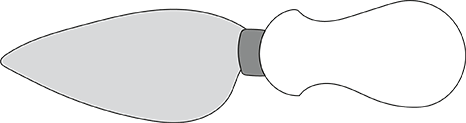
The Parmesan knife is ideal for cutting all types of cheese with a crumbly texture, such as Parmesan or Cantal. With this knife, you can cut your favorite cheese into shavings without hurting yourself. You can use it to season your pasta and salads!


