
Your cart
There are no more items in your cart
Looking for a Damascus kitchen knife that combines performance, durability and a blade that really stands out? Good news: you don't necessarily need to spend several hundred euros to enjoy a quality Damascus knife.
Damascus kitchen knives are instantly recognisable by the distinctive wavy patterns running across their blades. On many modern models, a hard steel core is surrounded by multiple layers of stainless steel. These layers create the characteristic Damascus pattern while protecting the cutting core and giving the knife its unique appearance.
But looks aren't everything! When choosing a Damascus chef's knife, you should also consider the steel used for the core, its hardness, the shape and length of the blade, the handle and, above all, the way you plan to use it. A chef's knife is ideal for versatility, a nakiri is perfect for vegetables, while a bunka or kiritsuke offers a more typically Japanese profile.
To help you choose, we've selected 10 of the best Damascus kitchen knives under €150. Chef's knives, utility knives, nakiri, bunka, kiritsuke... there's something here for every cooking style and every cutting board!
1. Kutoyama Damas Pakka Rainbow 20cm Chef's Knife
This 20cm Kutoyama chef's knife is an excellent all-rounder for everyday cooking. Its blade features a VG10 steel core surrounded by 66 layers of stainless steel, creating a beautiful Damascus pattern. With a hardness of 60 HRC, the blade offers a fine, durable cutting edge while remaining accessible to sharpen.
The mirror-polished finish highlights the Damascus waves, while the oval pakka wood handle features three colourful acrylic rings. Stainless steel at the bolster and end of the handle adds a clean, well-balanced finish.
Why we like it: a versatile 20cm chef's knife with a particularly original handle. It's an excellent choice if you want your first Damascus knife to be both practical and eye-catching.


2. Fukito Rosewood Damascus 67-Layer 15cm Utility Knife
With its intermediate 15cm blade, this Fukito utility knife is particularly versatile. It sits neatly between a small paring knife and a large chef's knife, making it perfect for fruit, vegetables, meat and a wide range of everyday preparation tasks.
Its 67-layer Damascus blade features a 10Cr15CoMoV stainless steel core containing around 1.05% carbon. The blade reaches 60 HRC for good edge retention. The upper section is hammered, creating an attractive contrast with the Damascus pattern.
The full-tang construction continues into a natural rosewood handle, secured by three rivets including a decorative mosaic rivet.
Why we like it: its 15cm format. It's compact enough for precision work but large enough to handle most everyday cutting jobs.


3. Kutoyama Damas Azur 17cm Nakiri Knife
Vegetable lovers, this one's for you! The nakiri knife is a traditional Japanese-style knife designed for preparing fruit and vegetables. Its wide, almost rectangular blade makes it particularly effective for chopping, slicing and finely cutting herbs and vegetables.
This Kutoyama model features a VG10 steel core surrounded by 66 layers of stainless steel. Its 60 HRC hardness gives it a durable cutting edge, while the mirror-polished surface beautifully reveals the Damascus pattern.
The blue resin handle with its light wood-effect finish gives the knife a modern appearance and an excellent visual contrast with the blade.
Why we like it: the combination of a genuinely useful nakiri profile and a blue handle that is anything but ordinary.


4. Fukito Olive Damascus 14Cr 9cm Paring Knife
Small knife, serious specifications! This 9cm Damascus paring knife is ideal for peeling, trimming, coring and all the precise tasks that are difficult to perform with a large chef's knife.
Its blade is built around a premium 14Cr14V3MoNb powdered steel core, surrounded by a total of 73 Damascus layers. With a hardness of approximately 64 HRC, it is one of the hardest blades in our selection and offers particularly impressive edge retention.
The natural olive wood handle is finished with a stainless steel bolster, steel end cap and decorative mosaic rivet.
Why we like it: its 64 HRC powdered steel core. For such a compact knife, its technical specifications are seriously impressive.


5. Fukito Ebony Damascus VG10 20cm Chef's Knife
This 20cm Fukito chef's knife combines the versatility of the classic chef's knife with a much more distinctive Japanese-inspired finish.
Its 67-layer Damascus blade features a VG10 Japanese steel core containing around 1% carbon. Hardened to 60 HRC, it provides a fine cutting edge with good edge retention. The upper part of the blade has a hammered, rough-forged finish that contrasts beautifully with the Damascus pattern below.
The hexagonal ebony handle provides a comfortable grip and is decorated with a mosaic rivet. Stainless steel fittings and gold-coloured detailing complete the premium appearance.
Why we like it: its balance between performance and design. The ebony, Damascus pattern and hammered finish make this a particularly elegant chef's knife.


6. Wusaki Sakin Damascus 10Cr 20cm Kiritsuke Knife
The kiritsuke immediately stands out thanks to its long blade and distinctive angled tip. This profile provides plenty of cutting length for slicing meat, fish and vegetables while its pointed tip is useful for more precise work.
The 20cm Wusaki Sakin blade has a 67-layer Damascus construction around a 10Cr15CoMoV stainless steel core containing approximately 1.05% carbon. At 60 HRC, it offers a durable edge while remaining relatively straightforward to maintain.
Its resin handle combines carbon fibre and gold leaf, giving every knife a bold, contemporary look.
Why we like it: the handle. Carbon fibre, gold leaf and Damascus steel together make this one of the most striking knives in the selection.


Wusaki Sakin Damascus 10Cr
Wusaki Sakin Damascus 10Cr 20cm kiritsuke knife with carbon fiber and gold leaf handle
In stock
7. Yuzo Damascus VG10 15cm Handcrafted Japanese Utility Knife
If you're looking for a Japanese Damascus knife made in Japan, this Yuzo Hamono utility knife is well worth a look. Its versatile 15cm blade is suitable for preparing vegetables, fruit, meat and fish without the bulk of a full-size chef's knife.
The blade uses a Japanese VG10 steel core containing around 1% carbon and reaches 60 HRC. Its polished surface reveals the Damascus waves, while Japanese kanji engraved on the blade add to its traditional character.
The octagonal olive wood handle is completed by a black horn bolster and white micarta ring.
Why we like it: its Japanese craftsmanship. It's a very appealing option for anyone looking for a genuine Japanese knife while keeping below the €150 mark.


8. Yuzo Enju Damascus 440C 8cm Handcrafted Japanese Paring Knife
This compact Japanese paring knife is made for precision. Its 8cm blade is perfect for peeling fruit and vegetables, removing stems, trimming ingredients and making small, controlled cuts.
At its centre is a 440C stainless steel core containing approximately 1% carbon. Hardened to 59 HRC, it offers a good balance between sharpness, edge retention and ease of maintenance. The Damascus surface is complemented by delicate hammering, while the flat grind provides stable and precise cutting.
The octagonal handle is made from smoked oak, and the knife is handcrafted in Japan by Tsunehisa.
Why we like it: a compact handmade Japanese knife with plenty of character, ideal for cooks who enjoy precision work.


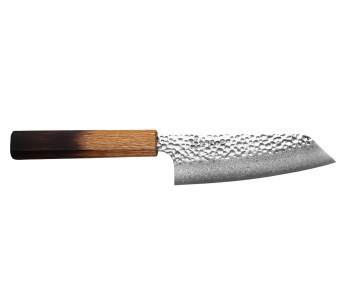
9. Wusaki Yaketa VG10 Damascus 15cm Handcrafted Japanese Bunka Knife
The bunka knife is one of the most versatile Japanese blade shapes. Its relatively wide blade works brilliantly for vegetables, while its characteristic pointed tip allows precise cuts in meat, fish and smaller ingredients.
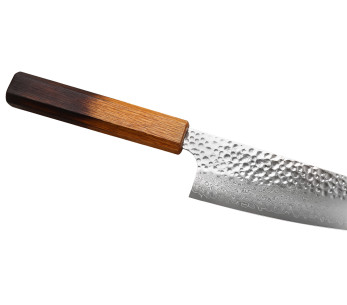
This 15cm Wusaki Yaketa features a Japanese VG10 steel core containing around 1% carbon and hardened to 60 HRC. Its Damascus construction is combined with a hammered surface and mirror-polished finish, creating plenty of contrast across the blade.
The octagonal handle is made from charred oak, which is resistant to moisture and gives each knife slightly different natural shades. The knife is made in Japan by Tsunehisa Cutlery.
Why we like it: its combination of Japanese craftsmanship, versatile bunka profile and burnt-oak handle. A lot of personality for under €150.
10. Yuzo Enju Damascus 440C 15cm Handcrafted Japanese Utility Knife
We finish our selection with another Japanese-made Yuzo Enju, this time in a highly versatile 15cm utility knife format. Its dimensions make it an excellent compromise for anyone who finds a chef's knife too large but a paring knife too small.
The Damascus blade surrounds a 440C stainless steel core with approximately 1% carbon. Its hardness of 59 HRC provides a sharp and durable cutting edge. A delicately hammered finish helps reduce the contact area between food and the blade while adding texture to its appearance.
The smoked oak handle has an ambidextrous octagonal shape and the knife is handcrafted in Japan by Tsunehisa.
Why we like it: its versatility. If you only want one compact Japanese knife for a wide variety of ingredients, this 15cm format makes a lot of sense.


FAQ about Damascus knives
▸ How should I clean my Damascus knife?
Always wash your Damascus kitchen knife by hand using warm water, a soft sponge and a little washing-up liquid. Never put it in the dishwasher, as high temperatures, aggressive detergents and prolonged humidity can damage the blade, its finish and the handle.
Dry your knife immediately after washing it. Even if the blade is made from stainless steel, leaving acidic or salty food residue on its surface for too long can eventually cause stains or oxidation.
▸ How should I sharpen my Damascus knife?
A Damascus knife is sharpened in much the same way as any other quality kitchen knife. What you are sharpening is the cutting edge of the core steel, rather than the decorative Damascus layers.
For regular sharpening, we recommend using a sharpening stone. A grit of around 1000 is ideal for restoring the edge, while a finer stone can then be used to refine and polish it. For Japanese-style knives, an angle of around 15° per side is common, although this can vary depending on the knife.
▸ What is the difference between a Damascus blade and a San Mai blade?
A San Mai blade is generally made from three layers: a hard steel core used for the cutting edge, surrounded by two softer outer layers. This construction combines cutting performance with greater durability and protection for the core.
A modern Damascus blade often follows the same principle, but uses numerous alternating layers of steel around the core. These layers create the characteristic wavy patterns visible on the blade.
The number of Damascus layers is not necessarily an indication of quality. The core steel, heat treatment, blade geometry and sharpening have a much greater influence on cutting performance.
▸ Why are some Damascus blades hammered?
A hammered finish, often called tsuchime on Japanese knives, has both an aesthetic and practical purpose.
The small indentations on the blade reduce the contact area between the food and the steel. This can help some ingredients release more easily from the blade during cutting.
The hammered texture also creates an attractive contrast with the Damascus pattern and gives the knife even more character.


