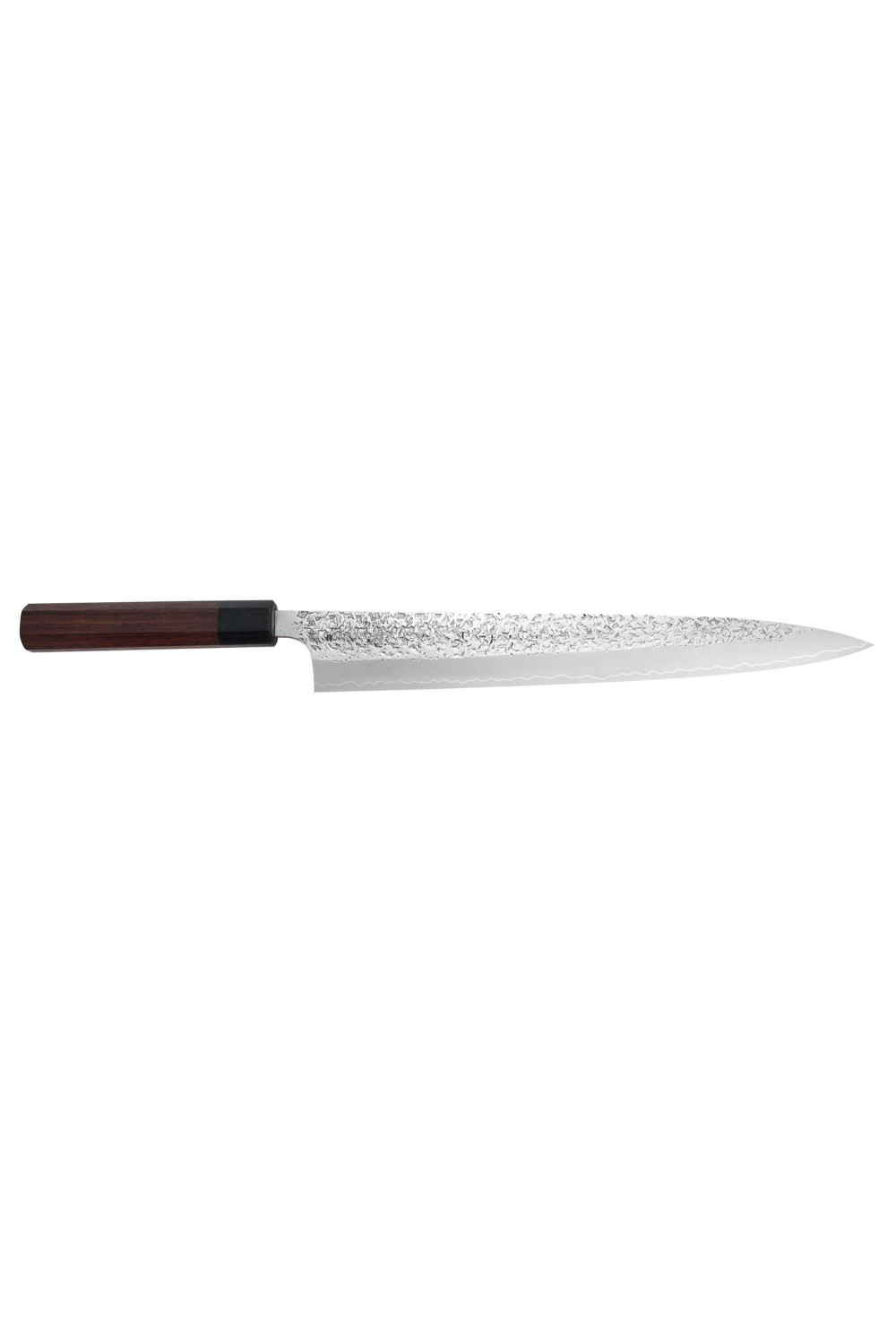
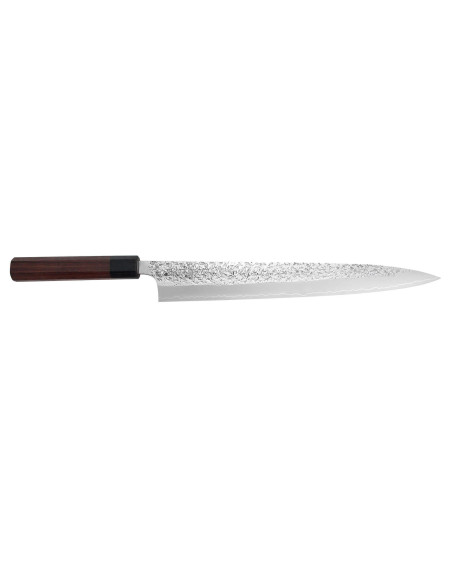
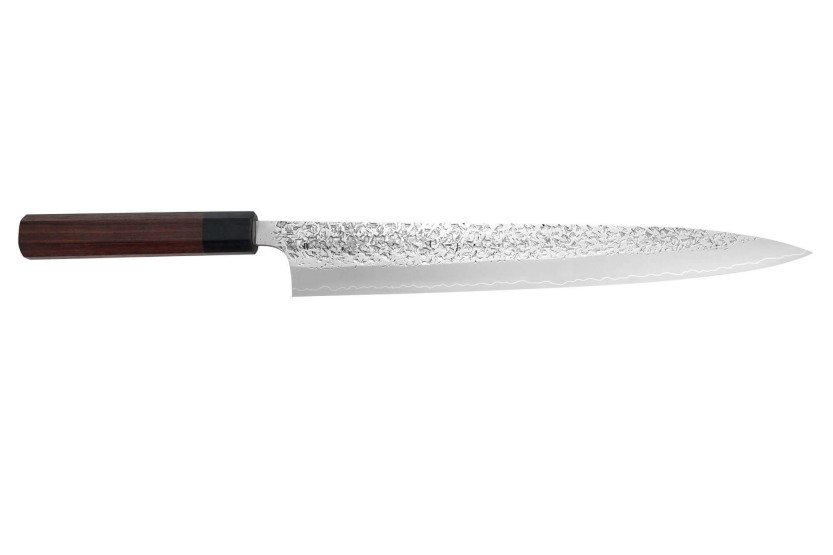
Japanese quality at its finest! This particular knife is designed for easy slicing of meat and fish (without bones, of course). Its long, thin, smooth blade makes cutting easy and intuitive, without ruffling the fibers. It's called a sujihiki knife in Japanese, but could be translated as a carving knife.
The Yu Kurosaki Shizuku slicing knife has a forged blade, meaning that a solid piece of steel forms its base. This is heated, then the blacksmith takes it with a long pair of pliers and passes it under the mechanical press, turning it regularly. As a result, the blade is stronger and more resistant (because there are no sticking points).
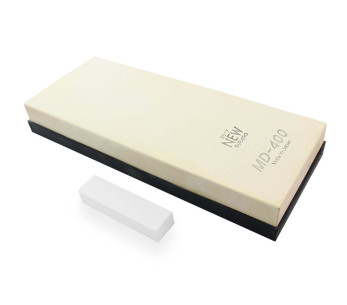
To form the heart of the blade, Kurosaki san uses SG2 powdered steel (also known as R2), a renowned and expensive alloy rarely found in cutlery. It has a high Rockwell index of -+63 HRC, enabling it to go the distance in terms of sharpness. What's more, despite its hardness, SG2 steel is easy to maintain if the need arises, which is a plus for such a rigid alloy. For perfect maintenance, opt for a Sharpening stone. Its razor-sharp edge will surprise you from the very first use (watch your fingers).
SG2 also has another advantage: its purity. Microscopically speaking, its structure is homogeneous, reducing the risk of chipping.
Beyond the alloy of choice, the knife's cutting edge is also high-performance, as it is hand-ground.
At first glance, it's the original hammering of the blade that stands out. It's as if small drops of water were mixing together, as if the steel were slightly wet. This is where the range gets its name, Shizuku meaning "drop" in Japanese. Moreover, Kurosaki san is a blacksmith renowned for his blade work, and his hammerings, each more beautiful than the last.
The brand has been engraved for even greater authenticity. Last but not least, the whole is enhanced by an elegant mirror polish, which brings light and depth to the knife.
Sandalwood was chosen for the handle. This grit wood is pleasant and light in the hand. Its octagonal shape fits perfectly in your palm (whether you're right- or left-handed). A black Pakkawood bolster links the blade to the handle.
For ideal care, this knife should be washed by hand and immediately wiped dry with a soft cloth, before storing away from moisture. It is delivered in a Japanese-style cardboard box.
A few words about the smith :
Yu Kurosaki is a master blacksmith based in Echizen, Japan. His workshop, with its modern facade, is located in the heart of the famous Takefu Knife Village , home to a large number of traditional blacksmiths who are experts in their field.
Kurosaki San began his training at the dawn of the 2000s, and perfected his skills with Master Kanehiro over a period of almost 12 years. Master Kanehiro taught him everything: how to forge a knife, how to sharpen it to perfection... It was after receiving orders from customers who were very satisfied with his blades that he decided to create his own brand, encouraged by his master. He also trained with the famous Hiroshi Kato San, a renowned master blacksmith and one of the founding members of Takefu Village.
Discover all the models in the range by clicking here!




 By buying this product you can collect up to