Octagonal handle in olive wood
The handle of the utility knife is octagonal in shape. Ergonomically designed, it is suitable for both right-handed and left-handed cooks. It provides a comfortable grip while being extremely easy to handle, which is much appreciated during long cutting sessions.
This Japanese kitchen knife features an olive wood handle, a wood renowned for its exceptional durability. Its natural density makes it resistant to bacteria and humidity, protecting the handle from deformation due to condensation. With its golden hue and distinctive grain, olive wood makes each knife unique and elegant.
A black buffalo horn bolster completes the handle, linking it to the blade. The appearance of the bolster may differ slightly from one knife to another, as horn is a natural material.
A handcrafted Japanese knife with a San Maï blade
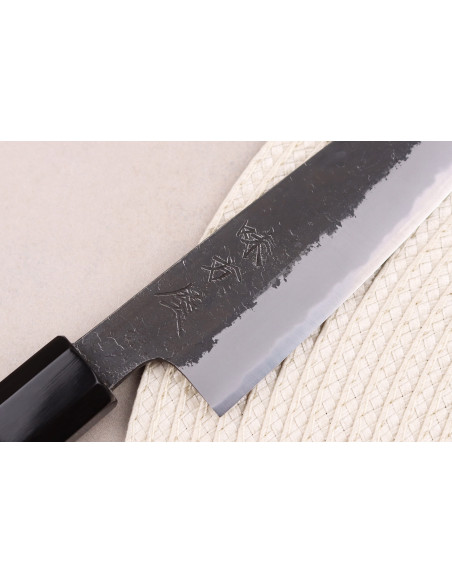
Your utility knife features a 13.5 cm blade designed according to the traditional Japanese structure known as San Maï, which means "three layers". These terms accurately describe the construction of the blade, which comprises a rigid steel core wrapped in a softer layer of steel folded on either side. Forming like a sandwich, this structure protects the core while ensuring optimum balance.
The heart of the knife is made from Shirogami #2 steel, also known as White Paper Steel #2. This premium Japanese alloy is produced by Hitachi, the world-renowned steelmaker. The steel's name, meaning "white paper", refers to the way it is packaged during production.
This alloy has a high carbon content, reaching around 1.3%. Carbon plays a crucial role in increasing the blade's hardness, ensuring greater strength and efficiency. With a hardness of 62 HRC, the blade of this handcrafted Japanese knife offers exceptional cutting performance and retains its sharpness for a long time.
Next, the core is surrounded bya layer of softer iron, creating the San Maï structure by folding each side. This design adds flexibility to the core while protecting it, making it less vulnerable to impact and therefore less likely to break when cutting. The superimposed layers of steel create a random wavy line along the edge, giving the blade a unique aesthetic.
A traditional Black Nashiji finish has been applied to the blade. This finish evokes the look of rough forging, while retaining its black color. Finally, authentic kanji have been engraved on the blade, adding to the knife's rustic character.
A Japanese kitchen knife forged by Mutsumi Hinoura
Mutsumi Hinoura works with renowned blacksmith Tsukasa Hinoura, who is none other than his father. Their family workshop is located in Sanjo, a Japanese town renowned for its high-quality tools and knives. Mutsumi is the fourth generation of blacksmiths in his family, having begun his apprenticeship with his father in 2001. He has spent almost twenty years perfecting his craft, skilfully fusing traditional techniques with contemporary standards, creating blades of exceptional quality.
In the Hinoura family, the tradition of knife-making dates back to the Meiji era in the early 20th century. The same forging techniques have been used since then, and have been passed down through the generations. Today, Mutsumi continues this precious heritage. Hinoura knives are internationally renowned for their traditional craftsmanship and exceptional heat treatment. Each knife, forged by hand with meticulous care, bears witness to the attention paid to it by the blacksmith during its creation.
The Ajikataya brand contains knives distinguished by their sober-looking blades, but the exceptional precision of their manufacture testifies to the meticulous work carried out by Mutsumi Hinoura. These hot-forged blades have a thick base that gradually tapers towards the tip.
As this knife contains a high carbon content, it is essential to wash it exclusively by hand. Use a mild detergent and a non-abrasive sponge, taking care not to wet the handle. After cleaning, be sure to dry the knife thoroughly to remove any moisture before storing it in a dry place. Do not leave the knife to soak in the sink or put it in the dishwasher.
Over time, it is normal for the blade to change color slightly. This is due to the natural reaction of carbon to external elements such as the acidity of certain foods, or the humidity in the air. We recommend keeping a sheet of paper towel handy to wipe the blade between cuts. In addition, you can occasionally apply a little mineral oil to the blade to protect it.
Ajikataya knives are waiting for you on our website!







 By buying this product you can collect up to


