
Your cart
There are no more items in your cart
The various steels used in cutlery
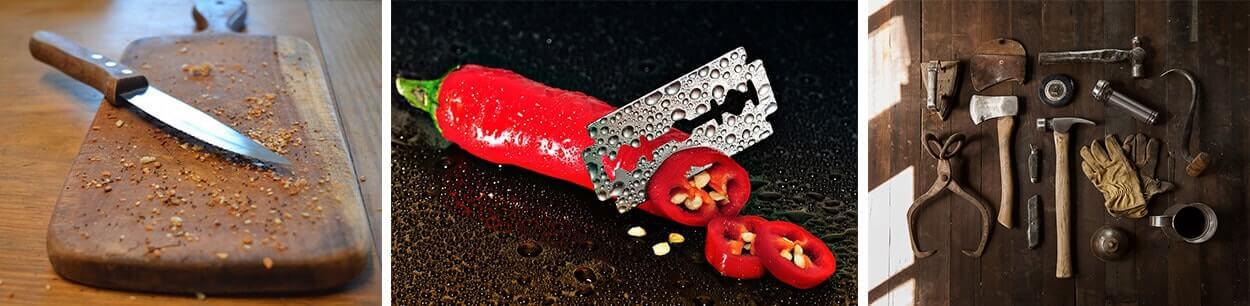
Blacksmithing is a profession, and you don't need us to tell you that. Given the multitude of steels available, you need to be highly qualified to know them all! Depending on the steel used and its specific composition, the knife will not have the same durability, nor the same resistance to aggression (acids, humidity, shocks...). These variables can also have an impact on the knife's sharpness and ease of sharpening... In short, beyond the actual function of a kitchen knife, you need to be sure that the type of steel used matches your expectations.
That's why we've put together this little comparison! All you have to do is read it and make your choice!
We've divided this article into 3 parts. First, we'll talk about carbon-enriched steels (often feared, but nevertheless very interesting). Then we'll move on to stainless steels. Finally, we'll talk about the elements that can go into the various alloys, and how they impact them.
Carbon steels :
First of all, it's important to point out that carbon steels are divisive. They are either highly prized for their sharpness and ease of sharpening, or not recommended because of their lower resistance to corrosion. They therefore require more extensive maintenance than a stainless knife, but offer real cutting qualities and edge retention. Carbon steel is often used in Japanese cutlery, where Hitachi is one of the world's leading manufacturers.
Blue Paper Steel (also known as Aogami):
This is a highly carbon-enriched steel produced by Hitachi. Its name comes from a literal translation: Blue Steel, because of the color of the envelope in which it is packaged before processing. To put it simply, its carbon content is around 1.2% (whereas the average in cutlery is between 0.5% and 1%). This high carbon content makes this particular steel very strong. Thanks to this strength, the edge of the blade can be incredibly fine, because it is sharpened to a higher level. What's more, this sharpening lasts a long time, and you won't need to sharpen it again every time you use it. We find this steel on Jikko Montan and Jikko Montan Kokutan Japanese knives. This steel is very reactive to water, so you need to dry it quickly with a cloth after each use.
White Paper Steel (also known as Shirogami):
Its composition is very similar to that of Blue Paper Steel. Indeed, it is highly enriched in carbon, but unlike its counterpart, has no tungsten or chromium in its alloy. In fact, it's a pure carbon blade. Beware, however, that because of this characteristic, you'll need to maintain it more regularly, as the cutting surface will tend to stain (but the edge will always remain exceptional, durable, and will also be easy to straighten). You can find it as a top layer in the Montan Kokutan mentioned above, or in Jikko's Betsuuchi series.
Yellow Paper Steel :
Also enriched with carbon, but at a lower rate than the above steels. It has the advantage of being more attractive in terms of price, but will not hold its edge as long over time. For this reason, it is used in toolmaking and in the creation of mid-range kitchen knives.
The different SK Steel grades :
These steels are divided into several families according to the level of components they contain in their alloys (e.g. SK n°3 contains more carbon than SK n°4, etc.). They are less pure than the above-mentioned steels, but are still very strong in their own right. In simple terms, they won't have extreme cutting power, but they will still have appreciable hardness, which is why they are used, for example, in the manufacture of hammers, axes and small kitchen knives.
Japanese carbon steels (Nihon type...) :
The Japanese are renowned for using carbon in their blades, that's a fact! What's more, they've been doing it for decades, if not centuries. And why? Quite simply because the cutting edge of a carbon knife can be exploited to a greater extent than a stainless steel knife. In comparison, Japanese carbon steel is harder than the highly regarded German steel. As a result, it has a higher sharpening potential (as mentioned above, carbon holds the edge of a knife and allows you to push its sharpening to the limit, for tenfold cutting power).
Stainless steels :
Simply put, the basic composition of a stainless steel blade is iron, chromium at around 13%, molybdenum and vanadium, and a hint of carbon. What precisely is the advantage of stainless steel? It's corrosion-resistant and easy to maintain.
However, with the evolution of production techniques, we now come across hybrid knives, which combine both chromium and carbon, and lie halfway between the main types of steel. These knives are designed to offer the best of both worlds: they are hard, ultra-sharp and corrosion-resistant.
SG2 steel:
This powder-based steel has fine structures, assembled at high density. It's a top-of-the-range steel, ensuring incredible cutting performance, edge retention and good corrosion resistance. It is also very hard, and therefore a little trickier to sharpen (as its HRC hardness is around 63). You'll find it, for example, on the Yaxell Super Gou range of Japanese knives.
VG10 steel:
VG10 is very popular, and is found mainly in Japanese knives. It is very interesting because it has a high carbon content (around 1%), while being highly enriched with chromium. It therefore has the hardness of a carbon blade and the rust-resistance of a standard blade. 2 qualities highly sought-after in cutlery! It holds up well to sharpening over time, and resharpens easily. It is widely used in the design of damascus blades. It can be found, for example, on Kai's Shun Tim Malzer series.
VG1 steel:
Part of the same family as VG10, but a little less concentrated. It is often used as a complement on a multi-layer blade, thanks to its ability to maintain the cutting edge, and its anti-corrosion properties.
Ginsan steel :
Very similar to VG10 in composition: it contains 0.95% carbon and 13% chromium. This combination of carbon and chromium makes the knife both hard and slightly supple. Thanks to the chromium, the knife's rustproof capacity is not impaired. It also retains a good cutting edge, achieves a good hardness (59/60 HRC) and resharpens just as easily. You can find it on the Premium Master II knife from Japanese specialist Jikko.
Swedish steel :
This is mainly found on professional knives. It is stable, consistent, rust-resistant and easy to resharpen. It is less hard than some Japanese steels and therefore perhaps easier to handle for novices. It also has the advantage of being very attractive in terms of price. You'll find it, for example, on Fischer Bargoin's high-performance Sandvik knife series.
Molybdenum-vanadium steel:
This is one of the most common steels. It's good quality, durable, and easy to sharpen too. The steel is more resistant to shock and rust than a standard blade. It is less expensive than the steels mentioned above.

The various elements of an alloy :
Finally, after all these fine types of steel previously listed, you can also find various elements entering into the composition of your knife's alloy. Here's a quick rundown!
Carbon: tenfold hardness and sharpness. Carbon is the main element responsible for blade hardness, and is found in all knives to a greater or lesser degree. It is also useful for increasing wear resistance.
Cobalt: ditto, it increases the hardness of a blade, and is also a very good joining element between all the components of an alloy (but that's more for the blacksmith). It is appreciated for its shock resistance.
Chromium: although it also increases hardness, it is best known for its corrosion resistance. For example, at a percentage of 13, you can safely say that the blade is stainless.
Molybdenum: this is very useful during the actual manufacture of a blade, as it helps to solidify the alloy in contact with air, but we can say that in final use it contributes to hardness and anti-corrosion capacity.
Tungsten: this is a definite element for hardness (it is also used in sharpening utensils thanks to its abrasive capacity on steel). It also enhances shock resistance.
Vanadium: perfect for impact resistance, while also giving the knife a little elasticity (which means it won't break at the slightest blow).



Fish knives
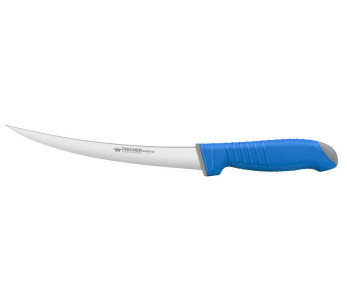
Fischer SANDVIK 19cm curved fillet knife with ultra-comfortable handle
Awaiting Manufacturing


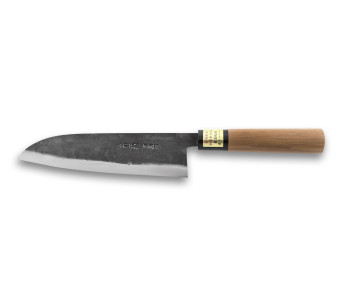
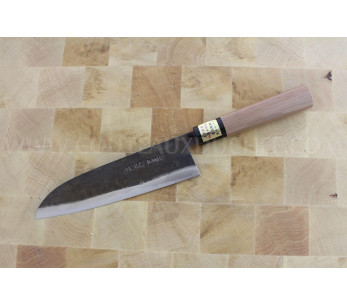
Wusaki Damas 10Cr
Wusaki Damascus santoku knife 10Cr with granton edge 18cm olive wood handle
In stock
84,90€
€99.90


The balance:
You now have all the information you need to make an informed choice when choosing your kitchen knife! Each knife can have an advantage or a disadvantage, depending on your selection criteria. They can all be suitable for you, as long as you check that they meet your specifications. The multitude of steels and alloys available also enables you to compare their capacities, and find the one that really meets your expectations. For example, if you're a fan of stainless steel knives, why not try a carbon knife? You'll know in advance that the sharpness of the blade won't be the same over time, but you can still find a knife with a sharper, longer-lasting edge. That's a risk worth taking! Be intrepid, and above all, be curious!


