Santoku knife: For which foods and how to use it?
Santoku knife features
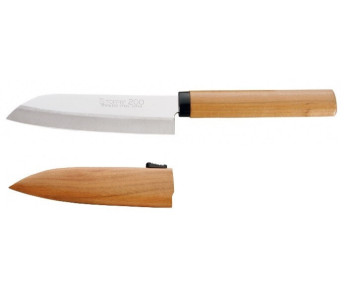
In Japanese, Santoku means something like "3 virtues", evoking this kitchen knife 's ability to slice, mince and chop food. This versatility is reminiscent of the chef's knife, of which it is ultimately the Japanese version, with characteristics all its own.
The blade of a Santoku knife measures between 10 and 20 cm in length, making it lighter and easier to handle than a Western chef's knife. What's more, its cutting edge is virtually flat, with the tip curved at a 60° angle.
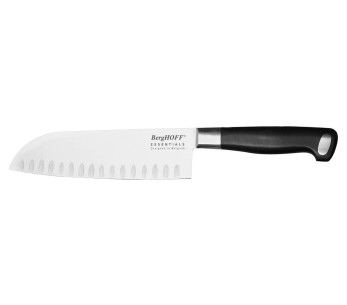
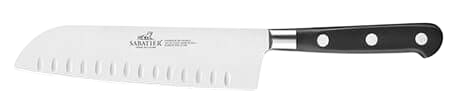
Although this is not always the case, Santoku knives often feature a honeycombed blade. This traps micro-bubbles of air in the cells, preventing food from sticking to them.
As a result, Santoku knives have capacities comparable to those of chef's knives. Its compact blade makes it difficult to cut long pieces of food. However, its maneuverability makes it a much-appreciated knife in kitchens the world over, by professionals and novices alike, who appreciate its reassuring quality.


Endless
How to use the Santoku knife
As its name suggests, the Santoku knife is a kitchen utensil that offers you a wide range of possibilities with a single knife. It is suitable for :
Chopping herbs with precision.
Slicing fruit and vegetables, thanks to its long blade.
Slice pâté or tomato slices.
Chop meat and fish effortlessly.
Crush a clove of garlic with the flat of the blade.
Break small bones and shells with the back of the blade.
Like all knives, the Santoku knife needs to be sharpened to maintain its cutting edge. To achieve this, you can sharpen it regularly with a whetstone or a sharpening gun. In addition, always use a cutting board to preserve the edge of the blade for longer.