
Your cart
There are no more items in your cart
 Understanding blade hardness
In this article, we'll explain what HRC hardness is, to help you choose the right knife for you.
You'll probably have noticed on our product sheets the HRC values we assign to steel knives. These correspond to the hardness of the steel, and therefore the hardness of the blades.
Okay, but what is blade hardness?
A blade's hardness is simply its resistance to impact and wear, and an important detail: it contributes to the longevity of its cutting edge!
Blade steel hardness is measured by the Rockwell test. It is equivalent to the steel's resistance to micro-shocks in relation to everyday cutting, and will have an impact on your blade's sharpness. It is expressed in degrees Rockwell C and abbreviated to HRC.
What is the Rockwell test?
This test consists of pressing a pointed object with a defined force against the steel to be tested. By measuring the indentation left, the hardness of the steel can be identified.
That's all very well, but it doesn't help you make your choice! That's why we've prepared a small summary table for you, along with detailed explanations below:
Up to 52 HRC
Steel is too soft to be used in the manufacture of knives. As a result, we can't sell you any (sorry!). But we've got a solution for you: we've got wooden knives! Well, they're not made for cutting (but we're trying to find you a solution - that's the most important thing, isn't it?).
From 52 to 54 HRC
The steel is rather supple, with a decent quality. We recommend this type of knife for people who don't necessarily cook very often (the blade will need to be sharpened often, so if you cook all day, it won't be very practical).
Here are all Western knives and all Japanese knives with an HRC of 52 to 54.
From 54 to 56 HRC
This is a common hardness in many French kitchen knives. The hardness of the steel is suitable for everyday use in the kitchen. However, it is necessary to use a sharpening steel regularly to maintain the blade's sharpness. This hardness makes sharpening quick and easy. This type of knife is ideal for those who cook at home on a daily basis, but don't forget to maintain it regularly.
Discover all Western and Japanese knives with a hardness of 54 to 56 HRC.
From 56 to 58 HRC
This is a common hardness for German professional kitchen knives. Knives with this hardness retain their cutting edge longer. They also need to be sharpened for proper maintenance. As with the previous hardness,sharpening presents no difficulties. As you can see, this type of knife is ideally suited to the professional environment, as it requires little maintenance (or at least easy maintenance), yet still has a good cutting edge. Of course, we don't restrict this category to professionals: it will also suit anyone who likes to cook (or not).
Here you can discover all Western and Japanese knives with a hardness of 56 to 58 HRC.
From 58 to 60 HRC
This is the hardness used for many Japanese knives, but also for quality pocket knives. Knives with this hardness retain their cutting edge longer than inexpensive knives. However,sharpening them is a little more complex. For this category of knives, the range of users is wide, whether you're a professional or a hobbyist, they'll be right for you. However, sharpening is more complicated (but less frequent).
Here you'll find all Western and Japanese knives with a hardness of 58 to 60 HRC.
From 60 to 62 HRC
Knives with this hardness also retain their sharpness for a long time, but can be more brittle. The harder the blade, themore difficult it is to sharpen. A knife with a hardness of 60 to 62 HRC will be suitable for advanced amateurs, due to the difficulty of sharpening. However, you may as well be a beginner and ask your brother or cousin to sharpen it for you (we ask our cutter Richard, a master sharpener, so we won't judge you).
Discover all Western and Japanese knives with a hardness of 60 to 62 HRC :)
From 63 to 66 HRC
These knives are mainly intended for enthusiasts. The hardness of their steel is very important, but their wire is much more fragile and can be damaged if not perfectly cared for. What's more, these knives often contain little chromium, so they tend to oxidize. You'll need to clean and dry them thoroughly after each use. These knives are recommended for two types of people: connoisseurs, who will know how to maintain a knife with a high degree of hardness, and people who like to collect super knives (or both, of course). However, be (very) careful with this type of knife. If, while cutting, you come across a bone (literally and figuratively speaking), there's a (high) risk that the blade will come away with a chip. In fact, we've listed all the HYPER IMPORTANT information you need to know to look after your Japanese knife!
Here are all the Japanese knives with a hardness of 63 to 66 HRC.
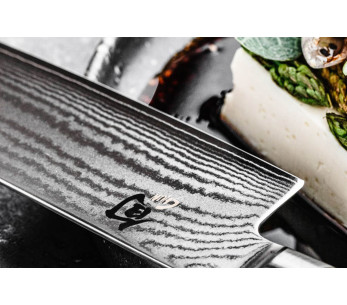
As you can see, the higher the steel hardness, the harder the blade, but the more brittle the edge. However, the edge is much sharper and more precise than on a knife with a low HRC hardness. This means less frequent sharpening. With lower hardness, it's impossible to get a razor-sharp edge. So you'll need to sharpen your knife often, but you won't get a very fine edge. Some sharpening guns are not suitable for knives with high hardness, so you'll have to opt for sharpening stones. Your choice of sharpening stone will depend on your blade and how you use your knife: here's a summary to help you make your choice. Knives with damascened blades have high hardness and are not as brittle as plain steel. Why is that? Quite simply because their blades are made of a mixture of hard and soft steel, in several layers, which generates a relative flexibility.
Thank you for reading this far! Find all ourblade care productshere!



Dick pouches
Knife set of 3 DICK SUPERIOR chef + universal + paring professional kitchen knives
Shipped within 10 days


Toshihiro Wakui
16,5cm Toshihiro Wakui Aogami 2 damask laminated santoku knife, japanese handmade
Out of stock


