
Your cart
There are no more items in your cart
How to use a chef' s knife For which foods?
Chef's knife features 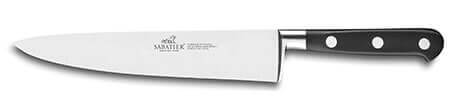
The chef's knife is one of the most widely used knives in the kitchen, whether you're an amateur or a professional chef. Indeed, if you don't have the range of knives available to a professional chef, its versatility means you can accomplish many tasks with just one kitchen utensil. It's basically a paring knife, only bigger. If you had to have only one knife, this would be it.
The blade of a chef's knife is thick and rigid. Its length is between 15 and 36 cm, with a height of 4 to 5 cm. Professionals generally opt for the middle ground, choosing 20 cm blades. The blade is slightly rounded to enable you to slice your food with a rocking motion. Finally, the blade ends in a pointed tip.
The handle of a chef's knife can be made of wood, plastic or metal. Whatever the material, the handle must be watertight to prevent the growth of bacteria, and provide a comfortable, practical grip.
The chef's knife should not be confused with its Japanese cousin: the Santoku knife. The latter, very popular for its maneuverability, has a flat blade, making it impossible to cut with a rocking motion.
How to use a chef's knife
If you had to have just one knife in your kitchen, it would definitely be the chef's knife! There is a wide range of chef's knives, with or without guard, measuring from 12 (a little small...) to 36 cm (a little too big...). A chef's knife with a 20 cm blade is ideal, and is the size preferred by all professionals.
Note: If you're not comfortable with a 20 cm blade, we recommend a 16 cm chef's knife, which is a very common size for many brands.
You can hold your chef's knife in many different ways, but you need to be comfortable with it, while respecting the various safety rules. Here's how chefs hold their chef's knife, to combine grip, speed and safety:
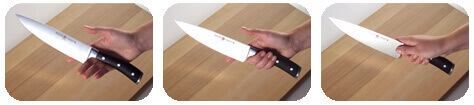
Left: Place 3 fingers around the handle. The bolster of the knife is close to the base of your index finger.
Middle: Place your thumb and forefinger on either side of the blade, close to the bolster. Fold in your index finger.
Right: You should feel comfortable with your knife, with your fingers away from the edge. Only three fingers are folded around the handle, the index and middle fingers gripping the base of the blade.
This position allows you to cut food quickly and precisely, while keeping your fingers away from the cutting edge.


How to cut or chisel with a chef's knife?
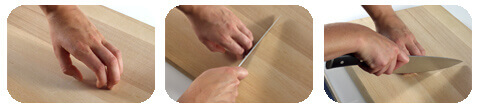
The best technique for cutting with a chef ' s knife is to keep the tip of the blade (part 2 in the diagram at the top of the page) on the cutting board throughout the cutting operation.
Place the food towards the rear (4) of the blade.
Hold the food with your free hand, fingers folded over. Your fingernails are in contact with the food and the cutting board. This technique avoids cutting your fingertips, as they are protected by your phalanges.
The joints of your fingers brush against the blade and guide it.
Next, rock the blade up and down, so that the middle part (1) and then the rear part (4) come into contact with the cutting board one after the other. This should not be a "chopping" motion, but a fluid movement in which the tip of the blade moves slightly forward on the cutting board.
Start slowly, and you'll pick up the pace with experience.
The various uses of a chef's knife 
A multi-purpose knife par excellence, the chef's knife is the one that enables you to perform the most diverse tasks in the kitchen.
The front of the blade, i.e. the part close to the tip, enables you to make small precision cuts. Ideal for :
- Slicing vegetables, such as carrots, onions, peppers, etc.
- Chopping herbs such as parsley, chives, etc.
The central part of the blade of a chef's knife is suitable for both soft and hard foods. It should be used for :
- Cutting vegetables into julienne strips, cubes, etc.
- Cutting a slice of pâté cleanly
The rear part of the blade, closest to the handle, is where the most pressure is exerted. It is therefore ideal for :
- Chopping meat and fish, after removing bones and flaps
- Cutting even the toughest vegetables
You can use the back of the blade to :
- Break small poultry bones
- Break the shells of shellfish
Finally, with the flat of the chef's knife blade, you can :
- Crush a clove of garlic
- Lift food to be sliced
Like any knife, a chef's knife needs to be sharpened to maintain its cutting edge. To achieve this, you can sharpen it regularly with a whetstone or a sharpening gun. In addition, always use a cutting board to preserve the edge of the blade for longer.


