
Your cart
There are no more items in your cart
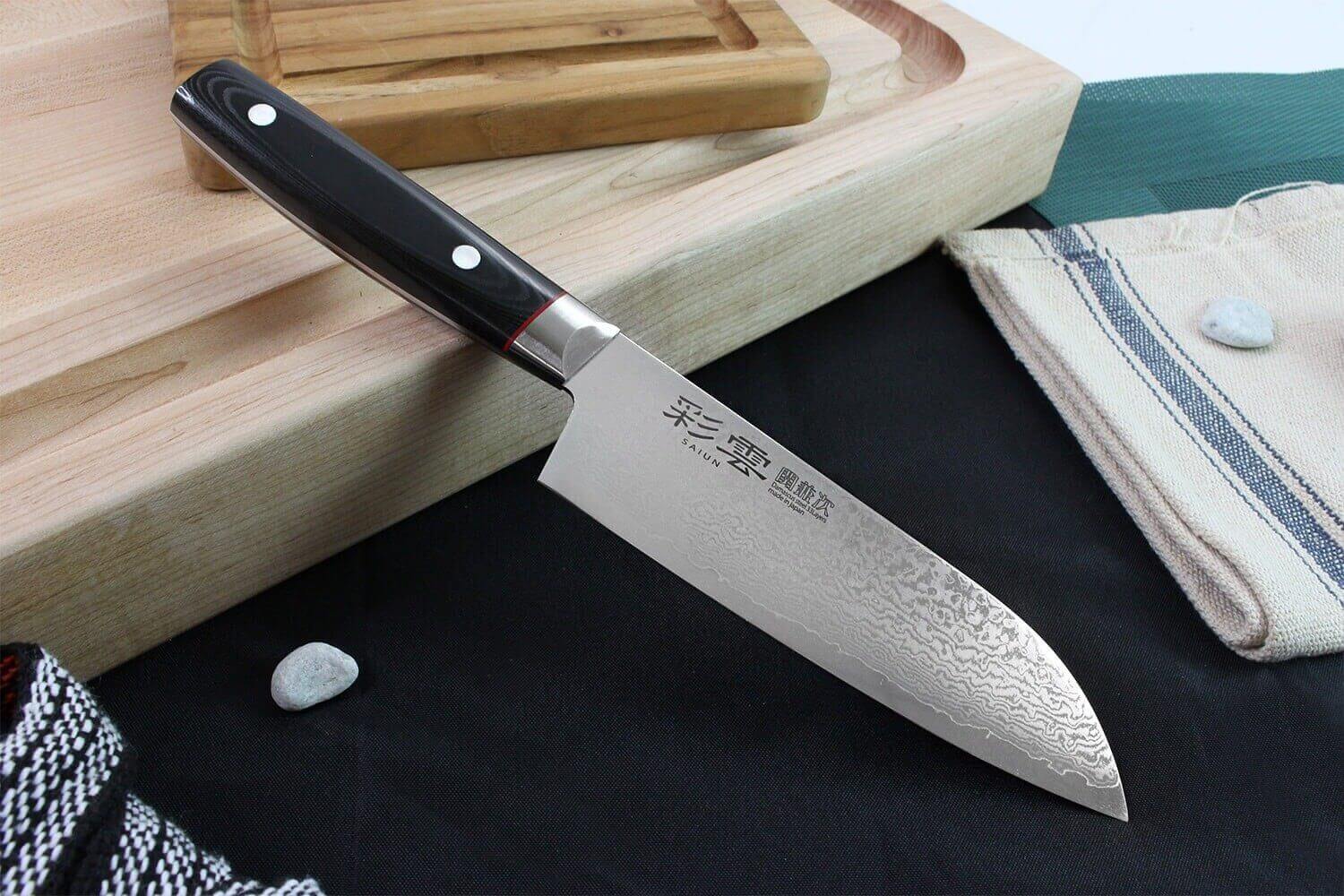
The Kanetsugu Saiun 17cm santoku knife is the ultimate all-rounder. The Japanese equivalent of the Western chef knife, it can be used for precision chopping, chiseling, slicing and mincing. Its intermediate length offers an excellent balance between maneuverability and cutting surface, making it just as effective for vegetables as for boneless meat or fish.
This model is the perfect embodiment of the Saiun philosophy, which means "the delicate ray of light piercing the clouds", a direct reference to its rippling damask and luminous aesthetic.


A 65-layer damascus blade with a VG10 core
The blade adopts a multi-layer damascus construction. It features a central core in Japanese VG10 steel, surrounded by 32 alternating layers of softer stainless steels on each side. In all, the blade has 65 layers, i.e. 32 folded layers on each side, plus the core.
VG10 is a high-performance stainless steel containing around 1% carbon. This high carbon content enables a hardness of between 60 and 61 HRC on the Rockwell scale. This hardness guarantees excellent edge retention over time, a fine, precise edge, and the possibility of sharpening to a narrower angle to obtain a razor-sharp finish.
VG10 also contains chromium, molybdenum and vanadium. Chromium improves corrosion resistance, molybdenum enhances the overall strength of the alloy and vanadium refines the carbide structure, contributing to a longer-lasting, more stable cutting edge.
The softer outer layers protect the hard core while providing slight damping in the face of mechanical stress. This structure results in a blade that is rigid but less susceptible to micro-chipping than a very hard monobloc blade. Visually, damascus creates unique irregular waves on each knife. The words "33 layers" engraved on the blade correspond to the 32 layers visible on one side plus the central core.
Sub-Zero heat treatment and precision cutting
The blade benefits from Sub-Zero heat treatment. After conventional quenching, the steel is subjected to a rapid descent to around -70°C. This process optimizes the transformation of residual austenite, improves the steel's structural stability and increases wire rigidity.
The result is a finer, more homogeneous internal structure, favoring precise sharpening and longer edge life. The result is fluid penetration of the food, limiting crushing of flesh and preserving its texture.
A durable, technical micarta handle
The handle is made of micarta, a composite material composed of around 60% flax fibres and 40% resin. Compressed under high pressure, it offers excellent dimensional stability, high resistance to humidity and tolerance to temperature variations.
Micarta is particularly appreciated in professional environments for its robustness and reliability. The full tang blade runs the full length of the handle, guaranteeing strength and balance. Two rivets reinforce the attachment.
The bolster is directly integrated into the blade, with no open junction, limiting any infiltration of water or food residues. This design enhances the knife's durability and overall hygiene. Ergonomics have been designed for prolonged use, with a stable grip, a balanced center of gravity and an immediate feeling of control.
Japanese manufacturing in Seki
Kanetsugu manufactures its knives in Seki, a Japanese town historically renowned for sword forging and cutlery. Founded in 1918 by Matsujiro Kawamura, descendant of a sword smith, the brand perpetuates a know-how combining traditional techniques and modern processes.
The Saiun series illustrates this continuity between heritage and innovation, with high standards of heat treatment, machining precision and finish.
Care and maintenance
Although the blade is stainless, careful care is recommended. Wash the knife by hand with a soft sponge and a mild detergent. Dry immediately after washing and store in a dry place. Avoid the dishwasher and prolonged soaking.
When sharpening, use a stone suitable for hard steels to preserve wire quality and maintain cutting performance over time.


