Find out more about the Baba family of blacksmiths
Kagekiyo Japanese knives are made by the Baba family, who founded their cutlery business almost 100 years ago. Today, the workshop is run by the third generation of the family, thanks to previous generations who have passed on their know-how. Baba Ichiji, one of the family members, was even awarded a medal by the Emperor: theOrder of the Rising Sun. This medal rewards his active participation in the cutlery industry. He was also awarded the Yellow Ribbon Medal, which distinguishes people who persevere in their field and become role models for others. The brand's expertise is evident today!
The knives are named Kagekiyo by the Baba family in homage to Akushichibe"Fujiwara" Kagekiyo, who lived during the Heian era, around the 10th century.
These knives are therefore excellent representatives of Japan. By blending ancestral tradition with the latest technology, they are suitable for all cooks. They are in keeping with the principle of Monozukuri, a Japanese concept referring to the art of making things with passion and in the best possible way. Also following the principles of Kaizen, they tend to lead towards constant improvement of the things we make or of ourselves. To this end, the Baba family uses electron microscopes to study the molecular structure of steel and improve every facet of it.
Here, the Baba family has called on young blacksmith Satoshi Nakagawa san to craft the knives in the range. Although young, he is known for his high-quality knives and excellent craftsmanship. When he was 18, he became a student of master blacksmith Kenichi Shiraki san for over 15 years. Today, he has his own production workshop. Having quickly assimilated the techniques taught during his apprenticeship, he now not only knows how to forge traditional carbon knives, but also how to use the Suminagashi and Honyaki techniques! Finally, he also knows how to forge stainless steel knives such as Ginsan or VG10. His know-how is very varied!
A top-quality santoku knife
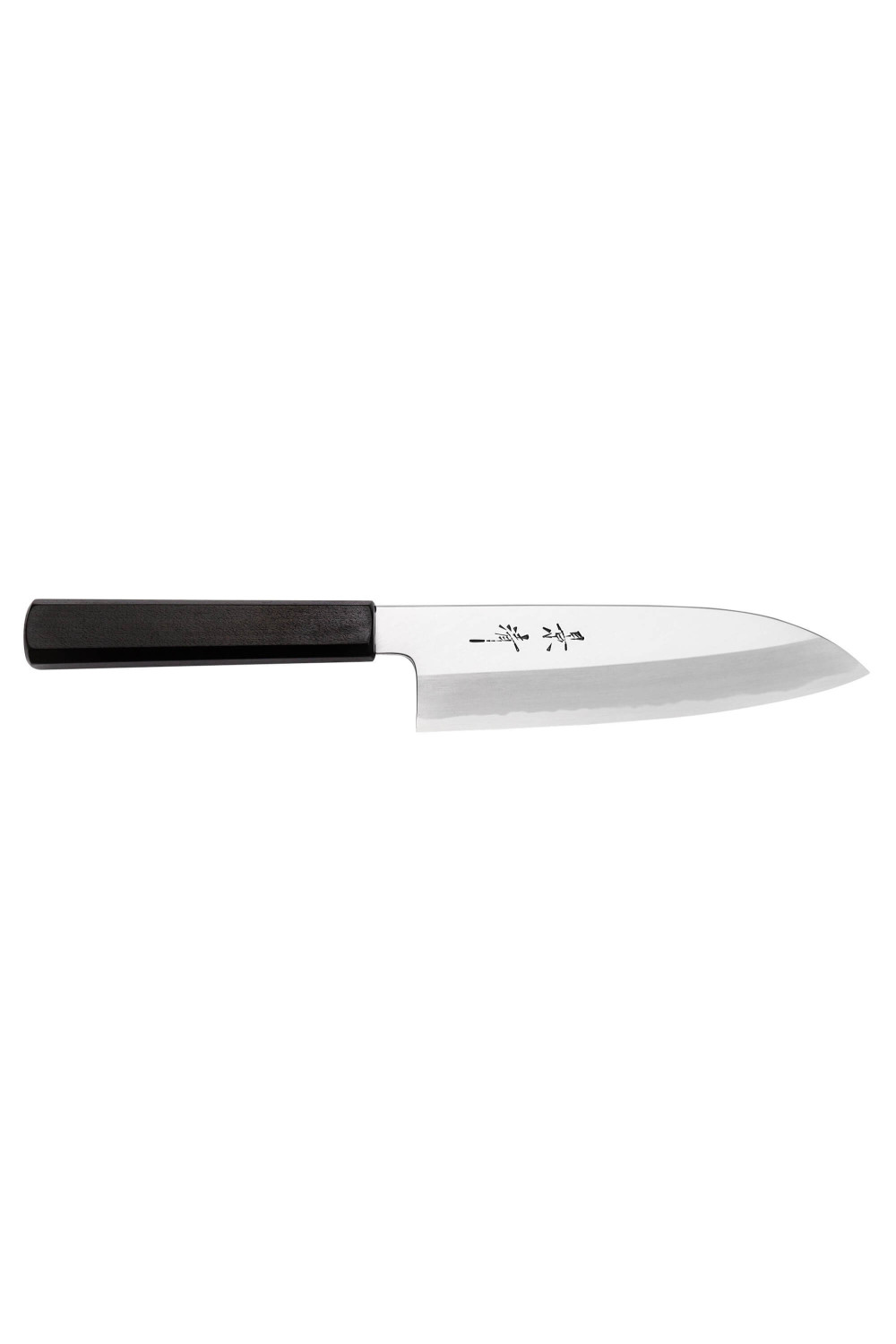
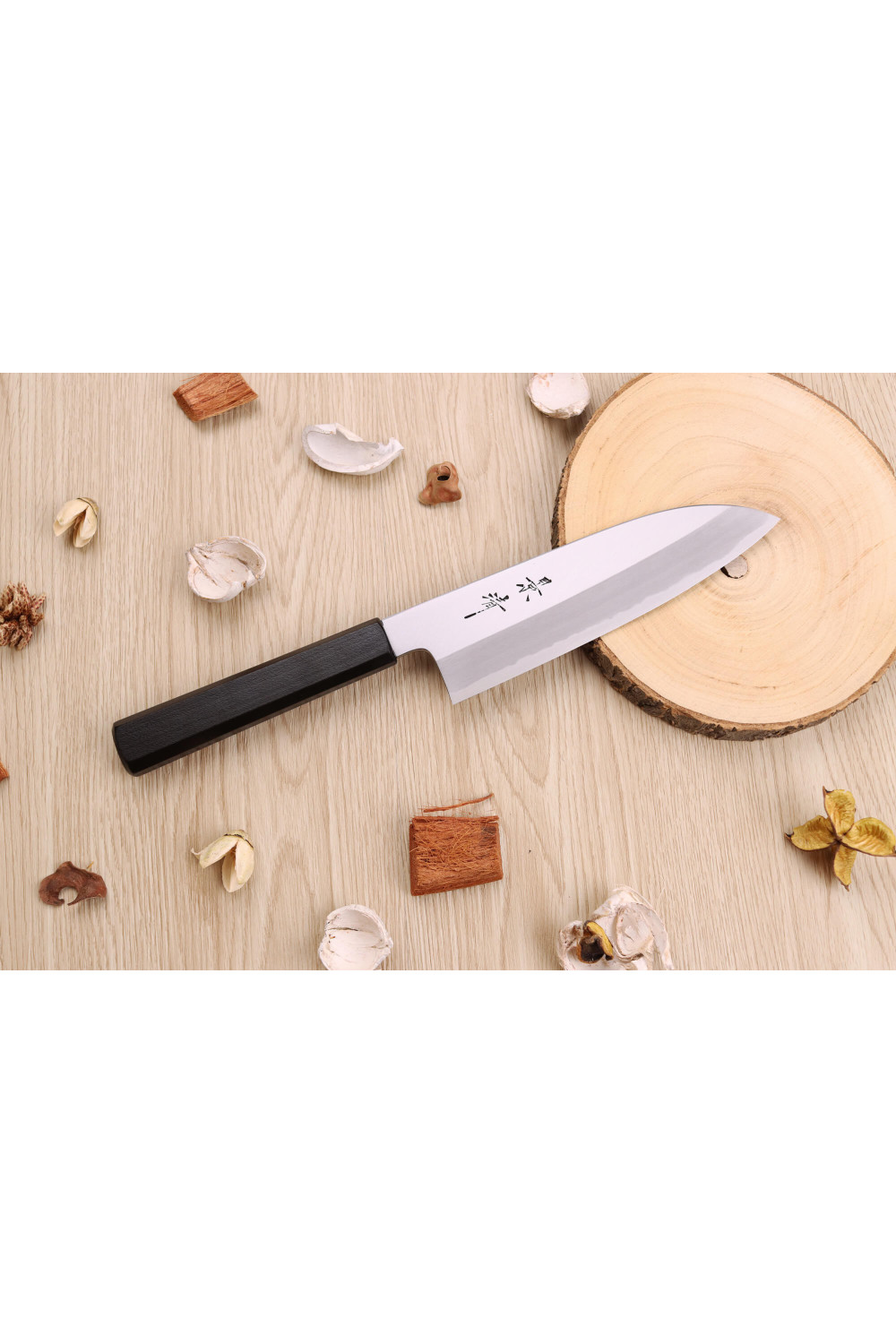
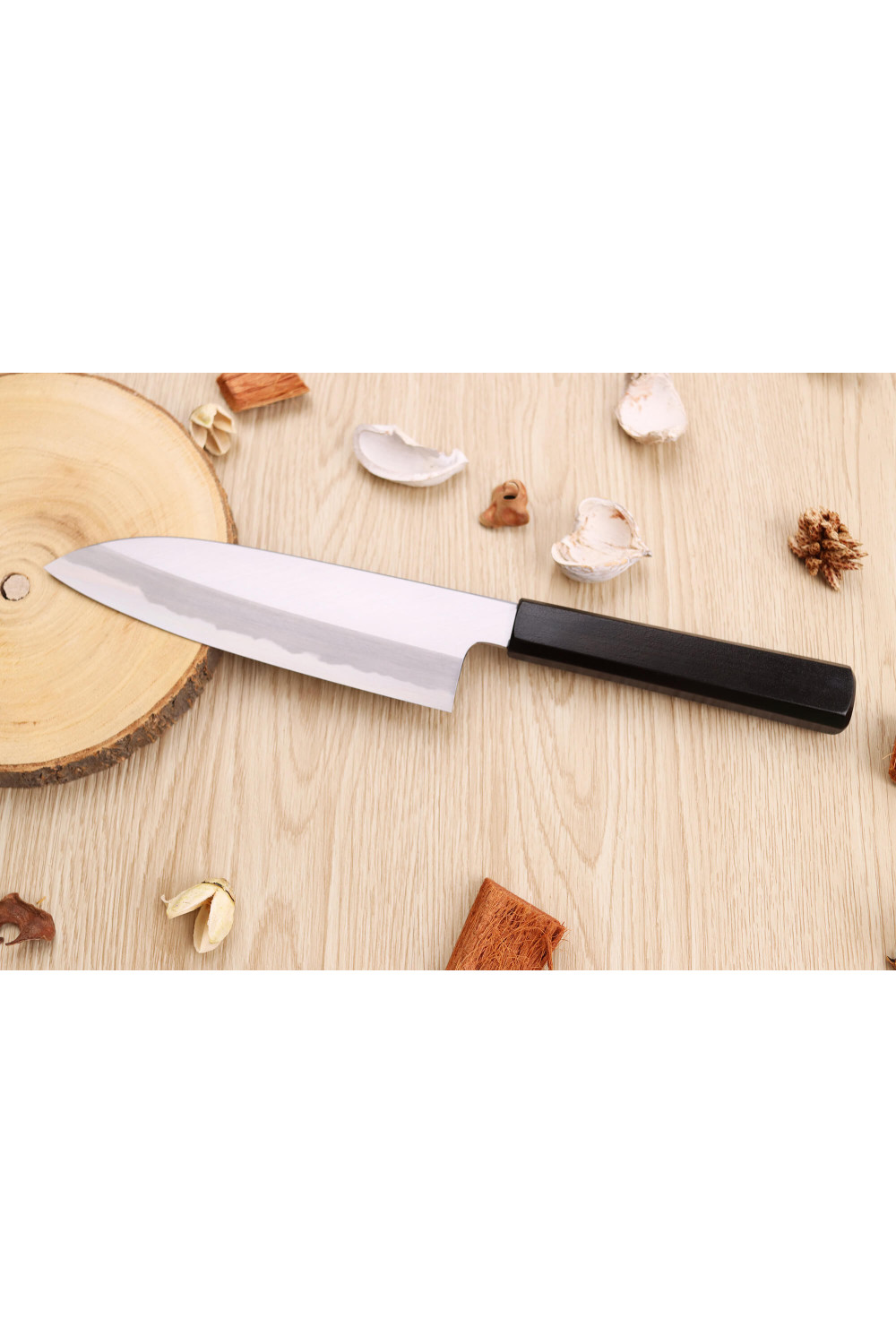
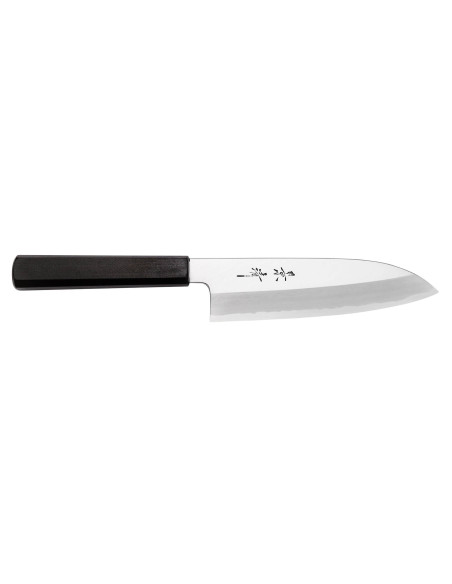
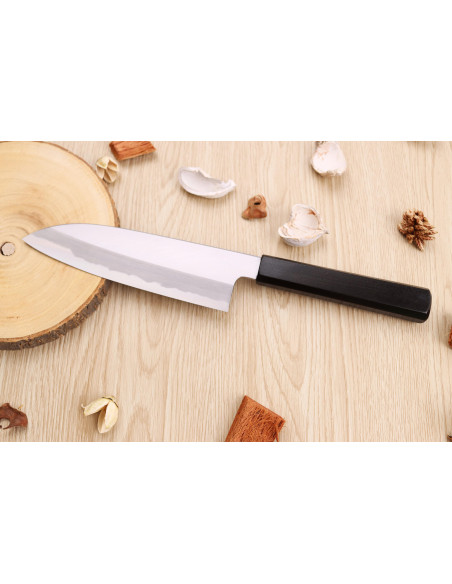
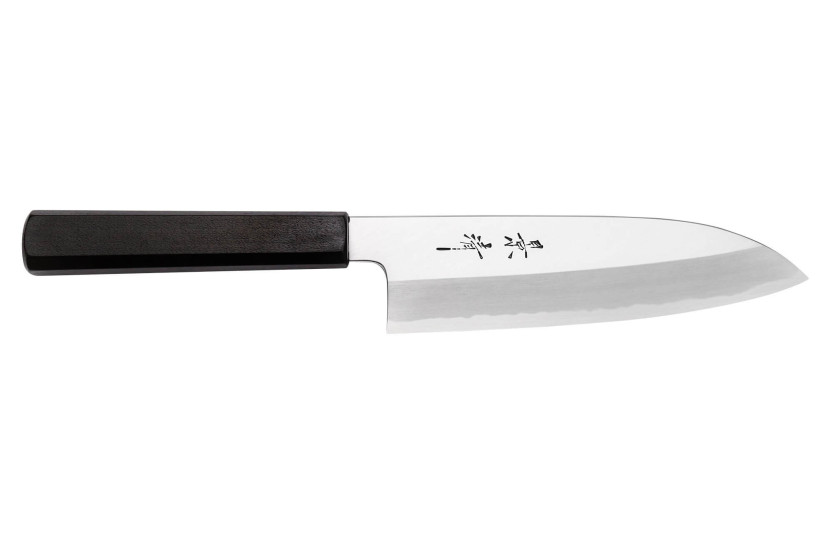
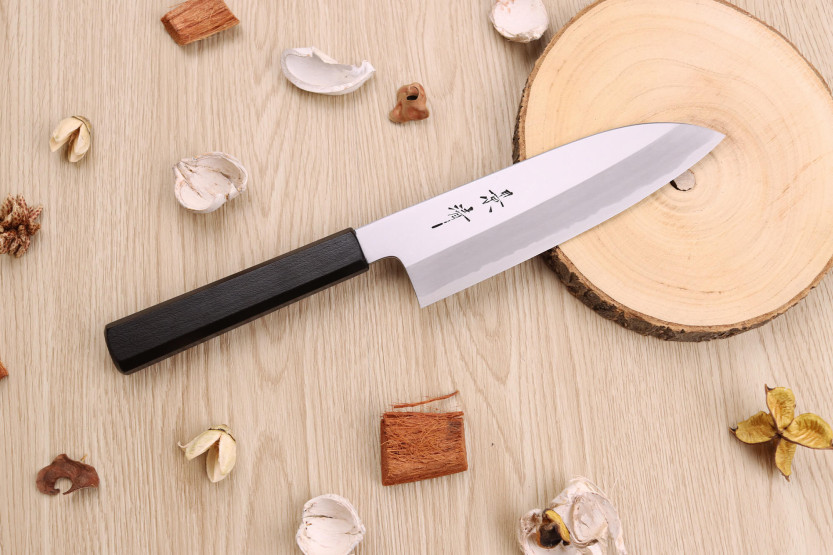
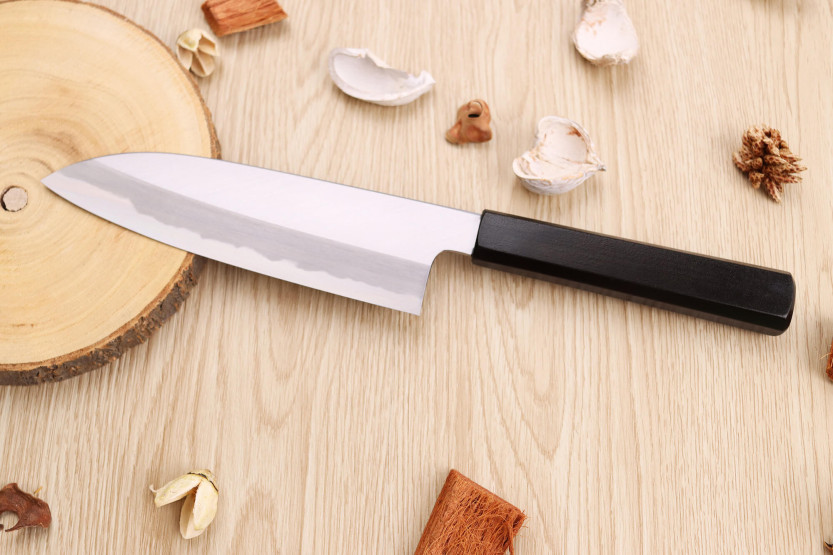
This 18cm Kagekiyo Suri Urushi santoku is a truly versatile knife. It can be used to cut many different types of food. You can slice vegetables, dice meat or chop fresh herbs. Its slightly curved blade creates a rocking motion that's pleasant to use.
The knife's blade has a San Maï structure: it is built with a rigid core which is then surrounded by a softer alloy sandwiching it. It features 3 distinct layers. This typically Japanese construction can be found on many knives.
Here, the blade's core is made of Yasuki White Steel 2, an extremely fine Japanese steel developed by the famous steelmaker Hitachi.
A knife made from Yasuki steel is highly appreciated by cooks with traditional values, as it is produced directly there, and only the best blacksmiths work it. Yasuki is one of the purest steels on the market. It is mainly enriched with carbon (between 1 and 2%) and iron ore. These two elements increase the alloy's hardness, giving the blade a hardness of 61 HRC. As a result, this highly rigid blade withstands extensive sharpening, while possessing a marked, long-lasting cutting edge. However, despite its high rigidity, the alloy remains easy to sharpen, especially on a Sharpening stone.
Steel's purity is another of its strong points. In fact, its structure at microscopic level is very homogeneous, and it is therefore more resistant (the risk of chipping during use is reduced).
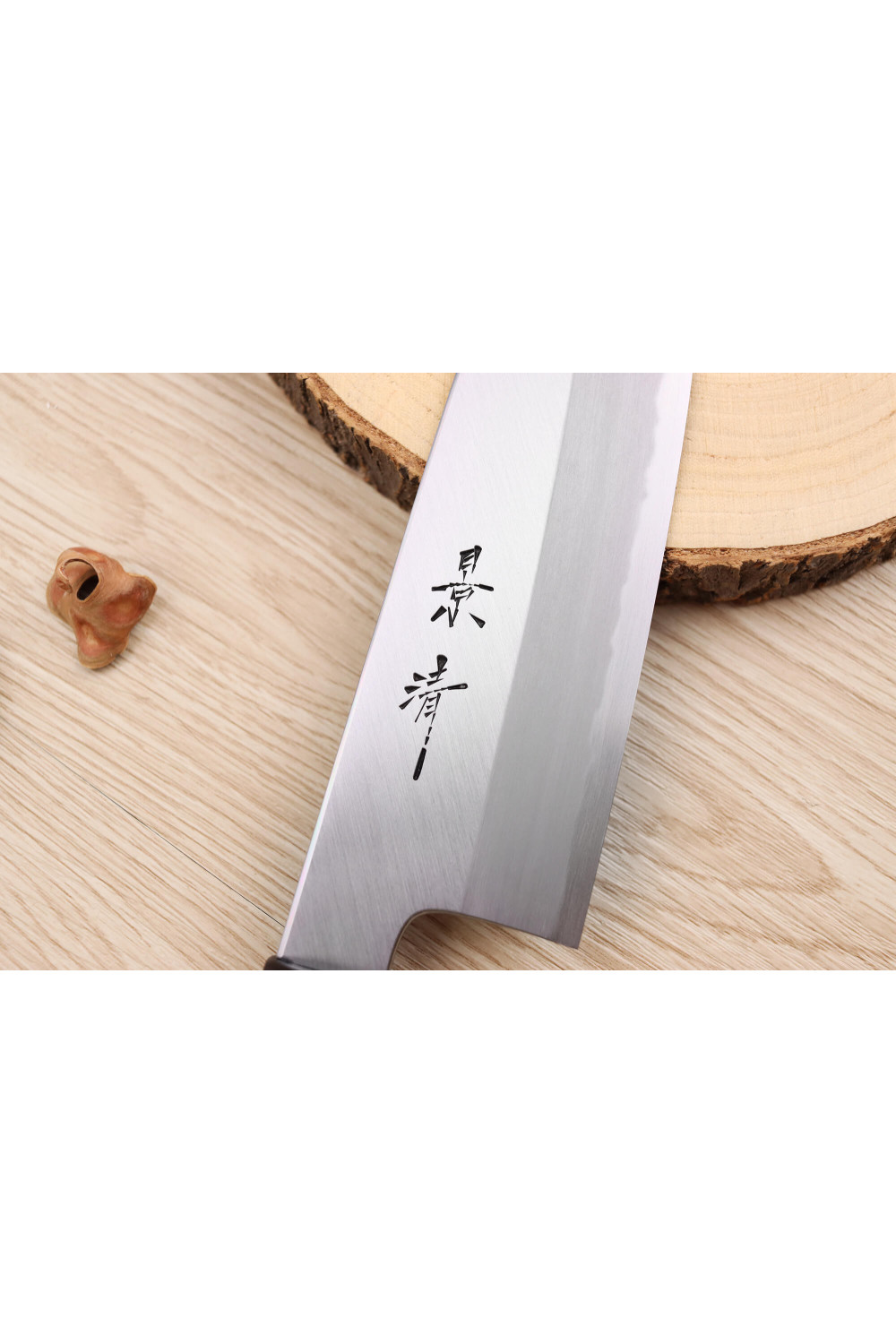
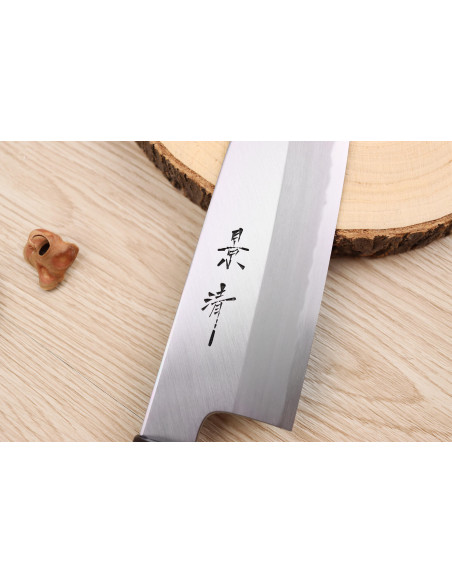
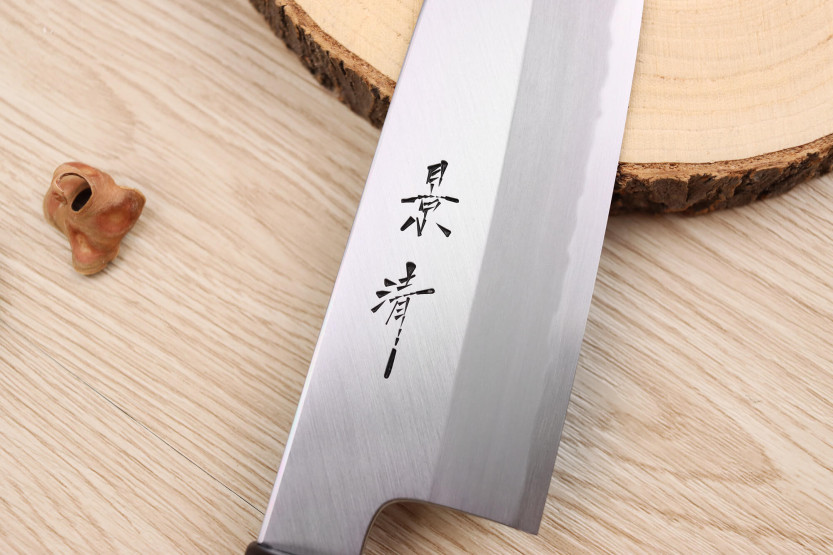
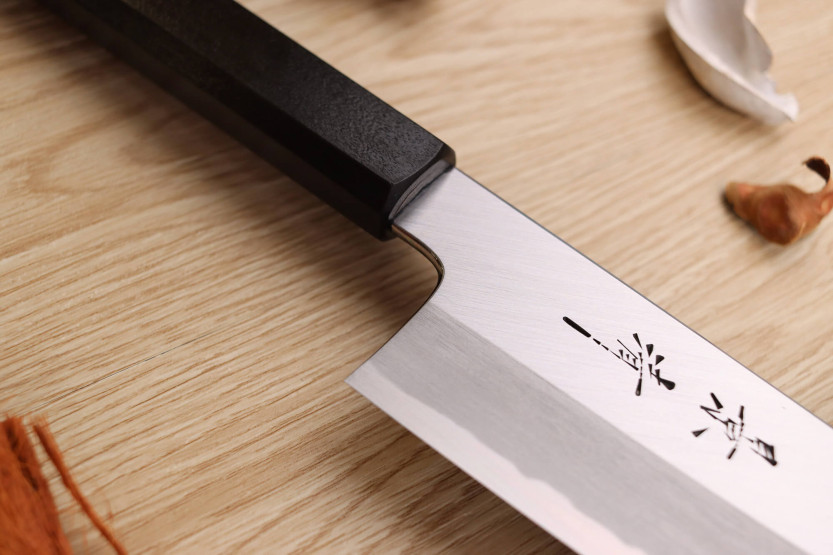
This high-quality core is then surrounded by a layer of softer iron that sandwiches it. You can see the difference between the steels at the cutting edge of the blade, with their nuanced hues.
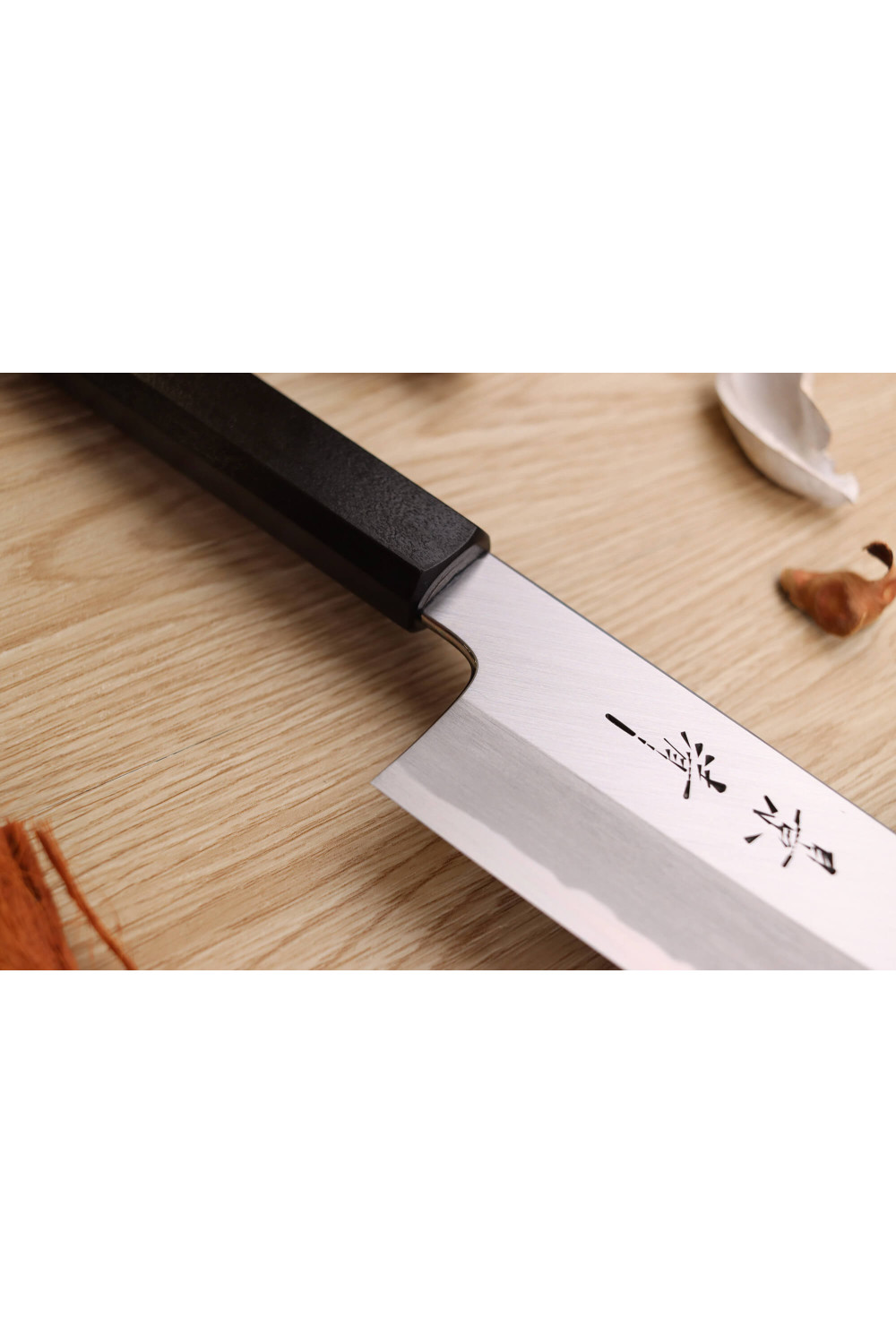
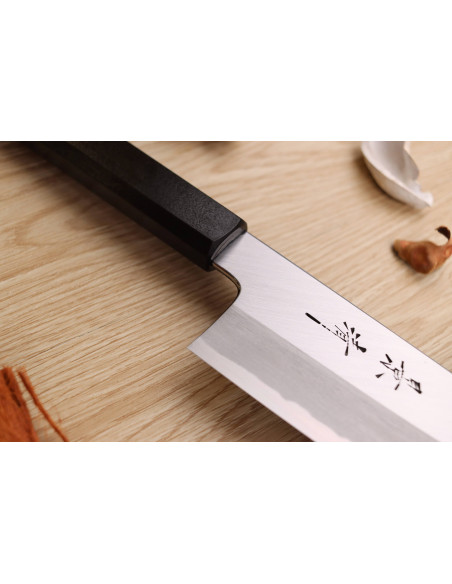
The top edge and the surface at the base of the blade have been polished to make them more pleasant to the touch. Some cooks take their knife very high up on the handle, and even rest their index finger on the back of the blade when cutting. Polished edges are more comfortable.
The brand logo has been applied to the cutting surface. The cutting surface also benefits from a traditional finish obtained using a sharpening technique in which stones of different grit are used. This technique brings out a wave on the steel, which appears more polished than the rest of the blade.
The knife's handle is made from magnolia, a robust wood widely used in Japanese cutlery. With its octagonal shape, it is very comfortable to hold and suitable for both left- and right-handed users. The magnolia has been lacquered in the traditional way by an expert craftsman from Nagano prefecture. The wood turns completely black and a deep color envelops it completely.
Caring for my carbon knife
As the blade is highly concentrated in carbon and surrounded by iron, it is more susceptible to corrosion. This knife must be maintained by hand. To do this, you can run it under lukewarm water using a non-abrasive sponge and mild soap. Then wipe immediately and carefully with a soft cloth to remove all traces of moisture from the blade and handle. Do not run the handle under water.
Please note that despite the utmost care, the blade can still become dull over time, as its alloy is highly reactive. To protect it and ensure its longevity, you can apply a little oil from time to time.
In fact, when you receive the knife, its blade is coated with protective oil: to remove it, simply wipe with a cloth soaked in vegetable oil and wash the blade as usual.
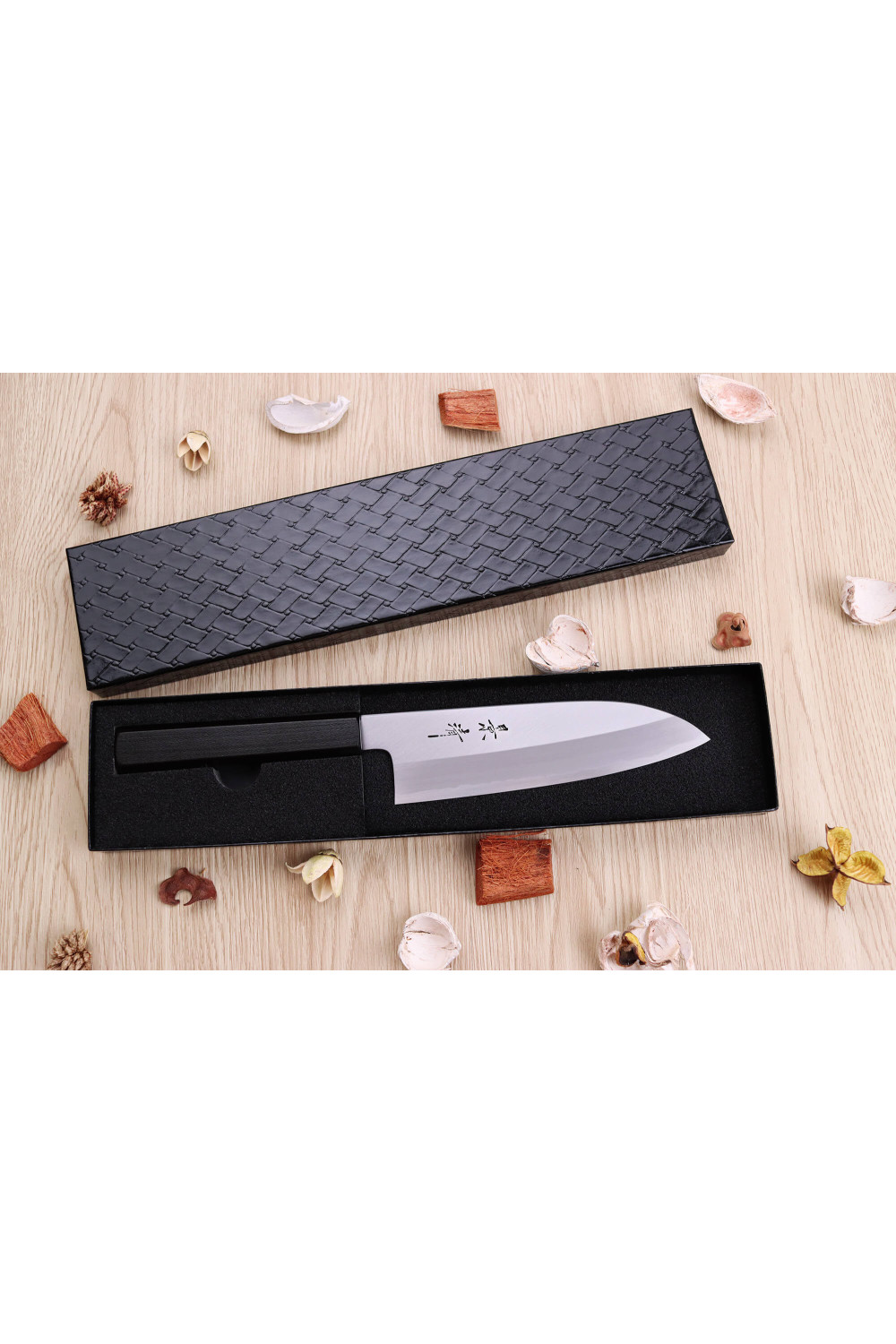
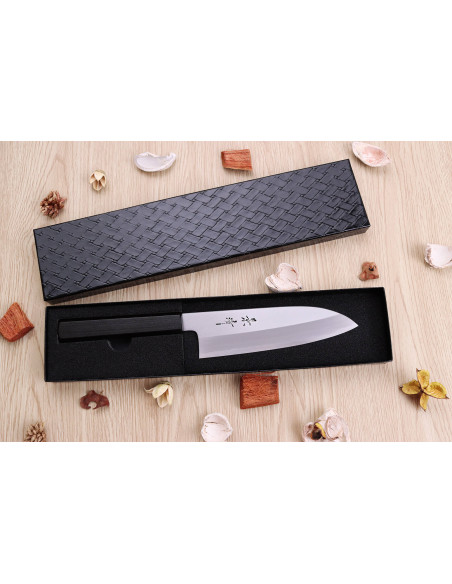
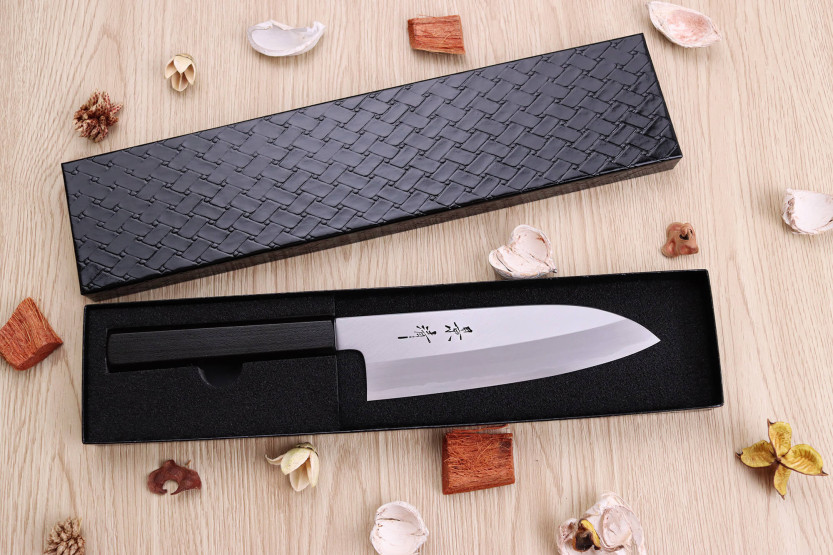
The knife comes in a glossy black cardboard box.
Click here to see all Kagekiyo Suri Urushi knives!




 By buying this product you can collect up to