A Japanese damascus knife with an efficient blade
This santoku knife features a 17cm blade with a damascus structure. Damascus is a technique that involves forging a core of hard steel, then surrounding it with several layers of softer steel, to create an optimal balance. These outer layers also provide additional protection for the blade core.
The blade core is made from Japanese SG2 steel, a powder-metallurgy alloy produced by the renowned Takefu Special Steel. Containing nearly 1.3% carbon, this crucial element reinforces the alloy's hardness, giving it excellent edge retention. With a hardness of 63 HRC on the Rockwell scale, this blade guarantees exceptional cutting performance and long wire life, reducing the need for frequent sharpening of your santoku.
SG2 steel also contains around 15% chromium, making it more resistant to corrosion. However, the blade of this santoku remains sensitive to oxidation and requires careful maintenance. At the microscopic level, SG2 steel is characterized by a "pure" structure, with evenly distributed micro-carbides, guaranteeing excellent balance.
This SG2 steel core is then surrounded by several alternating layers of soft and hard steels, forming the damascus. The superimposition of steels creates a unique pattern on the blade surface, specific to each knife. This process ensures both protection and balance at the heart of the blade.
Delicate kanji have been engraved on the hand-sharpened blade by Kei Kobayashi, adding a touch of elegance and authenticity to the knife. The blade also features a full flat grind: this polishing from the edge to the back of the blade ensures a blade with enhanced strength and a beautiful appearance.
Ergonomic Pakkawood handle
The knife has a heptagonal handle, an original shape that has the advantage of adapting perfectly to the palm of your hand. It ensures optimum comfort and maneuverability, even for prolonged cutting, and is suitable for both right- and left-handed users.
This hand-forged Damascus knife features a handle made of Pakkawood, an antibacterial composite material made from laminated wood and resin compressed under heat, giving the handle strength and durability. Highly appreciated in professional kitchens, it offers excellent resistance to shock and heat. Finished in a superb shade of red, the pakka wood is varnished to protect it and add a touch of elegance, while contrasting harmoniously with the damask blade.
How to care for this Japanese damask knife
It's essential to wash your knife exclusively by hand with a non-abrasive sponge and mild soap, without wetting the handle. After cleaning, dry it immediately and store it in a dry place to avoid any trace of moisture. Do not soak it in the sink or put it in the dishwasher.
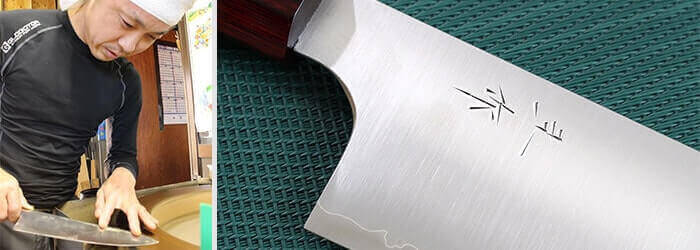
Discover the work of Kei Kobayashi
Kei Kobayashi is a young blacksmith based in Seki, Japan. He started out as a meticulous sharpener, working alongside numerous artisan blacksmiths. Inspired by their expertise, he set out to create his own knives. With the help of his father, he opened his workshop in the 2000s.
Kobayashi is known for his mastery of traditional forging techniques, such as San Mai and Damascus. He works mainly with Japanese SG2 steel, a high-grade powder steel that he masters perfectly. After each knife has been forged, Kei Kobayashi uses his expertise as a master sharpener to ensure that all his blades are exceptionally sharp.
Kei Kobayashi Heptagone knives are on Knifeleader.eu!





 By buying this product you can collect up to


