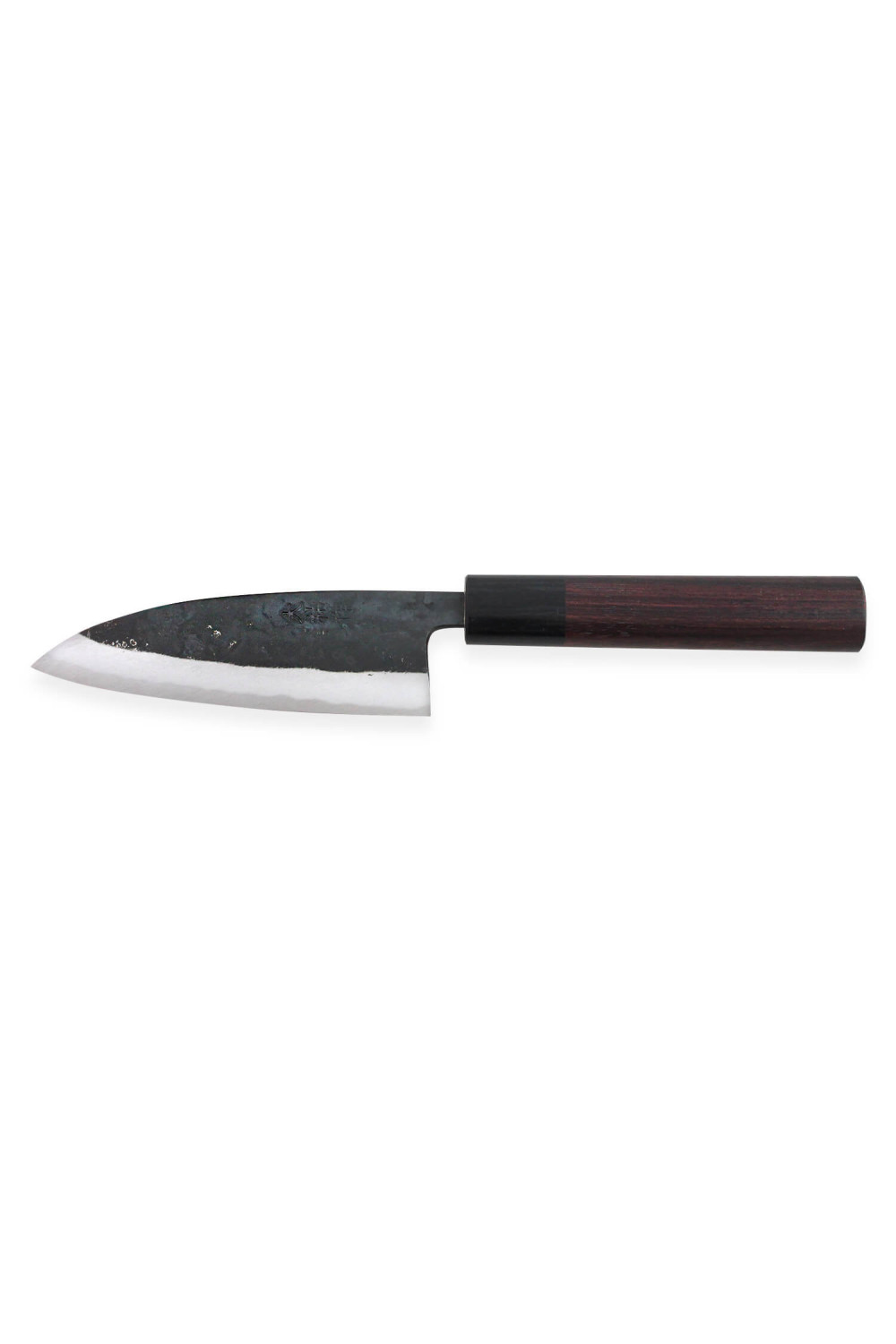
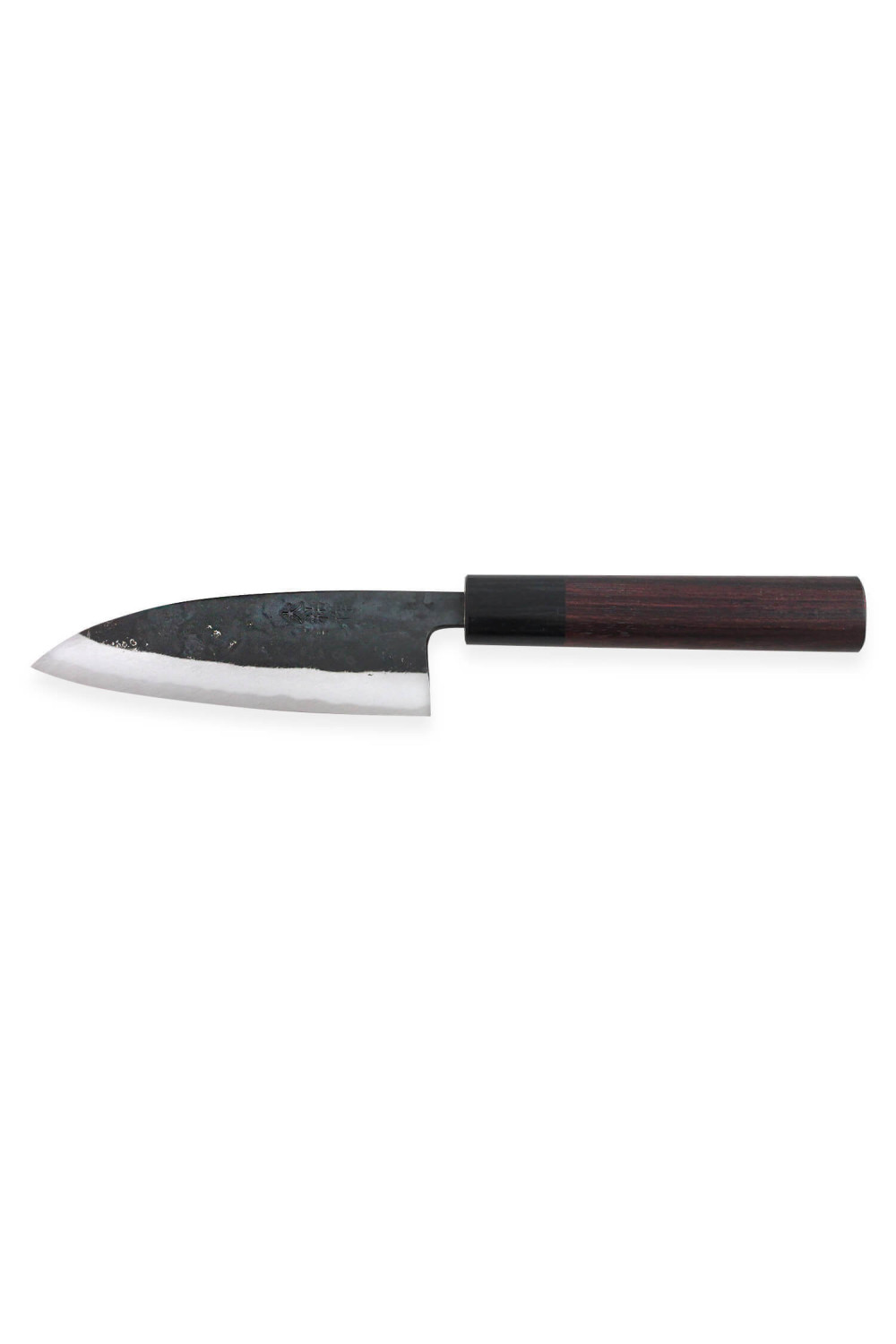
Nishida san is a young blacksmith who has been working in the cutlery industry for over ten years. He lives and works in Kumamoto, a Japanese city in the west of the island of Kyūshū. He thinks and creates his knives with great care, to give them impeccable finishes. The knives he puts at your disposal are both ergonomic and high-performance: work with pleasure every time you're in the kitchen!
The Ko Bocho knife is a Japanese model that could be described as hybrid. It combines the shape of a utility knife and a santoku knife, making it versatile. Its small size makes it easy to handle, and a pleasure to use for precision cutting.
The knife in detail:
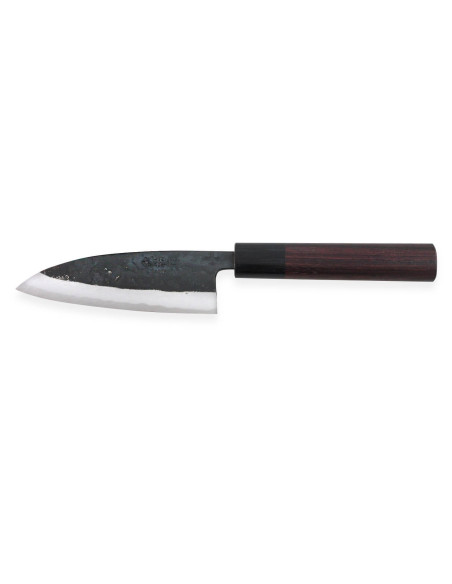
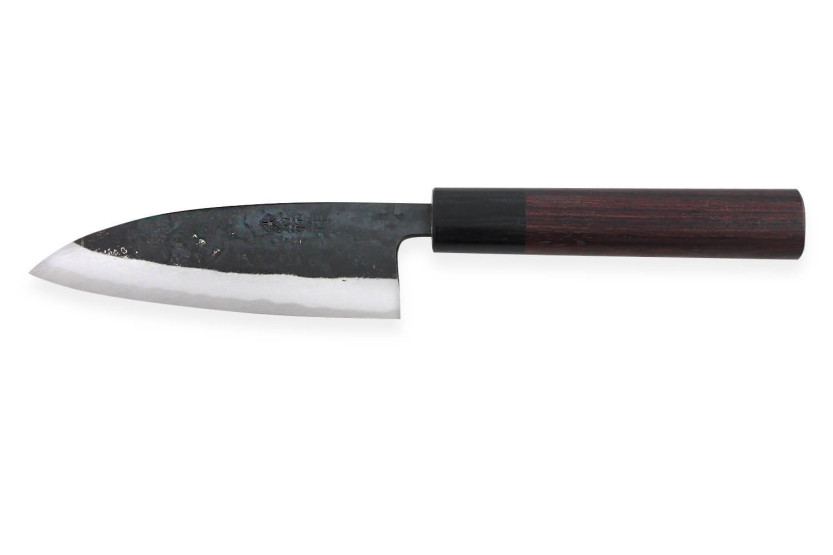
This Ko Bocho Nishida Shirogami 11cm knife has a typically Japanese structure. Its blade is called San Maï, which means "3 layers" in Japanese. This type of blade construction can be found in many ranges of all brands.
In the center is a core made of White Steel #1 (also known as Shirogami 1), a Japanese steel produced by Hitachi steelworks (a major steel producer in Japan). Cooks with traditional values love this alloy, since it is produced directly there and is worked by the best blacksmiths. Blacksmiths also like to work it because it's easy to handle and shape. In fact, this alloy is Nishida san's favorite.
It is said to be a "pure" alloy, enriched in particular with iron ore and carbon (at around 1.2%). These two elements increase the blade's rigidity (to around 61 HRC), and a stiffer blade can be sharpened more thoroughly. The result is a sharp edge from the very first cut, and one that lasts, thanks to the steel's high retention capacity.
And despite its high hardness, this alloy is easy to sharpen! You can maintain it with a whetstone when you feel it's losing some of its sharpness. Its purity also has another advantage: at the microscopic level, its structure is very homogeneous, making it more resistant (for example, there's less risk of chipping during use).
The Shirogami is then wrapped in a layer of soft iron. This protects it, while at the same time giving it a slight suppleness, making it less prone to breakage. Indeed, it's important to understand that a rigid knife is more prone to breakage, as its wire is so rigid that a small shock can cause it to shatter. Having a "softer" outer layer will balance out this marked rigidity, making the piece more resistant.
This knife has a rough forged blade, as opposed to a polished blade with a standard "steel" appearance. As a result, it is darker and looks rustic. It's a much-appreciated traditional finish: Japanese chefs love its authenticity. Finally, discreet kanji have been applied to the cutting surface, for even greater authenticity.
A black Pakkawood bolster links the blade to the handle. Pakkawood is a composite material with very interesting properties. Firstly, it is considered antibacterial. Secondly, it is resistant to temperature variations and humidity. The result is a material perfectly suited to the world of cooking.
The knife's handle is made of sandalwood, a beautiful dark wood that perfectly complements the rough forged blade. This light wood is pleasant in the hand, and has been polished for a soft feel. Its oval shape is suitable for all cooks, right- and left-handed alike. Wood paste fills the space between the blade and handle to prevent small scraps from entering.
The Nishida Shirogami knife is highly enriched with carbon and has an outer layer of soft iron. As a result, you must wash it by hand and dry it properly immediately afterwards. Do not put in the dishwasher or soak in the sink. Carbon is oxidizable, so the knife will be susceptible to corrosion, hence the importance of drying it thoroughly. Note, however, that the alloy remains highly reactive, and you may observe a difference in color over time. This is due to the acidity of the cut food and the humidity in the air - it's perfectly normal! Use mineral oil on the blade from time to time, as this will do it good and help protect it from corrosion.
Find out more about other Nishida Japanese knives!


 By buying this product you can collect up to