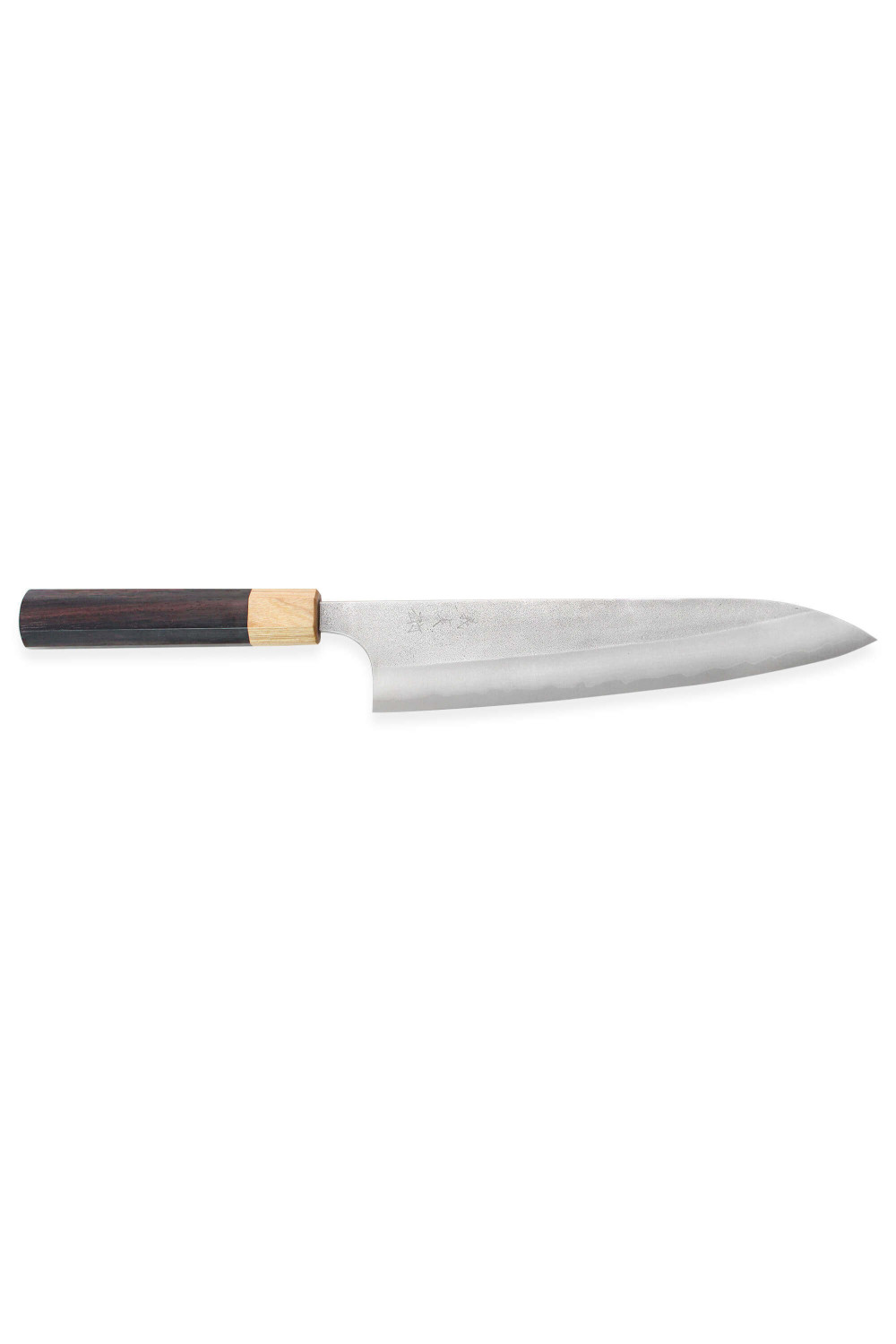
First of all, what is a chef knife used for? It's a very versatile knife, which can slice, chop, chisel...It can be used on fresh herbs, but also on fish and meat (without bones), vegetables...You'll quickly find a use for it! This is definitely the knife to go for if you're looking to upgrade and don't know which model to choose.
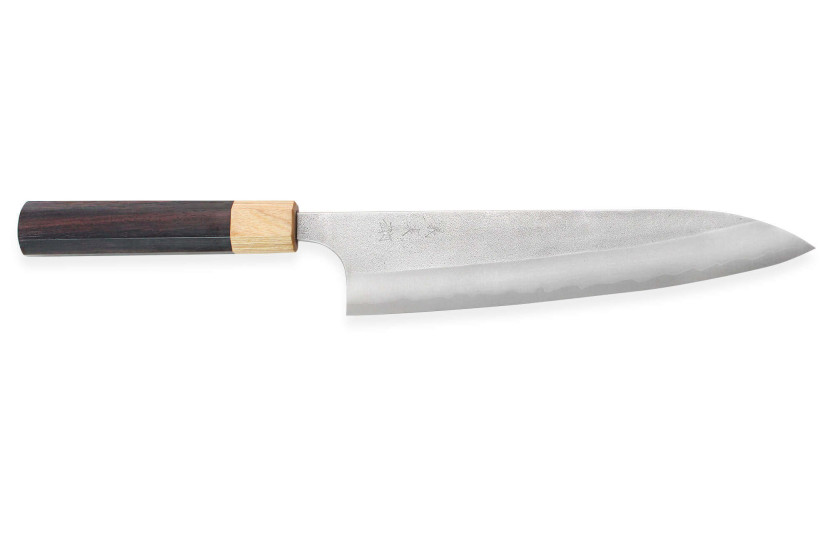
The blade of the Yoshimi Kat AS Nashiji chef's knife is made of 3 layers of steel. How does this work? It's a Japanese technique that aims to superimpose different alloys. There is always a rigid core surrounded by a layer of mild steel. This structure is called San Maï, which means 3 layers in Japanese.
To go into more detail, let's first talk about the knife's core. It's made from Japanese Blue Super Steel (also known as Aogami Super), an alloy produced by Hitachi steelworks. This top-of-the-range steel contains high levels of carbon, chromium and tungsten. For example, its carbon content rises to between 1.4% and 1.5%, which is quite high compared to the average of between 0.5% and 1% for Western and Japanese blades alike!
Blue Super Steel is characterized by its high rigidity of 64/65 HRC, a very high index. It is therefore rigid and can be carefully sharpened with a Sharpening stone to obtain tenfold cutting quality.
Rigidity also enhances edge retention! Indeed, the harder the steel, the less easily it will wear. It stays sharp for a long time. The need to sharpen is less frequent (for example, for a knife used by a private individual, you'd need to count on 2 to 3 sharpenings per year)! In addition, theAogami Super used for this range is highly prized by the Japanese for its ease of sharpening. In fact, despite its very sharp edge, it is easy to maintain.
A layer of softer stainless steel surrounds the core on each side (hence the 3 layers) to protect it from oxidation and make the cutting surface less brittle in use (it adds a little "suppleness" to the blade).
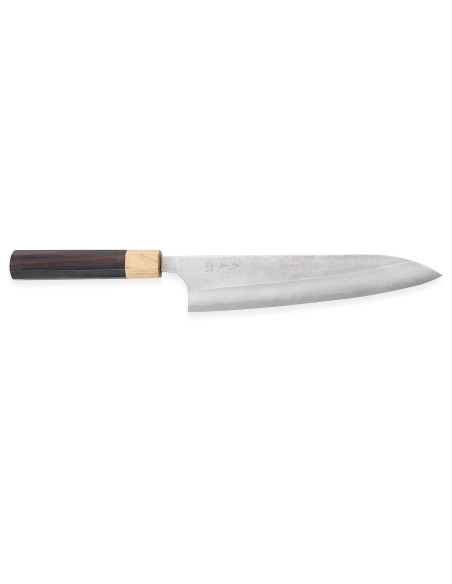
The blade is finished in the rough, also known as Nashiji, which gives it a rustic, characterful look. The blade is hand-sharpened to guarantee excellent cutting performance from the very first use. Kanji are engraved directly by the craftsman on the cutting surface.
Following on from the blade, the handle is made from sandalwood, a dark wood that is both robust and pleasant to work with. Its octagonal shape is pleasant in the hand, for better control of the knife. The white Pakka wood bolster forms the link between blade and handle. Pakkawood is an antibacterial composite material that resists moisture, and is widely used in cutlery. The handle is suitable for ambidextrous use!
The junction between blade and bolster is filled with wood pulp, making it watertight and preventing small pieces of waste and water from getting inside the handle, for enhanced hygiene.
How do I care for my knife?
It should be washed by hand, to maintain its appearance and efficiency over time. You can then wipe it with a soft cloth and store it in a dry place. It should not be left in contact with moisture for any length of time. Dishwashing, soaking in the sink or leaving to air-dry are all things to be forgotten (and this applies to all knives, even stainless ones!).
It's perfectly normal for steel to turn dark blue over time, despite good care. This is not a danger, as Aogami Super is a very reactive steel.
Find out more about the blacksmith!
The 21cm chef's knife (also called Gyuto) is made by Japanese blacksmith Yoshimi Kato san, a certified craftsman from the town of Takefu. Yoshimi san studied under several renowned blacksmiths, including Hiroshi Kato san, his father-in-law, who is highly respected in Japan. The latter is one of Japan's greatest master blacksmiths, and has been creating knives almost every day for almost 50 years! His level of expertise is colossal, and he was one of the founders of the TakefuKnife Village, which facilitates the work of the area's blacksmiths by enabling them to share their know-how, equipment and ideas, as well as becoming a highly sought-after area for apprentice blacksmiths.
(Hiroshi san on the left and Yoshimi san on the right)
Yoshimi Kato san is now also teaching his art to the next generation. He has taken over his father-in-law's workshop and continues to create the knives of his master, who has since retired, while creating his own line of knives. Each Yoshimi Kato knife is crafted in the Japanese tradition, using meticulous techniques and the finest finishing processes. These are unique pieces that will meet your needs, and they also make an ideal gift for a cook.
Yoshimi Kato san began his apprenticeship in 2013. He is an extremely talented blacksmith who learns very quickly. He continues Hiroshi Kato san's work, while bringing innovative ideas to the table!
To discover all Yoshimi Kato's Japanese knives, click here!




 By buying this product you can collect up to