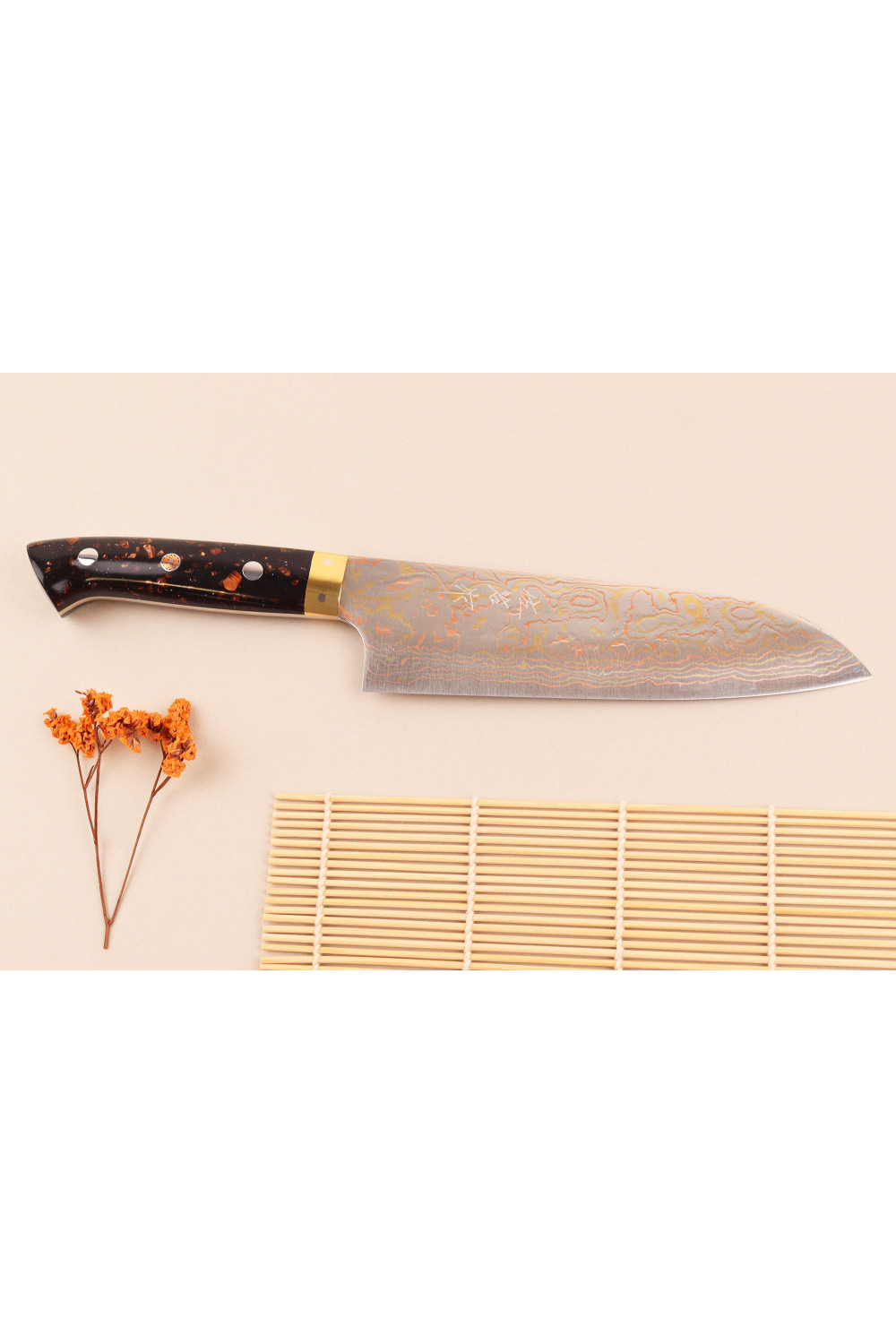
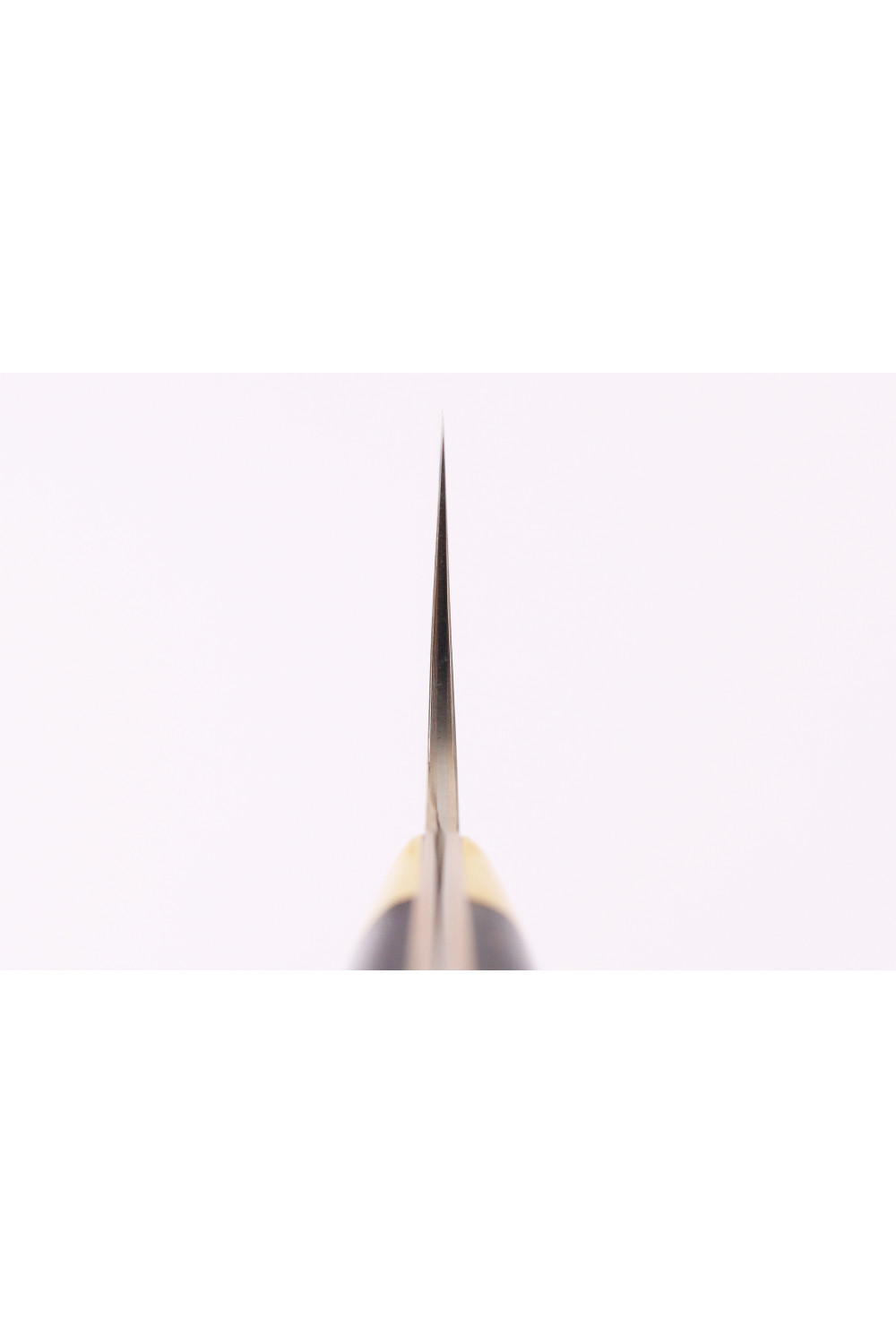
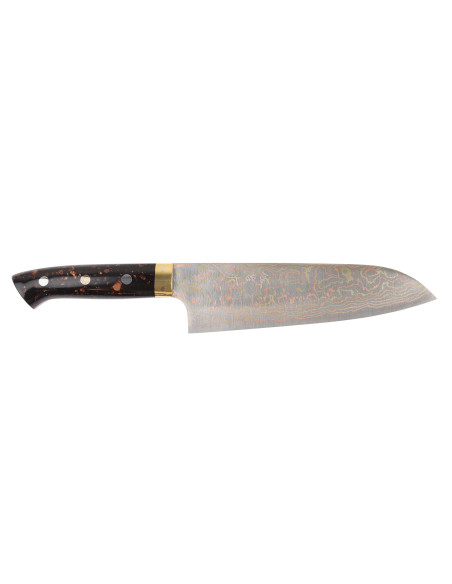
A high-end santoku knife with coppery hues
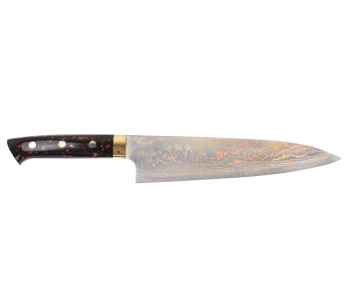
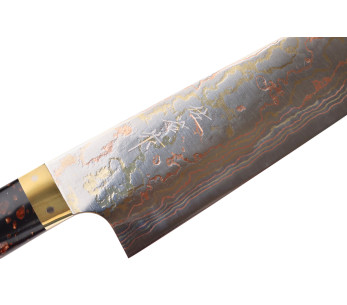
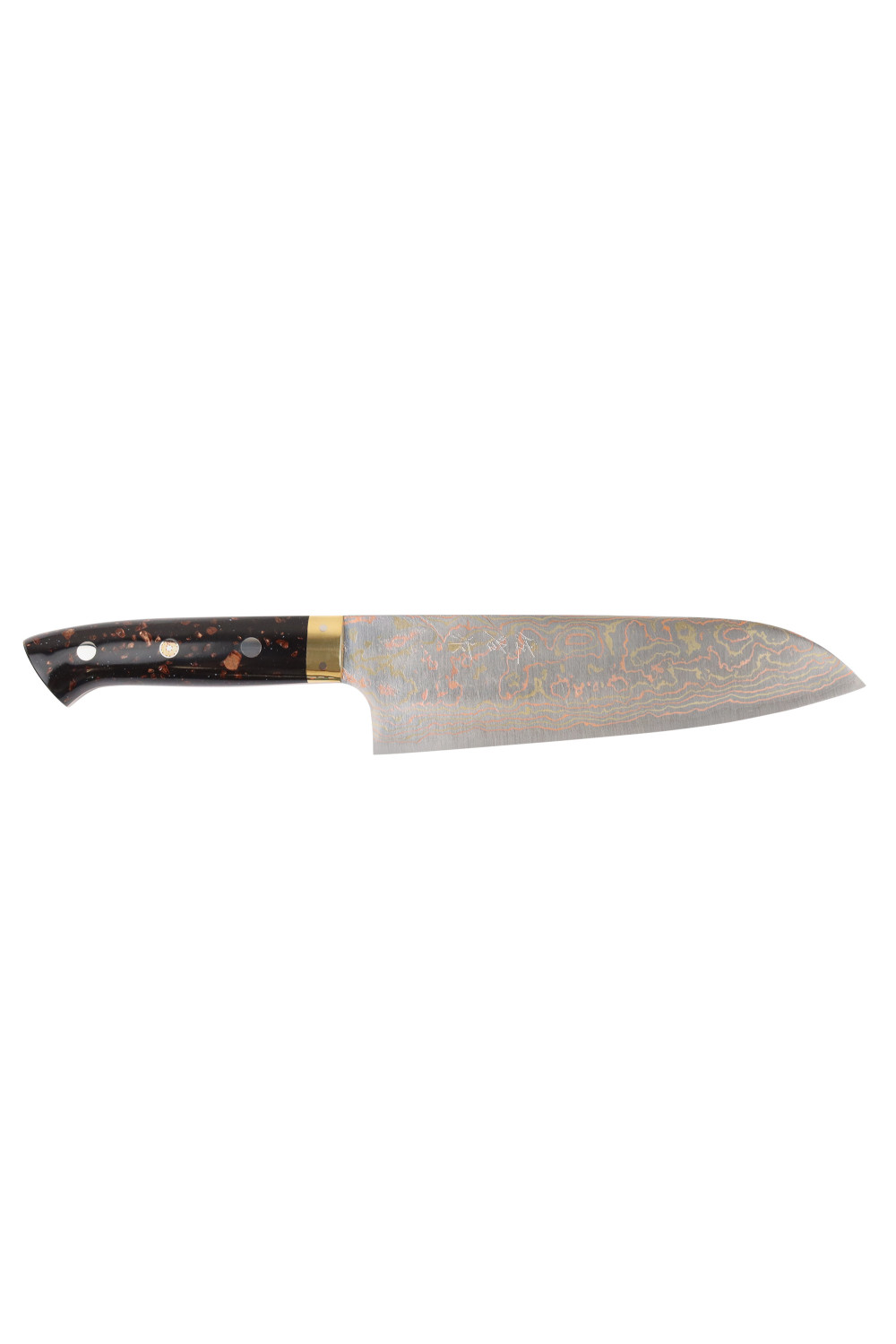
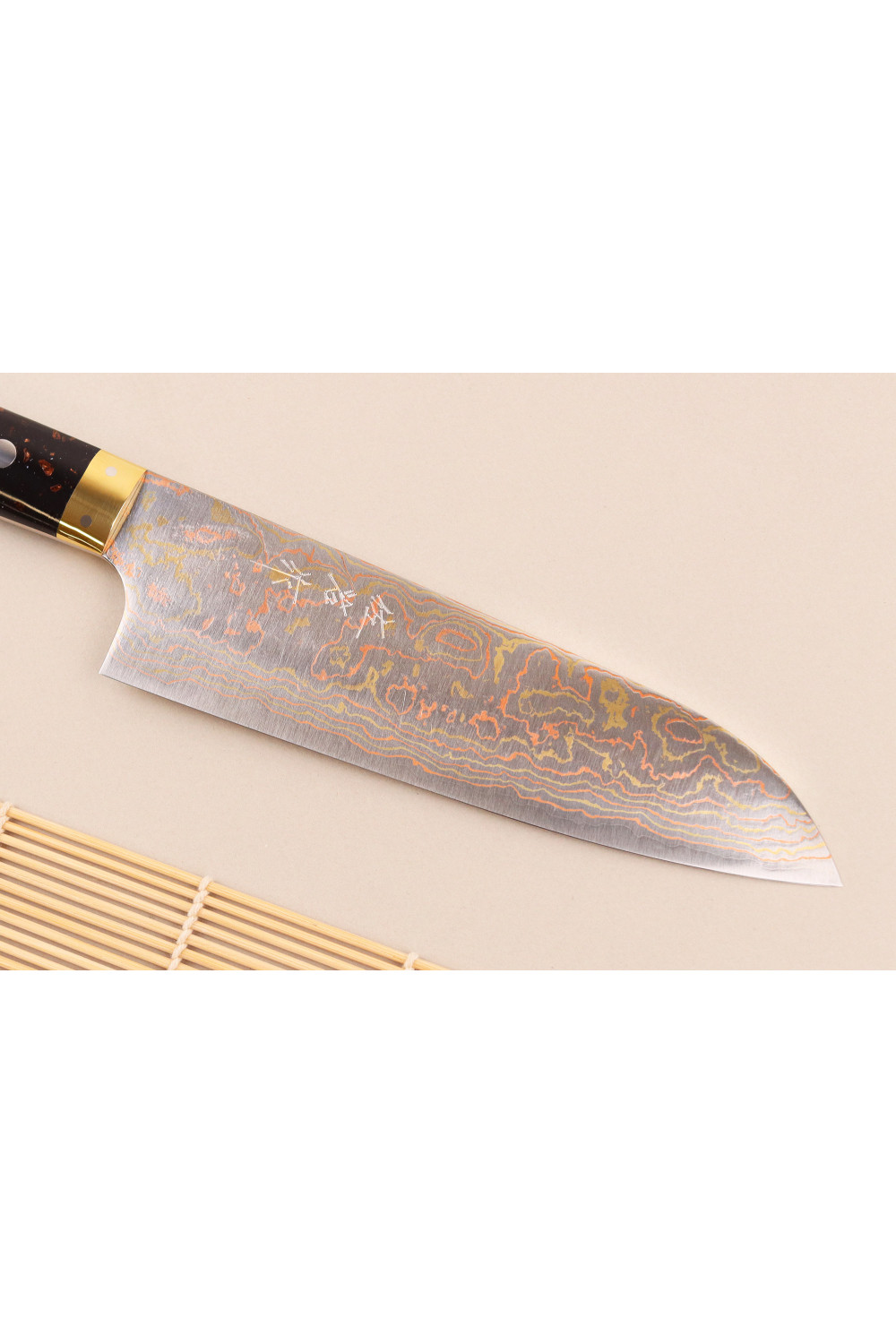
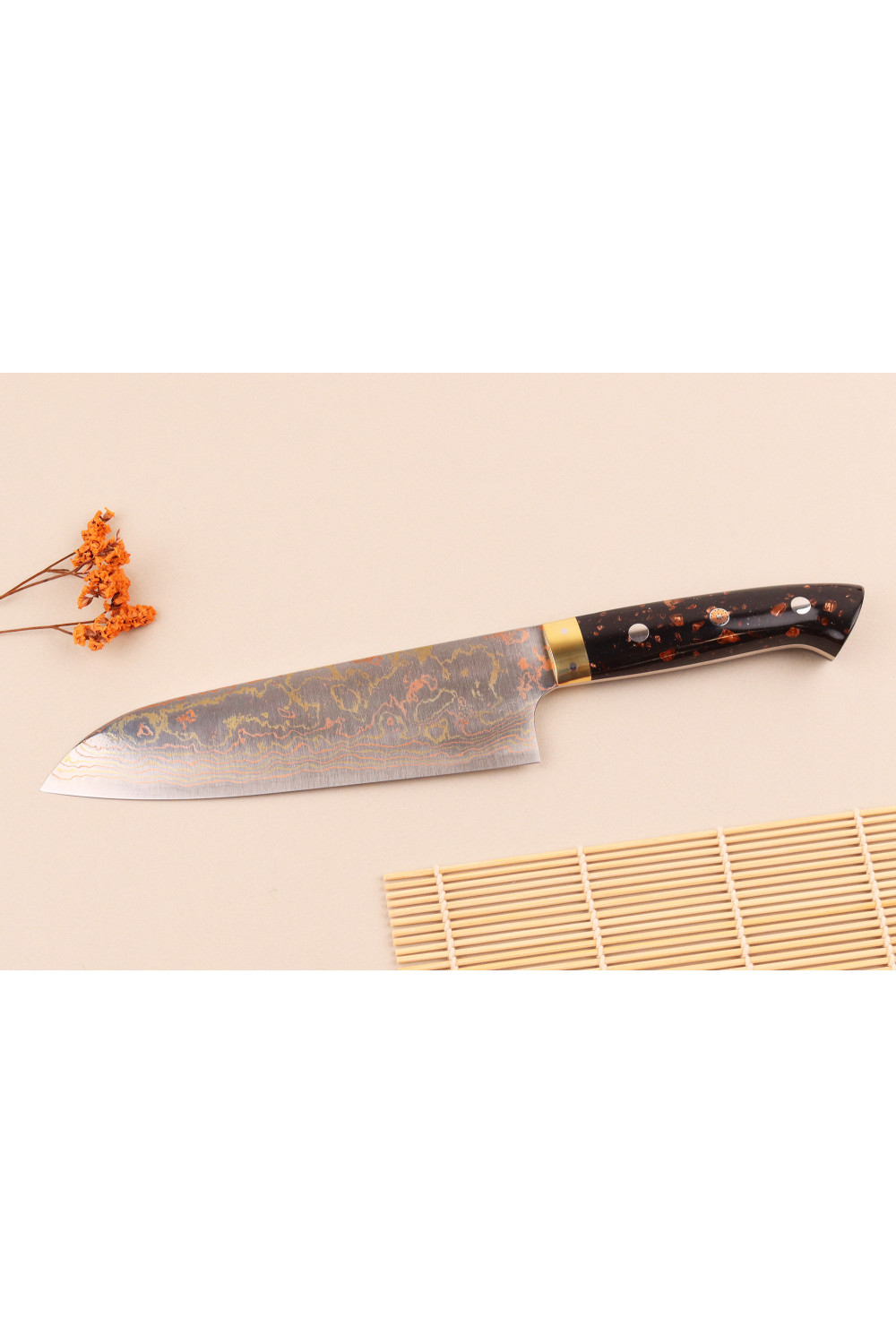
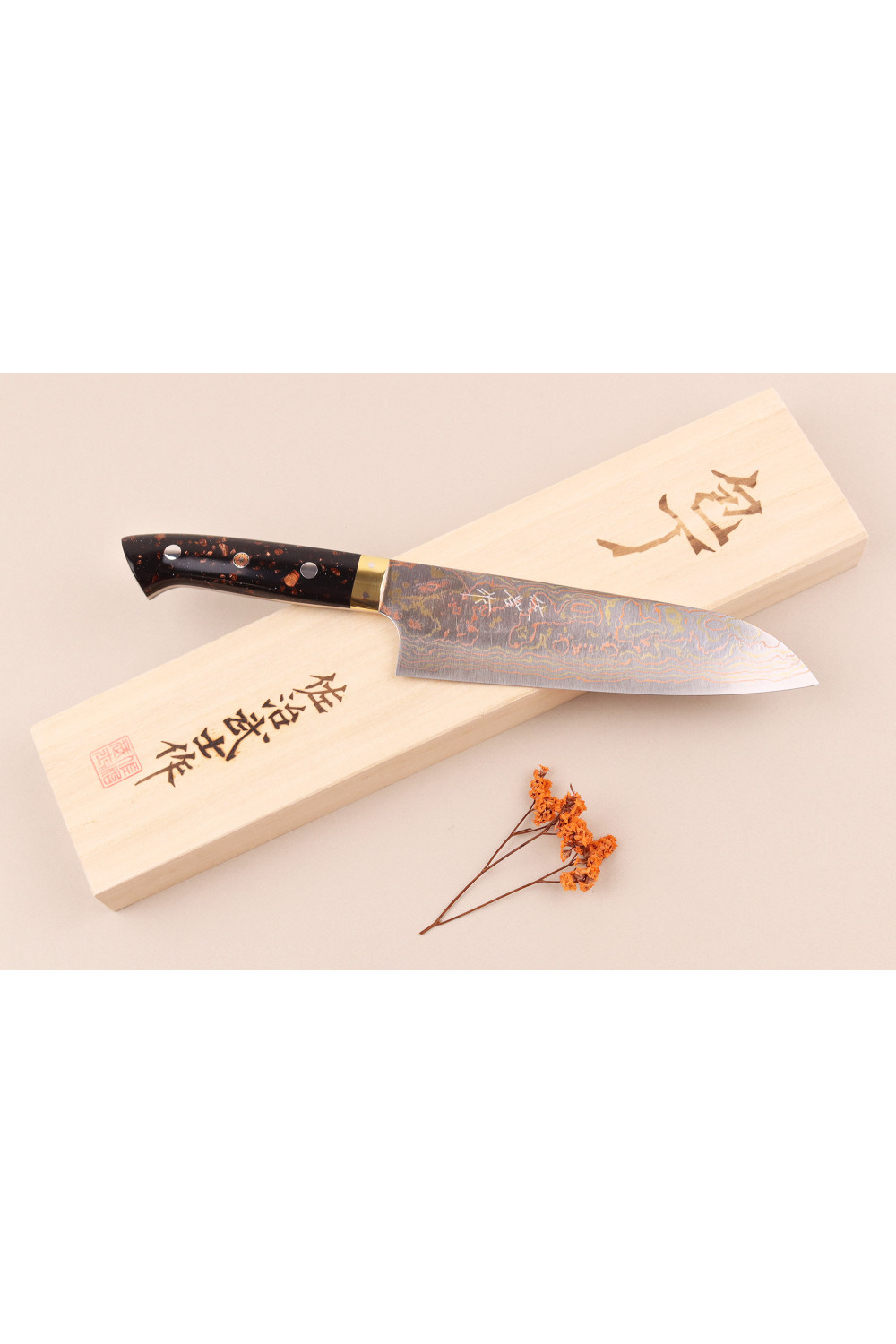
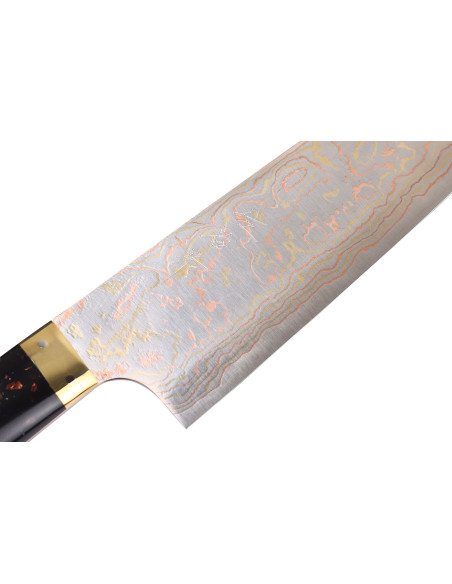
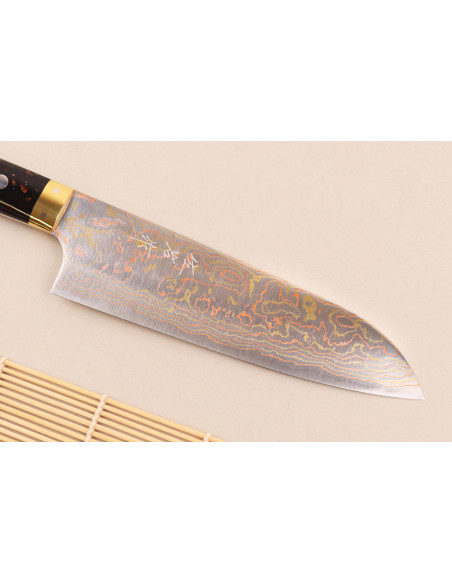
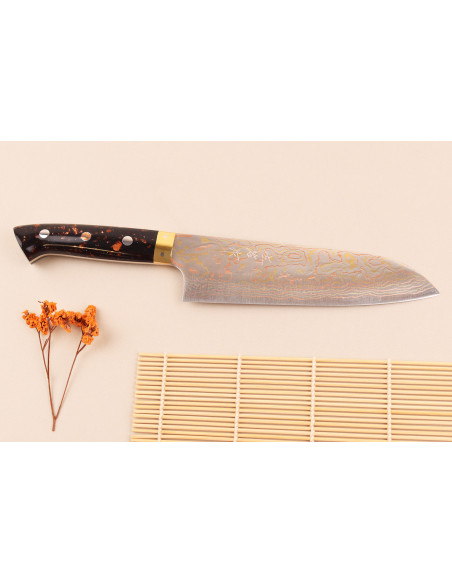
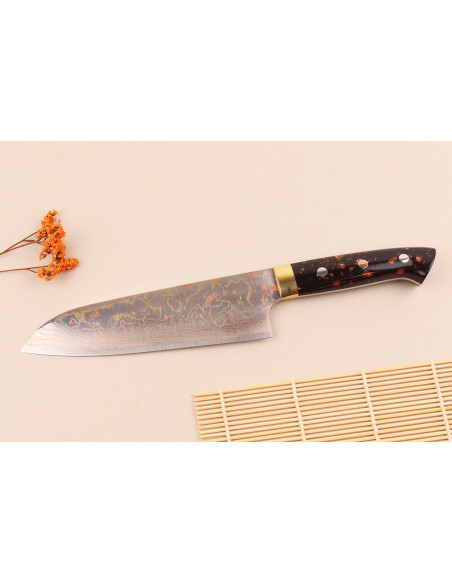
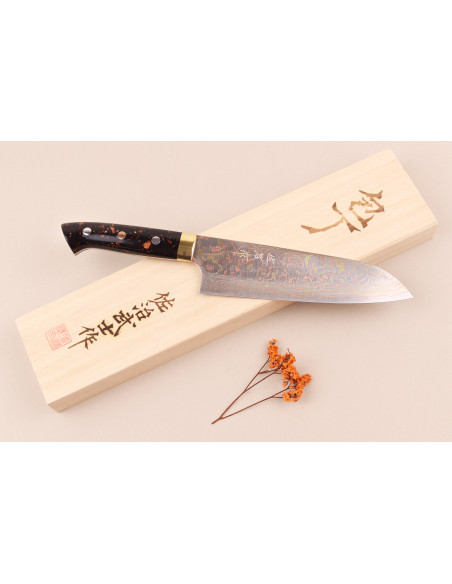
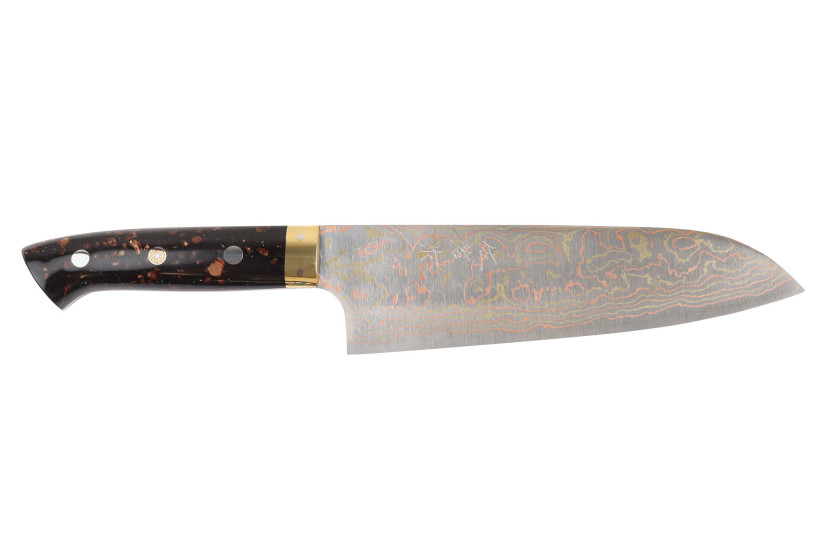
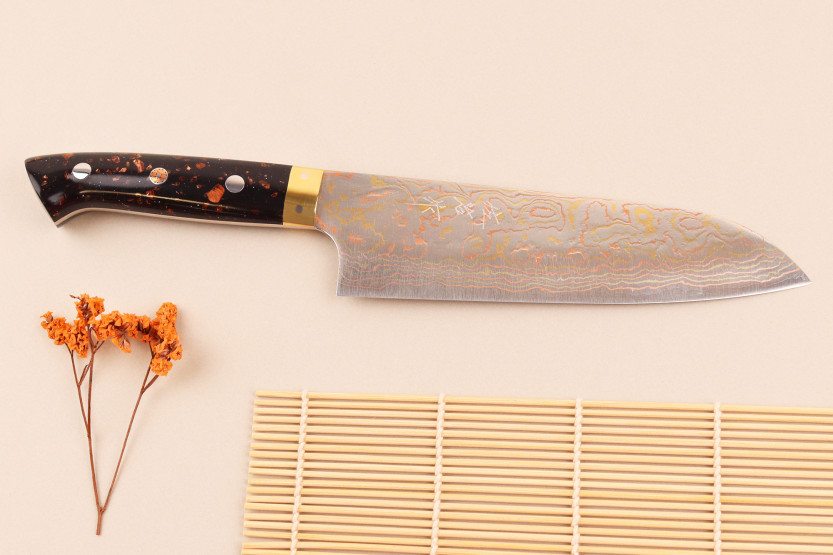
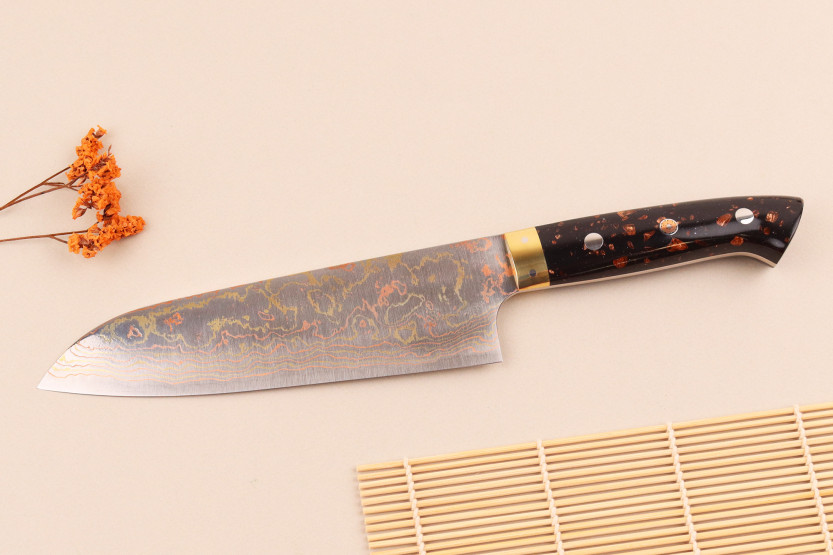
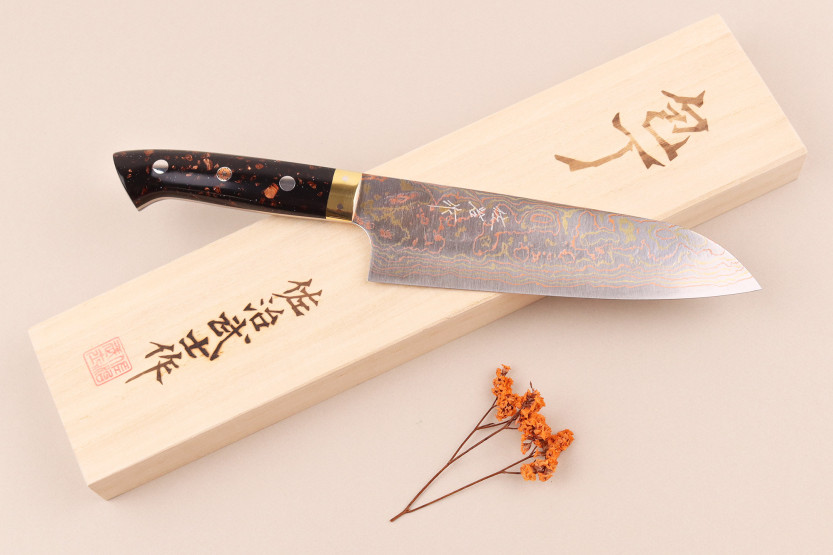
Forged in Japan, this 16.5 cm Takeshi Saji BS2 Rainbow santoku knife features an Aogami #2 steel core and a damascened blade with metallic contrasts. Layers of stainless steel, copper, and brass create a unique pattern that varies on each knife. The resin handle accented with copper-colored Corian® extends this warm color palette, while its Western-style silhouette offers a familiar grip. It is designed for a variety of food preparation tasks: mincing, slicing, and dicing ingredients with precision.
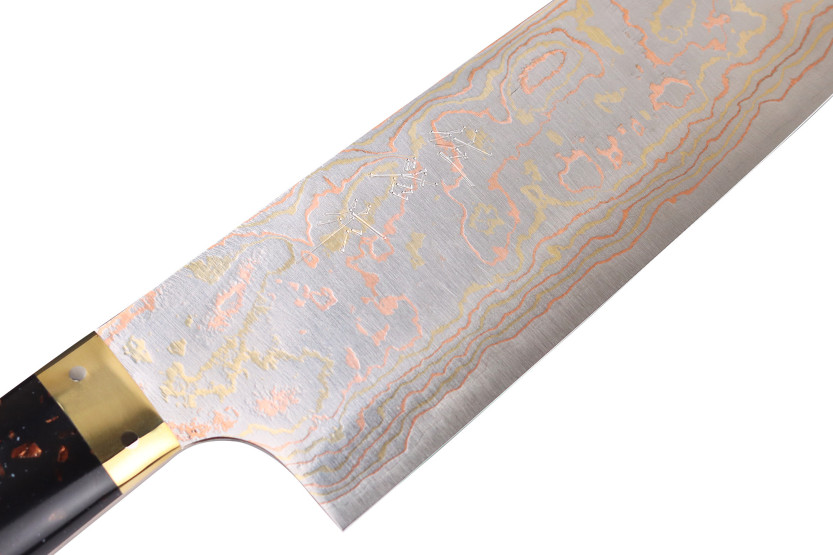
An Aogami #2 core beneath a unique damask pattern
The 16.5 cm blade features a core of Japanese Aogami #2 steel, also known as Blue Paper Steel #2. Its carbon content is approximately 1.2%, giving it a hardness of about 62 HRC on the Rockwell scale. The blade thus benefits from a fine edge that maintains its effectiveness during cutting. However, it requires careful handling: avoid twisting the blade, slamming it against the cutting board, and cutting frozen foods or bones.
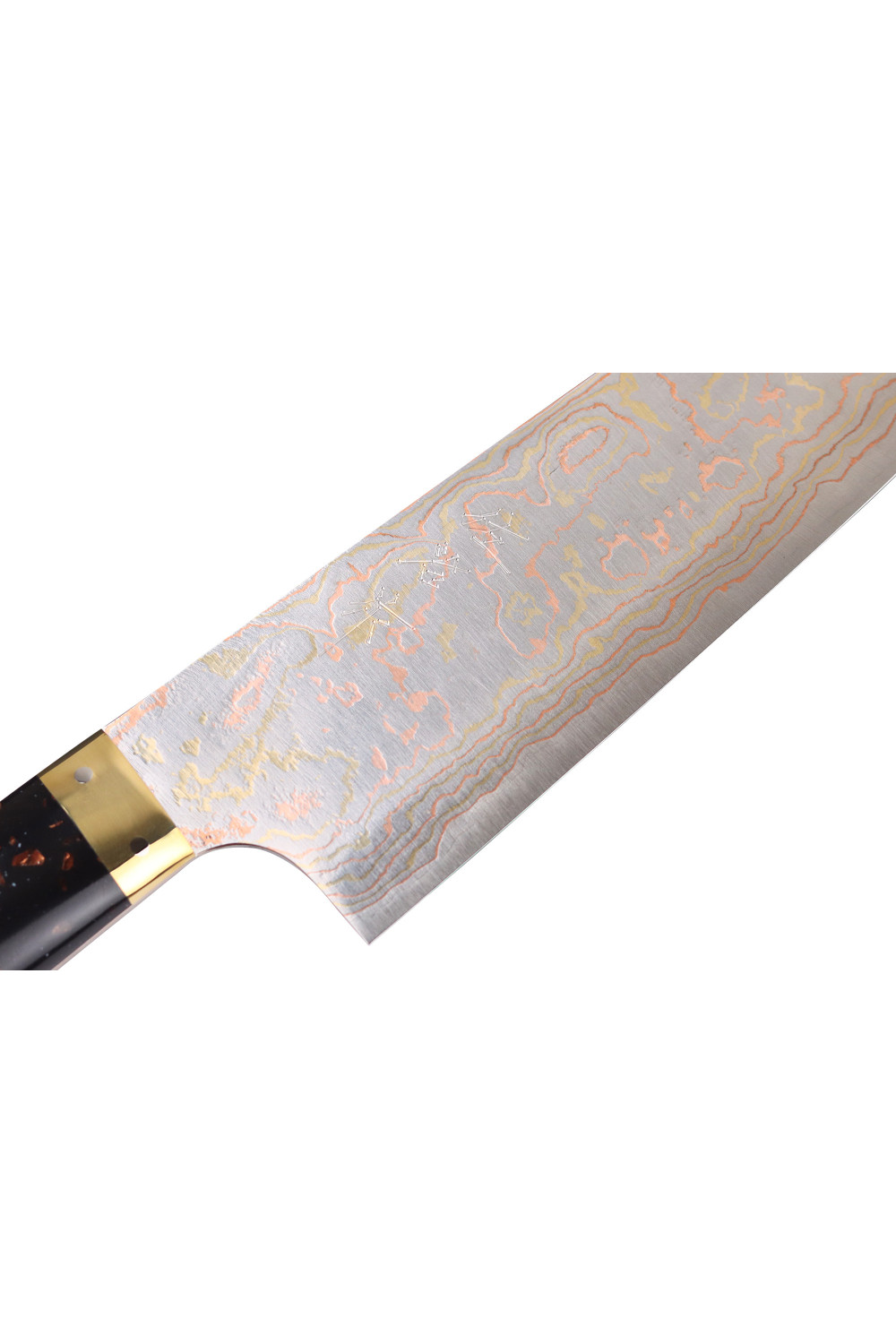
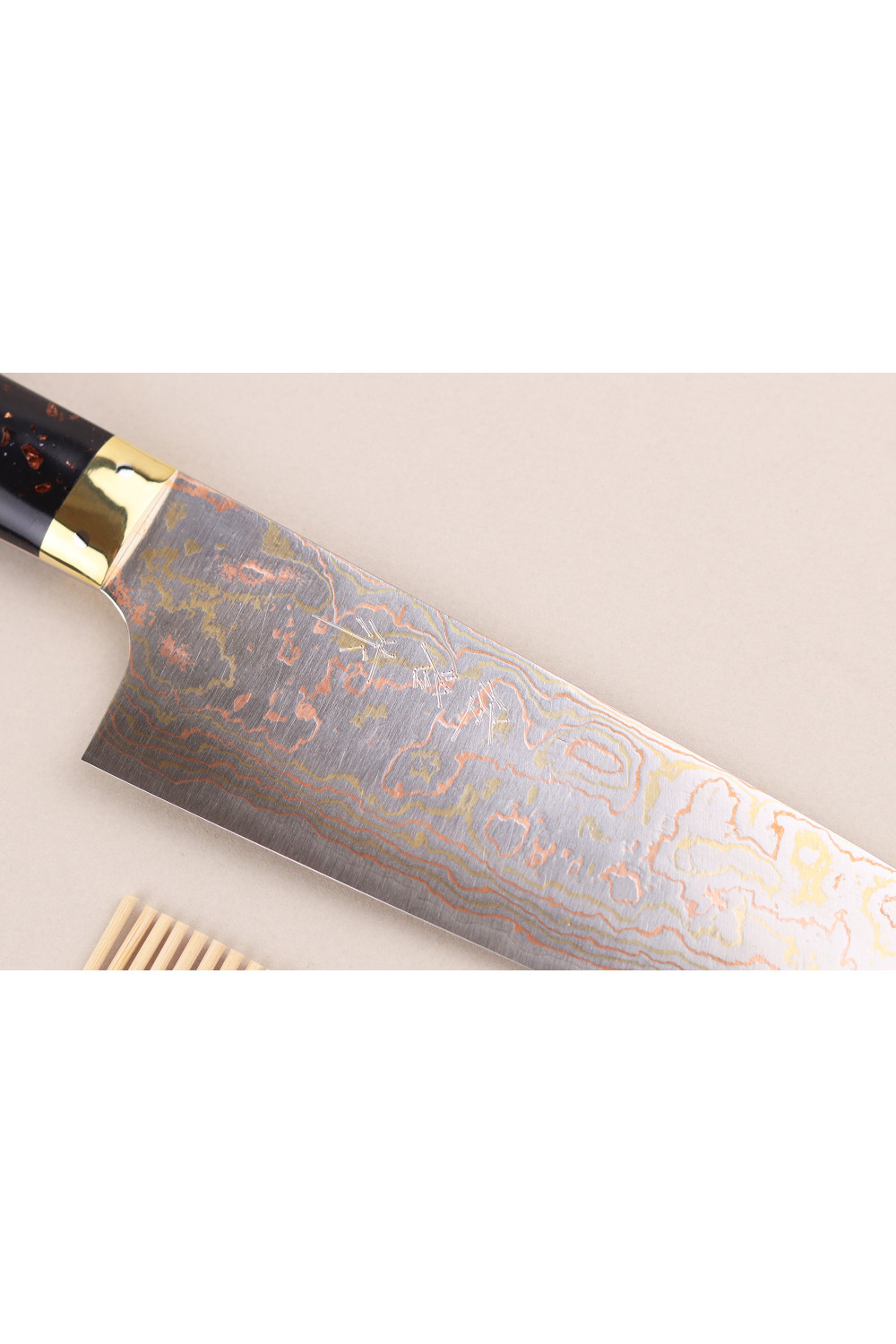
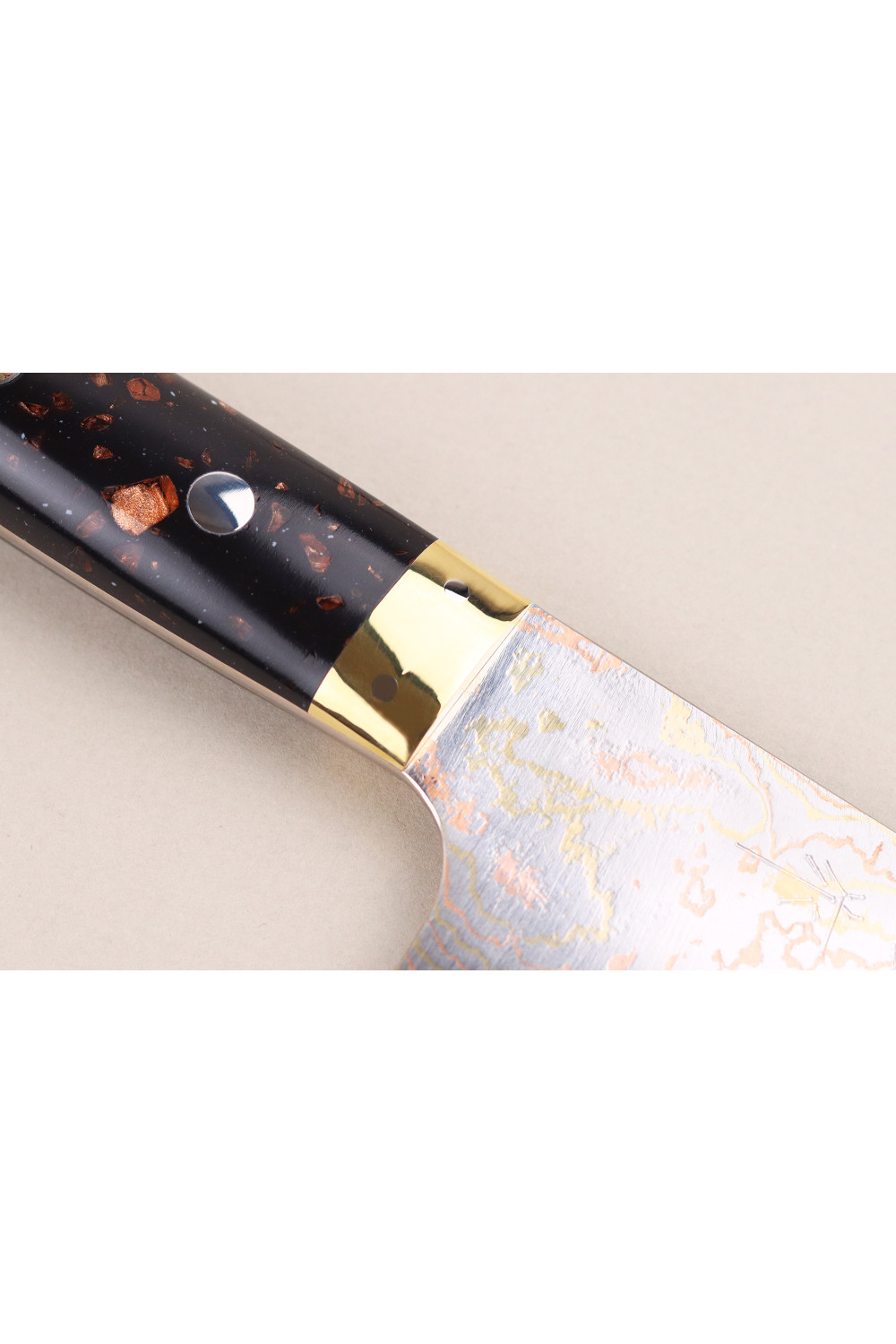
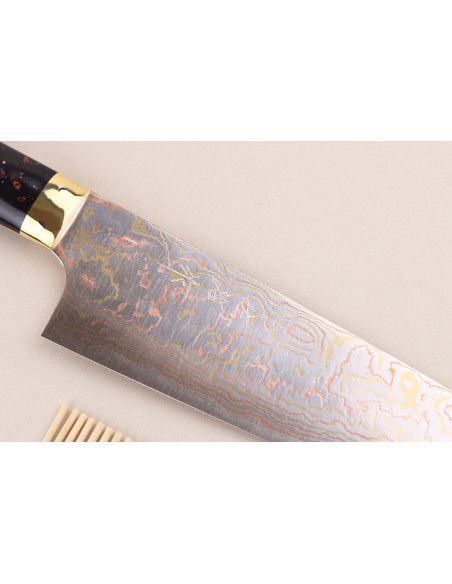
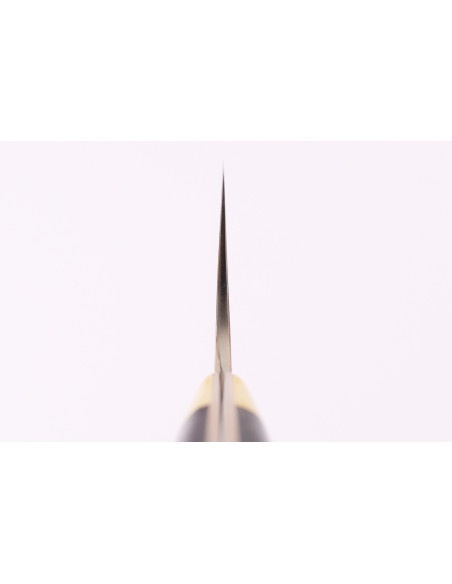
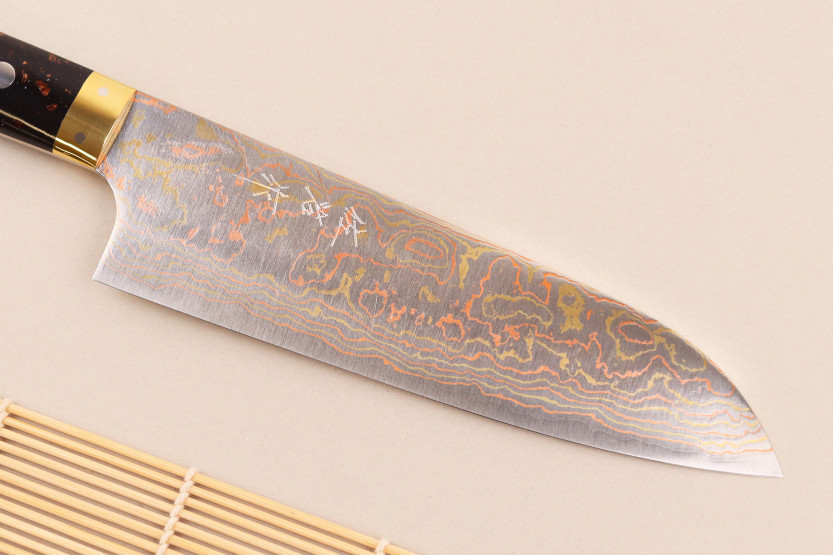
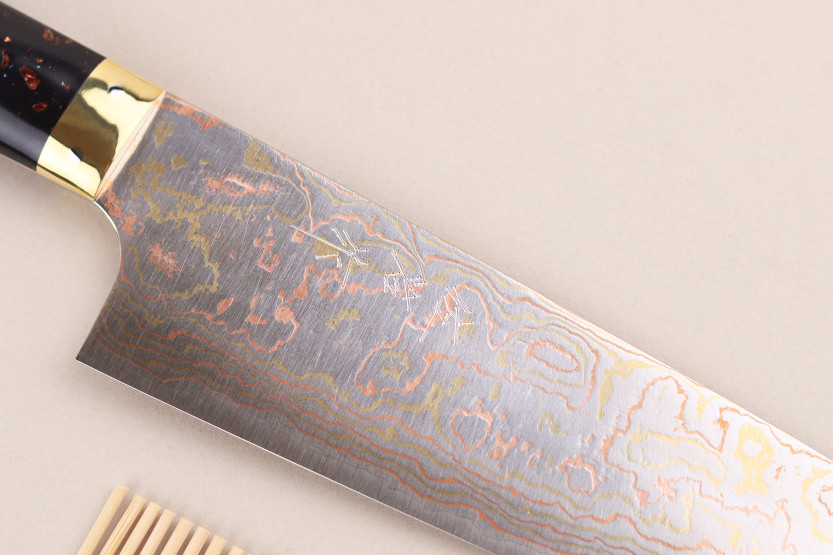
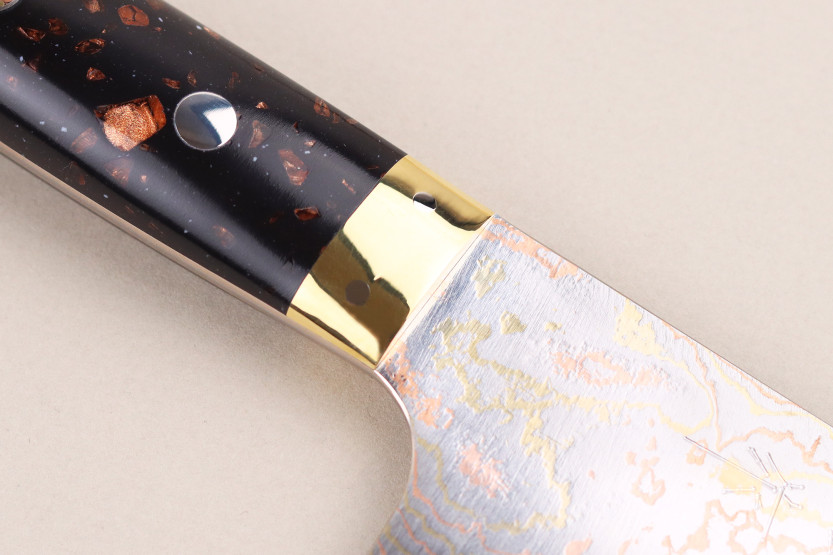
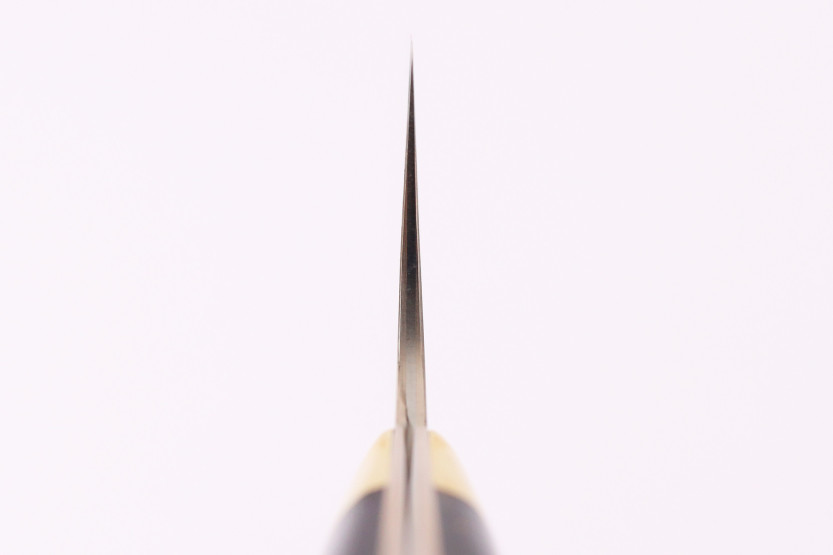
Surrounding the core, layers of softer stainless steel, copper, and brass form the damascene structure. Their arrangement creates a pattern unique to each blade: the patterns are therefore not identical from one knife to the next. The mirror polish highlights these variations and gives the surface a striking sheen.The flat grind ensures a smooth, even cutting path for slicing or mincing with linear movements.
The santoku is a versatile knife, suitable for preparing a variety of vegetables, fruits, fish, and boneless meats. Its carbon steel core requires careful maintenance: moisture can cause oxidation. Wash the blade after use and dry it immediately to keep it in good condition.
A Western-style handle decorated with copper-colored Corian®
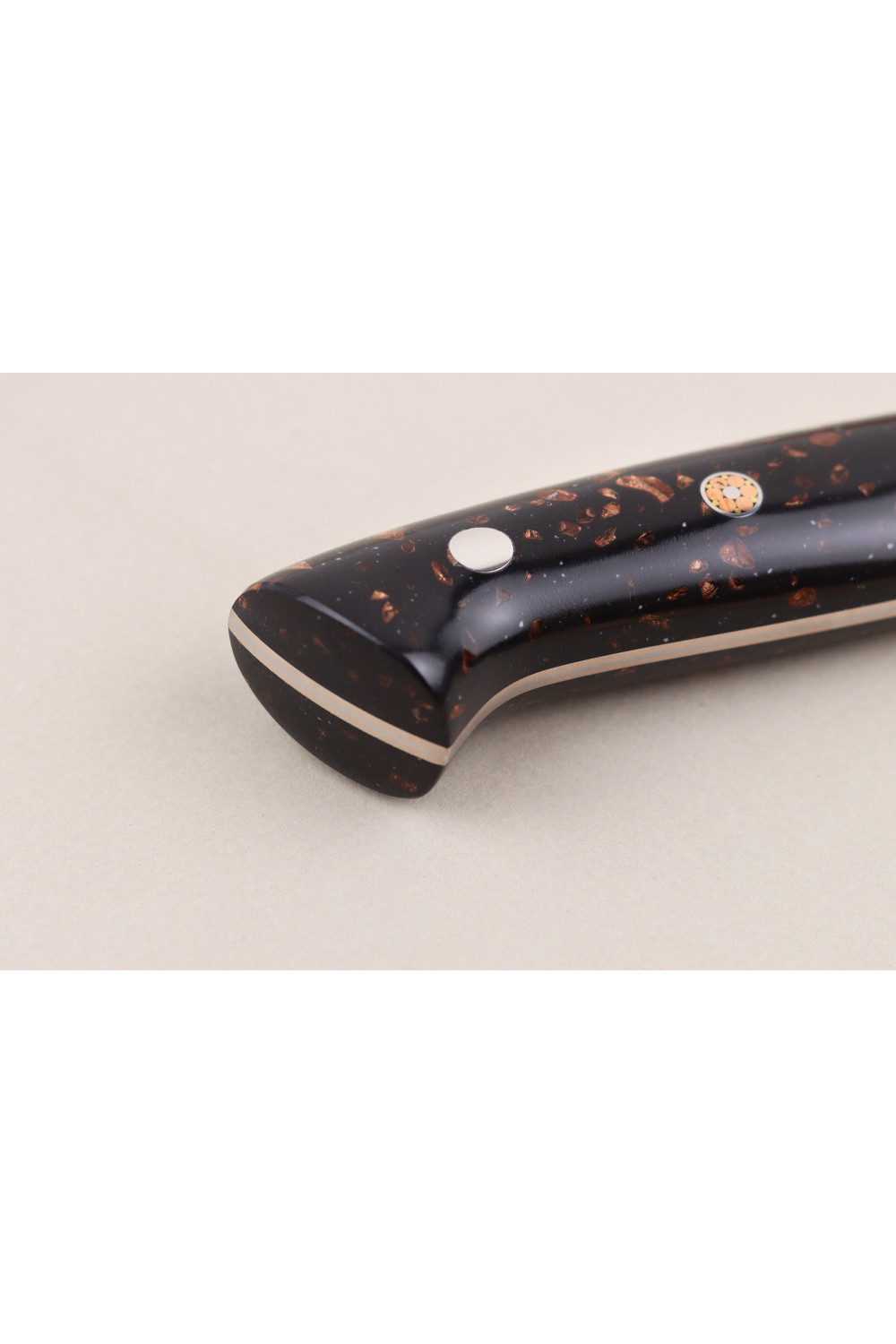
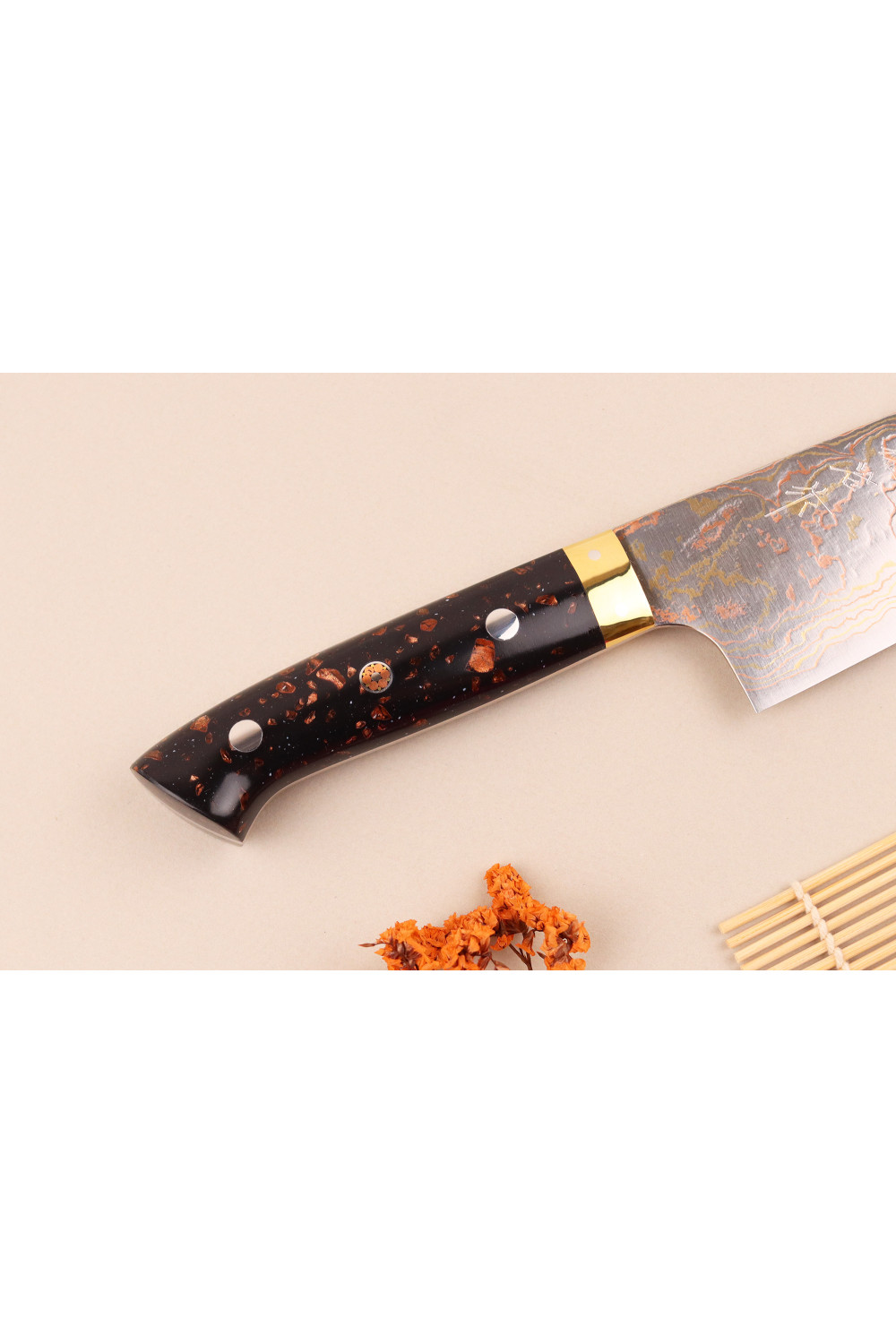
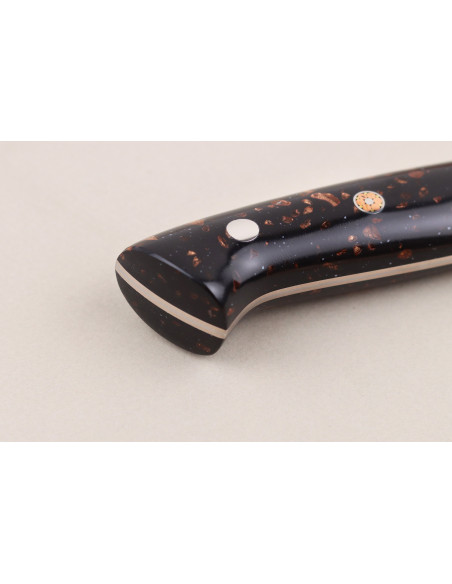
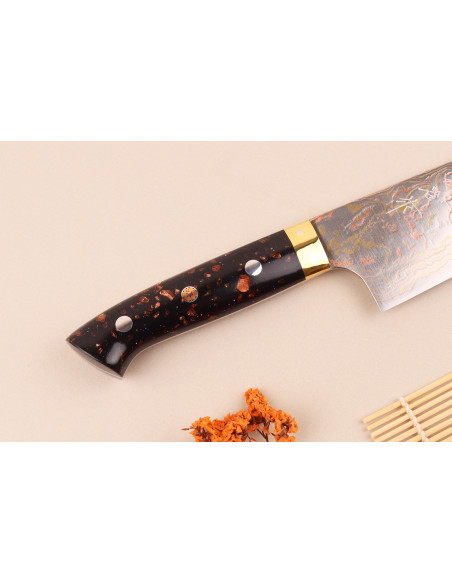
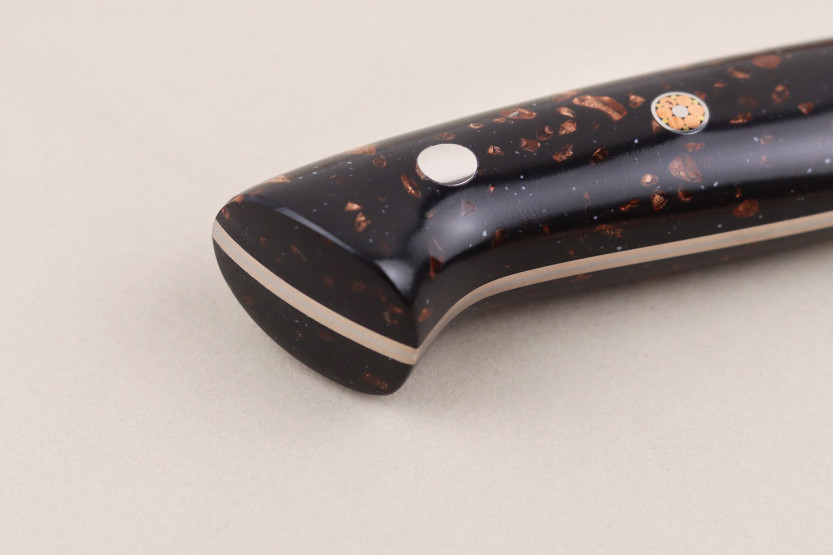
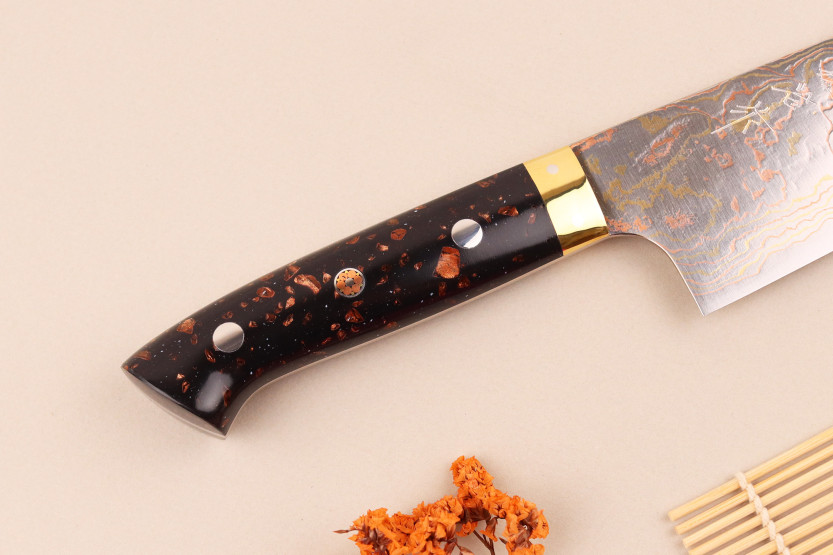
The handle is made of resin into whichfragments of copper-colored Corian® have been injected. These inclusions add depth to the material and complement the blade’s tones. Its Western-style shape, featuring a curved heel, offers an alternative to traditional Japanese handles. It provides familiar grip points and helps keep the hand steady during cutting motions.
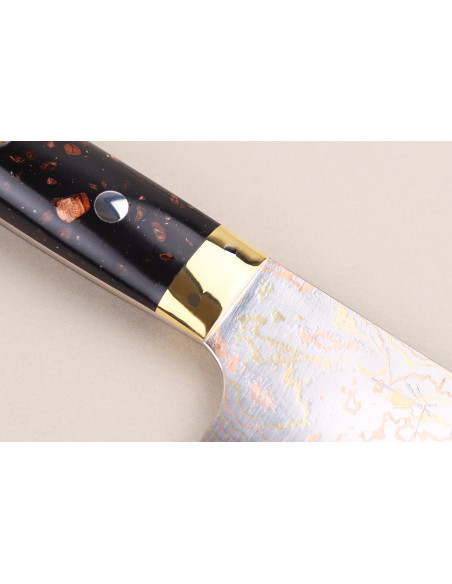
Two stainless steel rivets secure the scales. Between them, a central mosaic adds a distinctive graphic detail. At the junction with the blade, the gold-plated stainless steel bolster provides good balance to the knife, highlights the transition between materials, and completes the color scheme.
To preserve the handle, avoid prolonged soaking and impacts. After washing the blade by hand, be sure to wipe the handle dry if it is wet, then store the knife in a dry place. The result is a high-end, handcrafted Japanese knife in which the forging work and decorative materials come together to create a piece that is as functional as it is unique.
Key Features at a Glance
-
- 16.5 cm blade: ideal size for everyday cutting tasks
- Japanese Aogami #2 steel core: ensures a fine, precise edge
- Rockwell hardness of 62 HRC: long-lasting edge
-
- Stainless steel, copper, and brass Damascus pattern: gives each blade a
- unique
- design
- Mirror finish: highlights the reflections of the Damascus pattern
- Flat grind: ensures a smooth, even cut
- Handle made of resin and copper-plated Corian®: durability and design
-
- Western-style curved heel: for an easy grip
- Two stainless
- steel
- rivets and a central mosaic: secure and decorate the handle
- Gold-plated stainless steel bolster: marks the junction between the blade and the handle
- Hand-forged by Takeshi Saji: crafted in Japan
How to Use and Care for My Handcrafted Japanese Knife
Use the knife on a wooden cutting board or one made of a soft synthetic material. Avoid bones, frozen foods, impacts, and twisting motions, as these can damage the blade edge.
Wash the blade by hand with a soft sponge, then dry it immediately: the Aogami #2 steel core can oxidize with prolonged exposure to moisture. Do not let the knife soak, and do not put it in the dishwasher. When sharpening, choose a stone suitable for hard steels.
Takeshi Saji and the Echizen Tradition
Takeshi Saji is a Japanese blacksmith from Fukui Prefecture and one of the founding artisans of Takefu Knife Village. Created by knife makers from Echizen, this collective was formed to preserve local craftsmanship and develop new designs. Knife-making in the region is part of a long-standing tradition, passed down and renewed by the artisans.
As the head of Saji Knives, Takeshi Saji is recognized by Takefu Knife Village as a traditional master craftsman and the third generation of the Saji family. His work includes forged knives, kitchen knives, and pieces featuring a variety of materials and finishes. The Rainbow series combines a carbon steel core with decorative layers of various metals. The resulting damask pattern varies from blade to blade, ensuring that each piece is one-of-a-kind.
All knives forged by Takeshi Saji are available on our website!




 By buying this product you can collect up to