
Your cart
There are no more items in your cart
Blacksmith Yoshikazu Ikeda
Who am I?
My name is Yoshikazu Ikeda and I've been a Japanese blacksmith for some sixty years in the town of Sakai.
The town of Sakai is considered to be the cradle of Japanese cutlery. Centuries ago, the forges of Sakai were renowned for the creation of katanas, the emblematic swords of the samurai, the warriors who served the Japanese lords. But in the 1870s, Japan began to modernize, and the samurai role gradually became extinct, leading to a considerable evolution in blade manufacture.
Japanese craftsmen diversified their activities, designing blades for a variety of tools and professions. Sickles and machetes were made for agriculture, and Japanese knives for cooking.
To preserve the heritage of katana-making, the ancestral Honyaki blade technique, originally used for swords, was adapted to Japanese kitchen knives. The result has been handcrafted knives with performance worthy of the famous Japanese swords. This has played a major role in preserving the know-how of blacksmiths down through the generations to the present day.
I am the descendant of a family of craftsmen who have been forging since the Meiji era (1868-1912), I currently represent the 3ᵉ generation. I began my apprenticeship in the forging business in the late 60s with my father Kameo Ikeda, in 1967. My brother, Tatsuo Ikeda, is also a renowned blacksmith in Sakai.
After acquiring many traditional forging techniques, as well as expertise in the Japanese cutlery world, I was able to open my own workshop in Sakai in 1983.
I have continued to improve my forging methods, while continuing to develop my authentic craftsmanship to the point of receiving awards. The Japanese Ministry of the Economy certified me as a Master Traditional Craftsman, attesting to my extensive knowledge and experience in forging.
I am now training my two grandsons in the field of cutlery, so that they too can perpetuate this heritage.
My work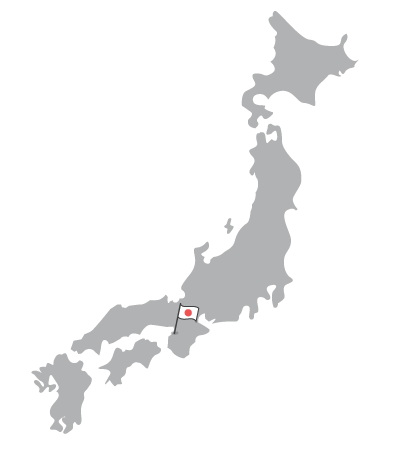
In the course of my extensive experience, I have mastered many forging techniques, including traditional methods.
I'm one of the few Japanese blacksmiths who know how to forge Honyaki blades, the process used to make katanas. It's a complex process, requiring a large number of precise steps. Honyaki knives require a great deal of time and skill to forge.
I usually use carbon steels to give my blades a high degree of hardness for a remarkable cutting edge.
I create handcrafted Japanese knives with minimalist designs; for example, I like to create a fine, light damascus for an elegant result.
Our favorite knife
KnifeLeader's favorite knife is the Kasahara Shigehiro 24cm kiritsuke yanagiba knife forged by Yoshikazu Ikeda!
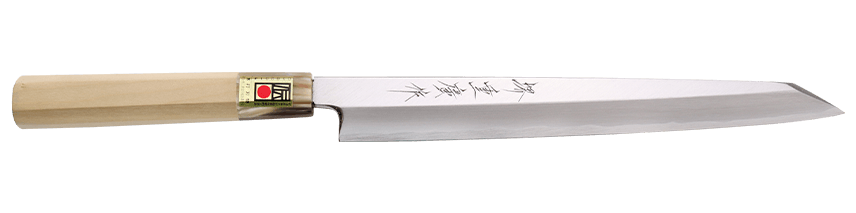
This handcrafted Japanese knife features a 24cm blade with a San Maï structure: its core is made of Japanese Shirogami #2 steel with a micro-structure known as "pure", this alloy is very similar to the tamahagane used to make katanas.
This alloy contains around 1.2% carbon for a hardness of 61HRC Rockwell, giving this Japanese knife excellent edge retention and cutting performance. To protect the heart of the blade, a layer of soft iron is wrapped around it.
This yanagiba knife is the result of a collaboration between Ikeda Yoshikazu and Kasahara Shigehiro, a renowned master sharpener who gave it a high-end edge.
The handle is made of magnolia wood, a light-colored wood that is robust and durable. It is accompanied by a white horn bolster that links the handle to the blade, adding a touch of character to this handcrafted knife. A sticker is affixed to guarantee the authenticity of this kitchen knife, with a serial number.
It is octagonal in shape for an ergonomic and comfortable grip, for right- and left-handed users alike!
Discover many forged Japanese knives on KnifeLeader.eu!


