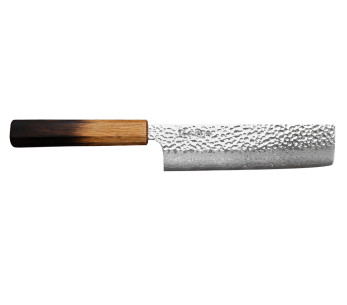
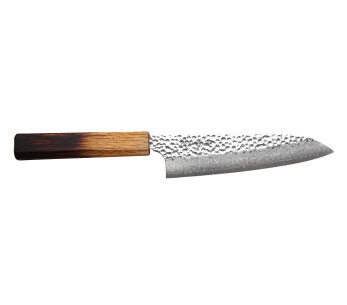
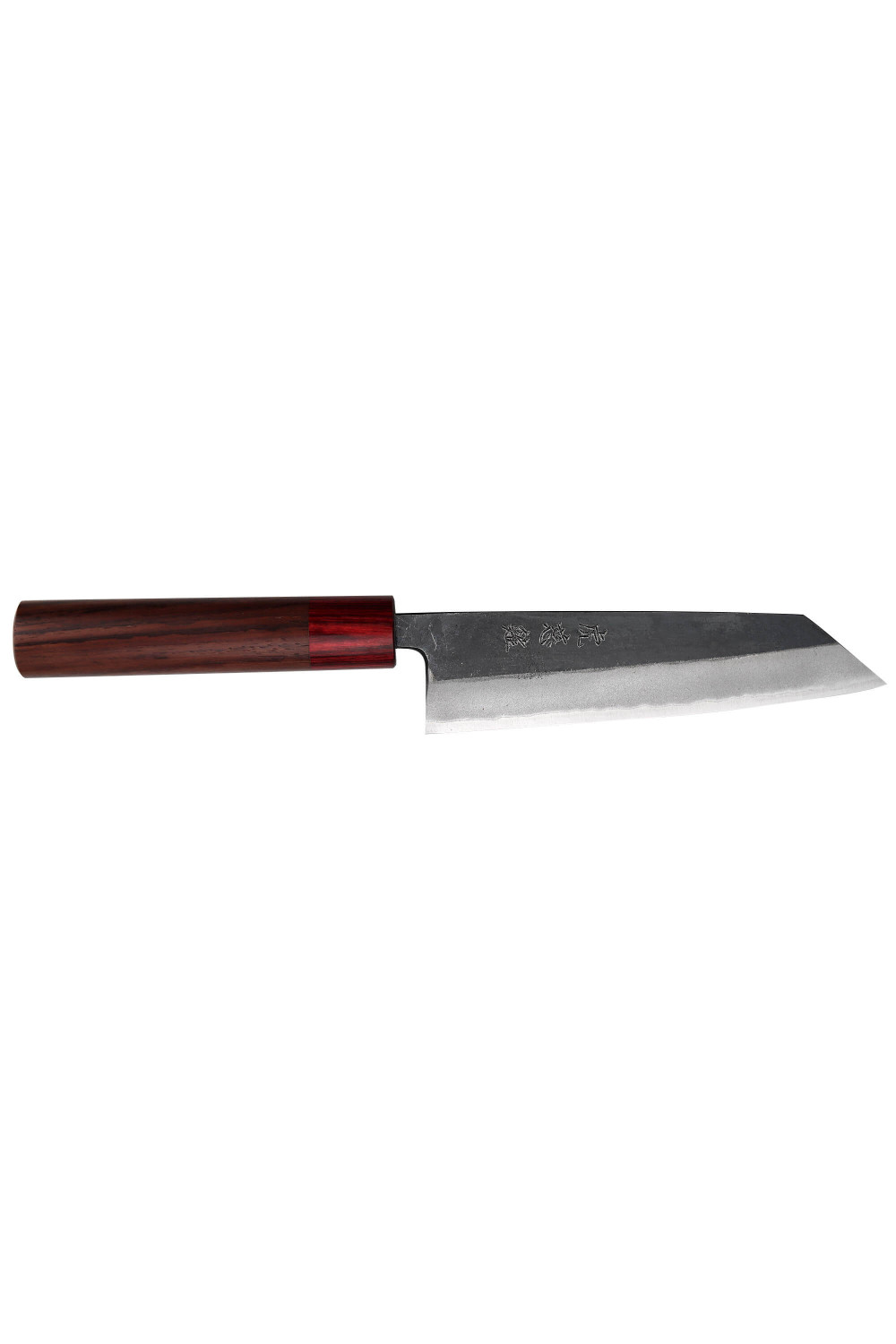
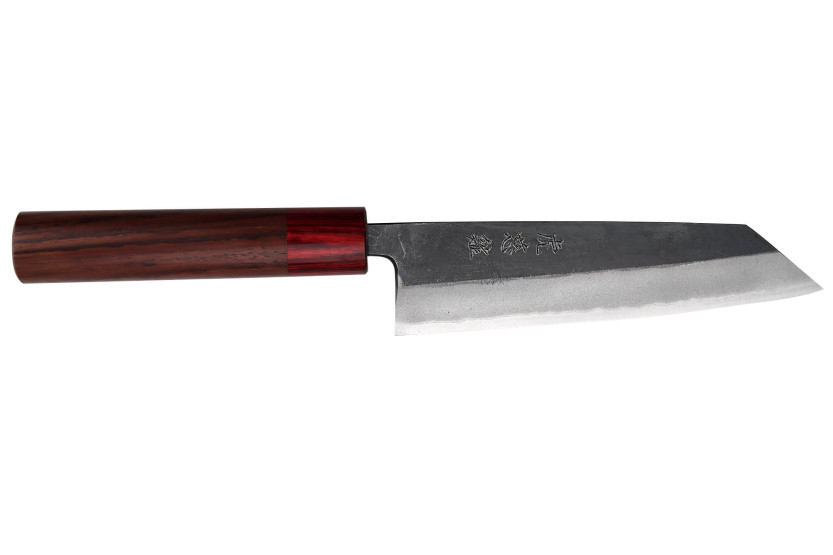
This Wusaki YuzoKiritsuke knife is a beautiful Japanese model. It's versatile and allows you to alternate cuts: chopping herbs, slicing vegetables or mincing meat (without the bone), nothing will hold any secrets for you!
Muneishi Forge was founded in 1955 by Hirotaka Muneishi san, a second-generation blacksmith in the family. Initially, the focus was on tools such as axes and machetes. It was with the third generation of blacksmiths that the family turned to kitchen knives: Kosuke Muneishi took over the work and carries out all the manufacturing stages himself, from forging and tempering to hammering and sharpening. As a result, quantities are limited and lead times vary.
Quality materials for your Japanese knife
This knife has a San Maï structure: these Japanese words mean "3 layers". As a result, the knife has a core, which is often very hard, and a protective layer folded over it (hence the 3 layers). The alternating steels on the bottom of the blade can be distinguished by the fine wave running along the edge.
For the Yuzo knife, the core is made of Japanese Aogami 2 steel (also known as Blue #2 Steel). It is produced and packaged by Hitachi steel mills. They are famous in Japan, supplying steel to many blacksmiths.
Aogami 2 has an excellent carbon content of around 1.2%, higher than the average found in Western knives (which have a carbon content of around 0.5%). This element makes the steel stiffer, which in turn enables it to be sharpened more thoroughly. The result is a sharper edge.
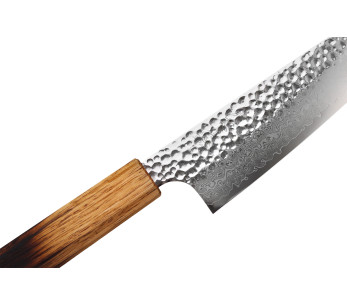
The carbon core is then enveloped in a layer of soft iron that "sandwiches" it. You can see the difference in this layer on the bottom of the blade, with the demarcation of colors. The iron adds a little suppleness (not in terms of flexibility, but rather in terms of resistance to breakage). The San Maï is now complete.
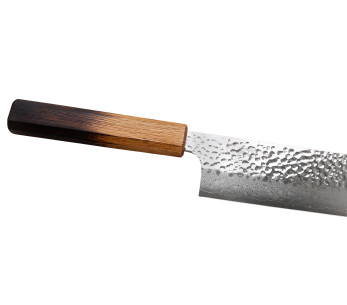
You can appreciate the kanji engraved on the blade, for even more authenticity. The rough forged finish also adds character and authenticity to the blade. This type of finish is very popular with Japanese chefs, as it has a more traditional appearance.
A Pakka wood Bolster provides the link between the unpolished blade and the handle. Pakka wood (also known as Pakkawood) is a composite material widely used in culinary circles. It consists of laminated wood and resin, all hot-pressed together. The result is natural, with some of the veins that can be seen in wood. The material is resistant to humidity and temperature variations.
A wood paste fills the space between the blade and the Pakkawood. This makes the handle watertight, to prevent small scraps from getting inside.
The handle is made from morado wood. This exotic wood is considered top-of-the-range, and its warm hues are very pleasing. The wood grain is unique to each piece. Oval in shape, it is suitable for all users.
Here are our tips for ideal knife care:
The high carbon content and the iron folded around it are sensitive to oxidation. You should therefore wash your knife by hand, without soaking it in the sink. Once washed, you can wipe it with a soft cloth to remove all traces of moisture. Please note, however, that color may change over time, even with perfect care. This is a normal reaction of the alloy (the knife is in constant contact with moist food, and moisture is also found in the ambient air...). You can apply mineral oil to the steel from time to time.
Please note: the blade arrives lightly oiled. This is perfectly normal, and helps protect the blade. Simply wash the knife before first use, and the oil will disappear.
Find the full range of Wusaki Yuzo knives on our site!




 By buying this product you can collect up to