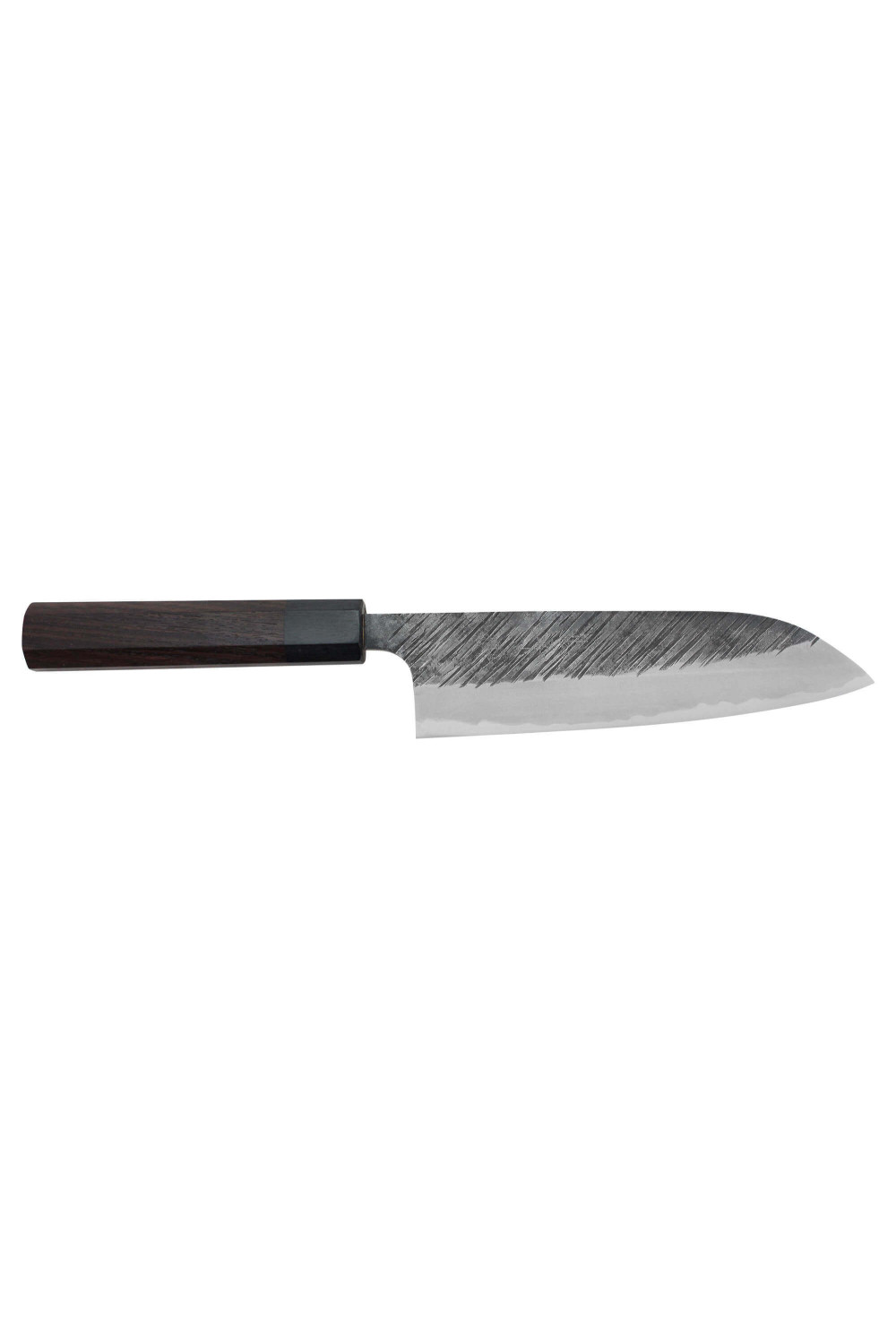
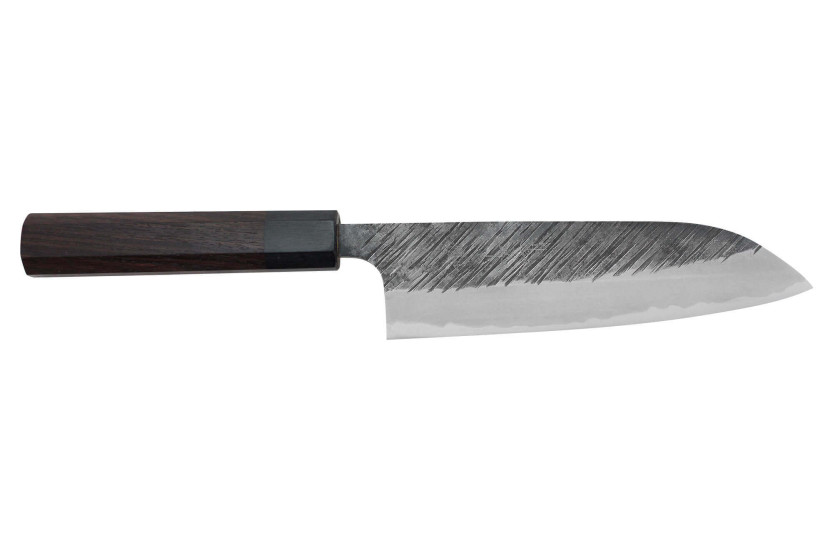
This Yu Kurosaki Fujin Black Japanese santoku knife features a San Mai structure, which means "3 layers" in Japanese. The central layer is chosen from a hard alloy, in this caseAogami Super, a renowned Japanese steel. It is designed by steelmaker Hitachi, which supplies many of the country's blacksmiths with its quality alloys. This steel is also known as Blue Steel Super (blue because it is packaged in paper of this color) and contains a very interesting carbon content of 1.5%. Such a high carbon content stiffens the alloy (65 HRC), making the wire more enduring and enabling it to be sharpened to the highest level of cutting ability. It also contains tungsten, which further stiffens the alloy.
Its cutting edge lasts a long time, and the need for sharpening is greatly reduced. However, if you feel it's necessary, you can use a Sharpening stone to restore its full effectiveness. You might think that its rigidity would make it difficult to maintain, but this is not the case (due in part to the carbon it contains).
On top of the Aogami Super is a layer of steel that protects and balances it (to contrast its hardness). You can see the superposition of steels near the cutting edge, with the difference in color.
You can admire the rough, traditional forge finish, which gives it its rustic appearance. Japanese chefs love it for the authenticity it brings. Kurosaki san adds the finishing touch with its special beveled hammering. The visible kanji are engraved by hand and the cutting edge is worked on a grinding wheel.
Rosewood is used for the handle. This deep, hard wood is naturally resistant to humidity and shock. The grain is unique to each piece, of course, as it is a natural material. Octagon-shaped, it is pleasant to use and suitable for ambidextrous use.
A black bolster, also octagonal in shape, connects the handle and blade. The space between the bolster and the blade is filled with wood paste for watertightness. The blade is made of pakka wood, or Pakkawood. This material resembles wood, but blends laminated wood with resin, making it a composite. It's a real asset in the kitchen, thanks to its sturdiness and longevity.
Ideally, it should be washed by hand and then wiped with a soft cloth, before being stored away from moisture. It comes in a cardboard box.
Find out more about manufacturing :
This is a knife with character, made by Yu Kuosaki san, a renowned blacksmith. He works at the Takefu Knife Village, in a beautiful workshop with a modern facade. Inside, it's the traditional look of the old forges that catches the eye, and the methods used by this cutler are derived from the skills of the blacksmiths of yesteryear.
This famous village is a hotbed of Japanese craftsmanship. Apprentices enjoy training here, as they learn the true methods of their ancestors. The workmanship is precise, rustic and intuitive.
Kurosaki San began his apprenticeship in 2000 and worked with Master Kanehiro for over 10 years. The latter taught him the traditional art of forging. It was after receiving orders from very satisfied customers that he decided to set up his own workshop, encouraged by his master. He also trained with the famous Hiroshi Kato San, a renowned master blacksmith and one of the founding members of Takefu Village.
Now, it's Yu Kurosaki San who trains his apprentice, so that one day, he himself can open his own business.
Please note that quantities are limited, due to the origin of the knives and the capacity of the blacksmith, who performs all operations by hand.
If you'd like to browse our full range of handcrafted Japanese knives, click here!




 By buying this product you can collect up to