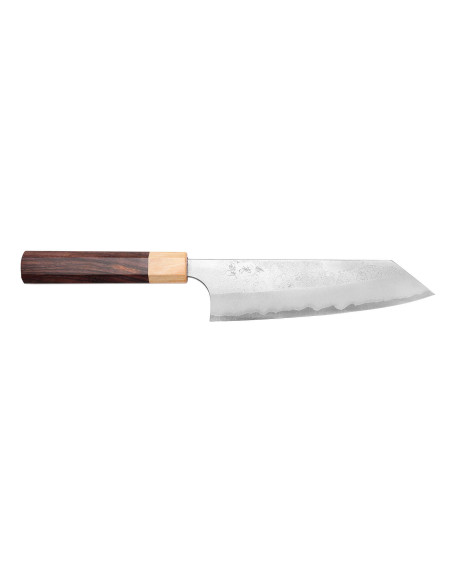
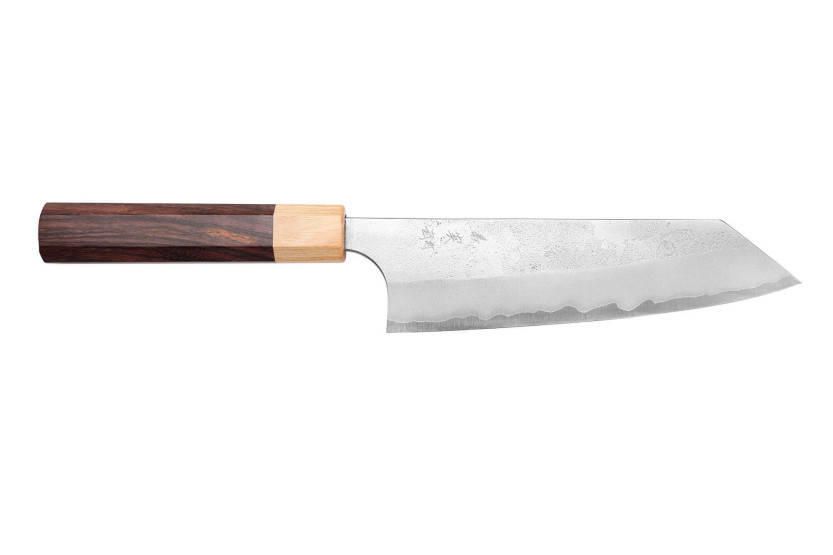
This 16.5cm bunka knife was crafted by Yoshimi Kato, a certified Japanese master blacksmith from Takefu.
Learn more about Japanese blacksmithing
During his training, Yoshimi Kato apprenticed with several renowned Japanese blacksmiths, including Hiroshi Kato san, his father-in-law. Hiroshi Kato is a highly respected knifemaker in Japan and internationally, and a great master blacksmith. He has spent almost 50 years creating knives almost every day, and is also one of the founding members of the Takefu Cutlery Village. The village was created so that blacksmiths could share their ideas, skills and equipment. He now teaches his art to the next generation.
Yoshimi Kato took over Hiroshi Kato's workshop and continues to create the knives of his now-retired master. But that hasn't stopped him from launching his own range of knives. Each of his knives is crafted in the purest respect for Japanese tradition, using extremely fine processes and meticulous techniques. This ensures a unique knife that can be a great gift idea for a cook, or just the thing for cutting.
Yoshimi Kato's apprenticeship began in 2013. Highly talented, he quickly assimilated the craft of blacksmithing. Thanks to his talent, he continues to perpetuate the work of his master Hiroshi Kato San, but adds his own touch with innovative ideas that will be appreciated by all cooks!
Left: Hiroshi Kato san. Right: Yoshimi Kato san
Blade features
The blade's structure is based on 3 layers of steel, known as San Maï. This is a Japanese technique that consists of superimposing layers of different alloys. San Maï means "3 layers" in Japanese.
The heart of the knife is made from Japanese Blue Super Steel, or Aogami Super in Japanese, produced by steelmaker Hitachi. This is a top-of-the-range alloy with a high carbon, tungsten and chromium content. In fact, its carbon content is around 1.4/1.5%, which is high compared to other steels whose average is generally between 0.5 and 1%, Japanese and Western blades alike.
Blue Super Steel's unique characteristics enable it to achieve a very marked hardness of around 64-65 HRC. This high index is proof of its high rigidity. It requires careful sharpening in order to achieve the highest cutting quality.
Such high hardness also gives the blade excellent edge retention. Harder steel wears less quickly, ensuring that the edge stays sharp longer, and spacing out sharpening sessions. For example, if you're a home user, you won't need to sharpen more than 2-3 times a year. Also, the Aogami Super steel used here is highly appreciated by the Japanese for its ease of sharpening. In fact, it remains very quick to sharpen despite its very rigid cutting edge.
Yoshimi Kato has added a layer ofmild stainless steel to surround the core on each side, which protects Aogami Super from oxidation and makes the cutting surface "softer". Please note that this does not mean that the blade becomes "flexible", but that it is less brittle during use.
The blade boasts a superb Nashiji finish. This not only gives the blade a lot of character, but also a traditional rustic look. It is then hand-sharpened to give you superior cutting performance. The surface is embellished with hand-engraved kanji.
Handle features
The knife's handle is made of Sandalwood, a dark-colored wood that is both robust and pleasant to the touch. Thanks to its octagonal shape, it hugs your palm perfectly, ensuring great control of the knife every time you use it. You can also see a white Pakkawood bolster that joins the handle to the blade. This is a moisture-resistant, antibacterial composite material. The knife is suitable for both left-handed and right-handed use.
The space between the blade and the bolster is filled with wood pulp to make it watertight. This also prevents food residues and water from washing from entering the handle.
Good maintenance
To preserve the knife's appearance and efficiency over the long term, it's important to wash it by hand, taking care to wipe it immediately with a soft cloth before storing it in a dry place. Be careful not to leave it exposed to damp for too long. Do not put the knife in the dishwasher or let it air-dry (this applies even to stainless steel knives).
Over time, the knife's steel will discolor: this is perfectly normal. Despite good care, it will turn a darker shade of blue. This action is harmless; it simply shows that Aogami Super steel is very reactive.
To discover all Yoshimi Kato knives, click here!




 By buying this product you can collect up to