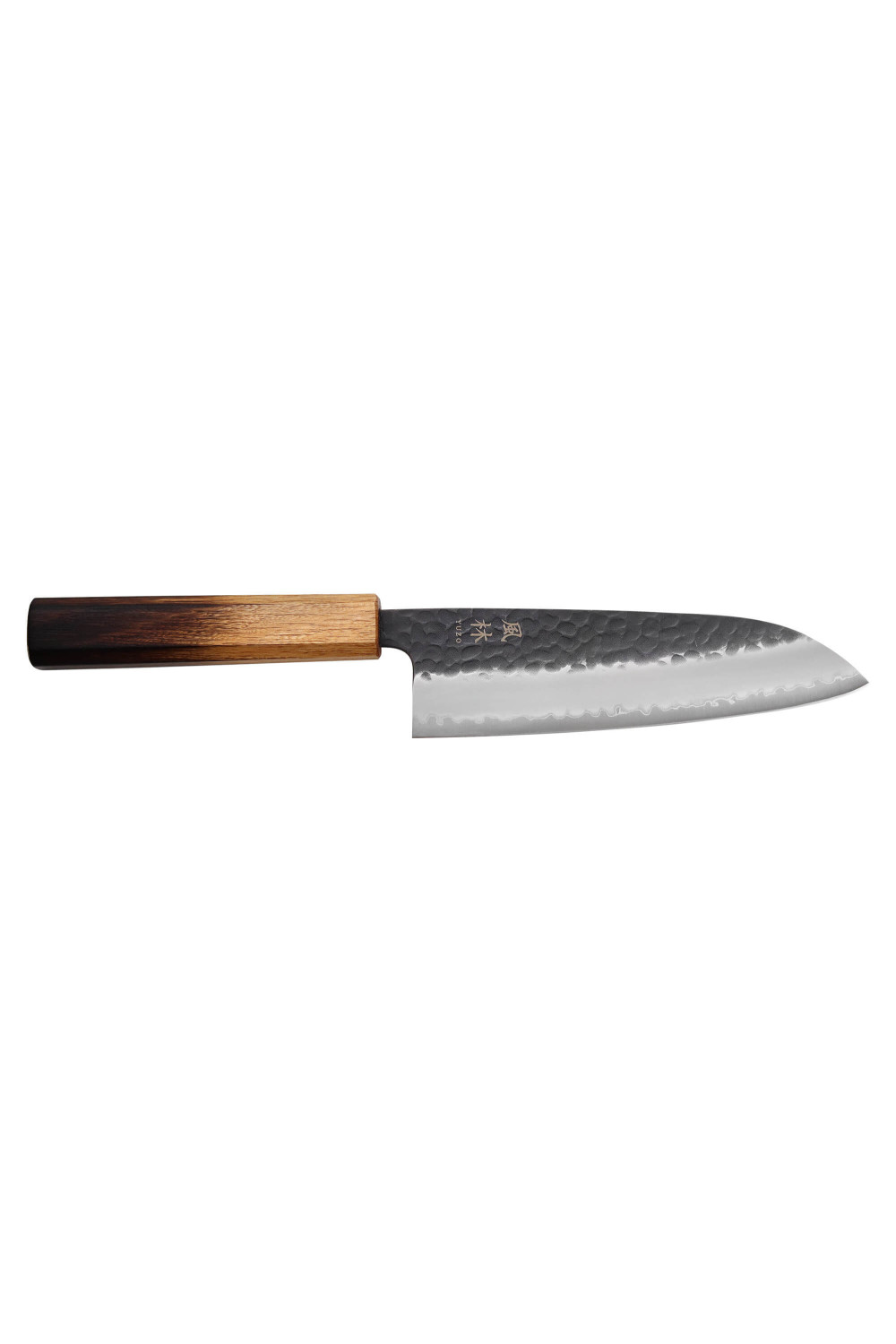
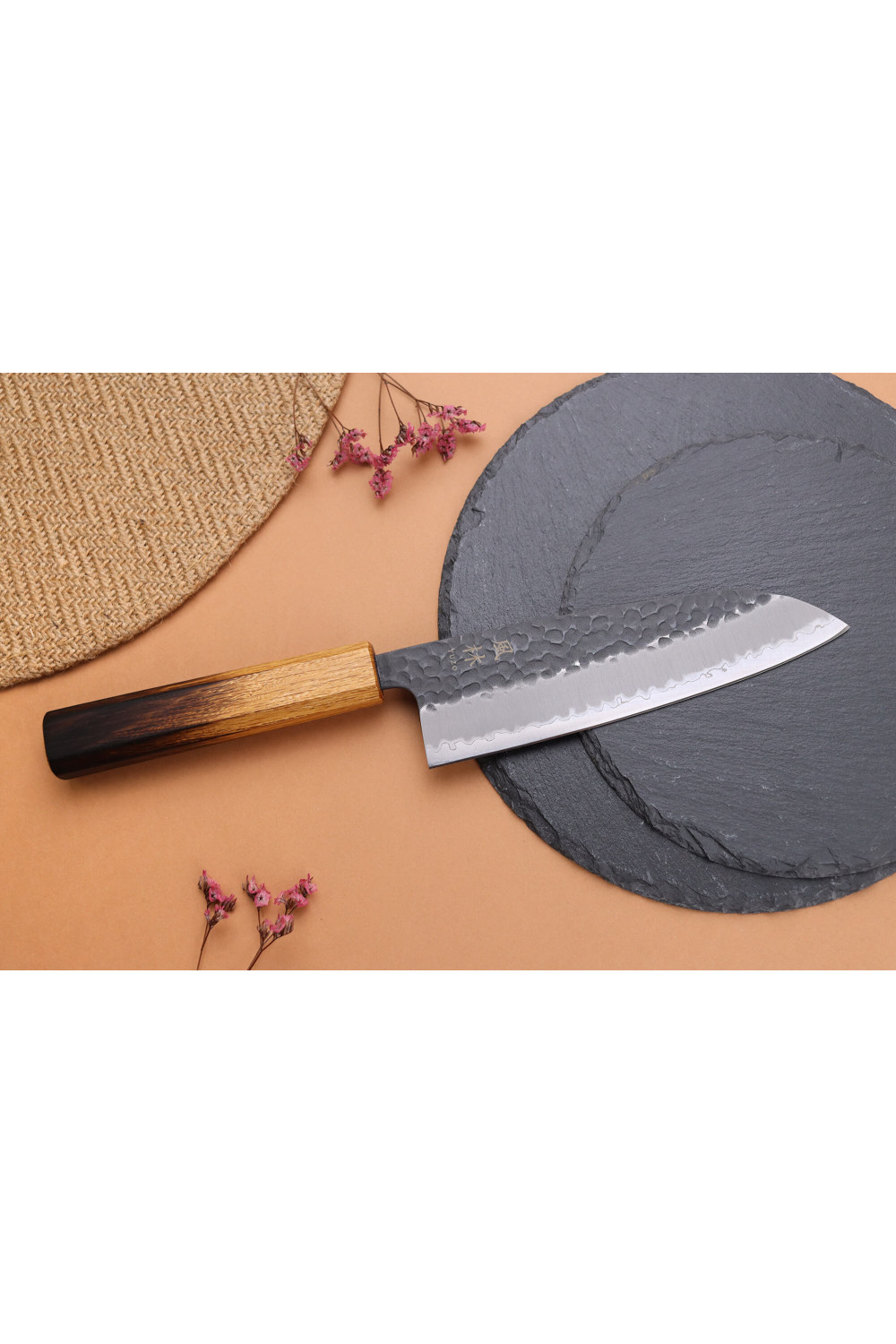
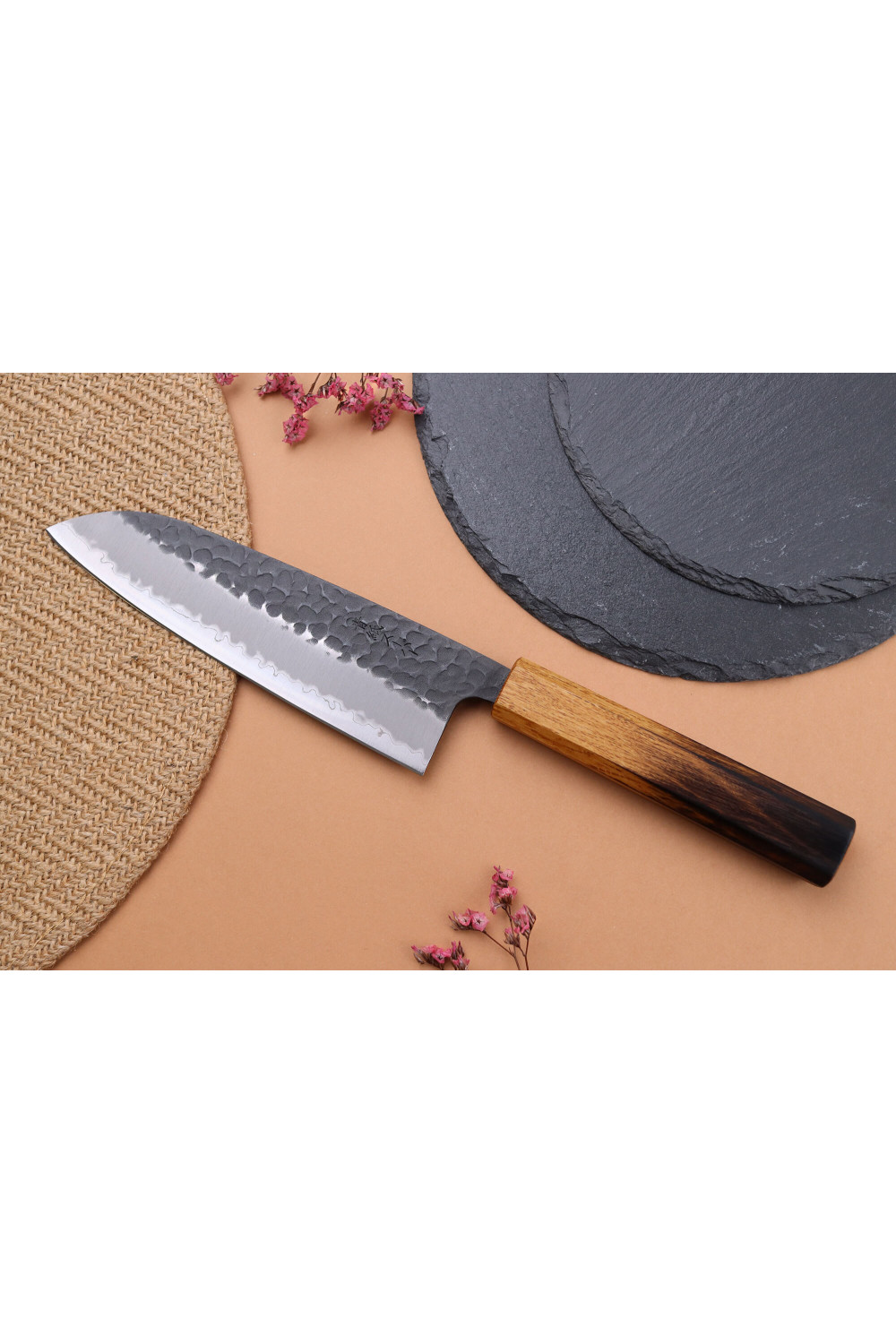
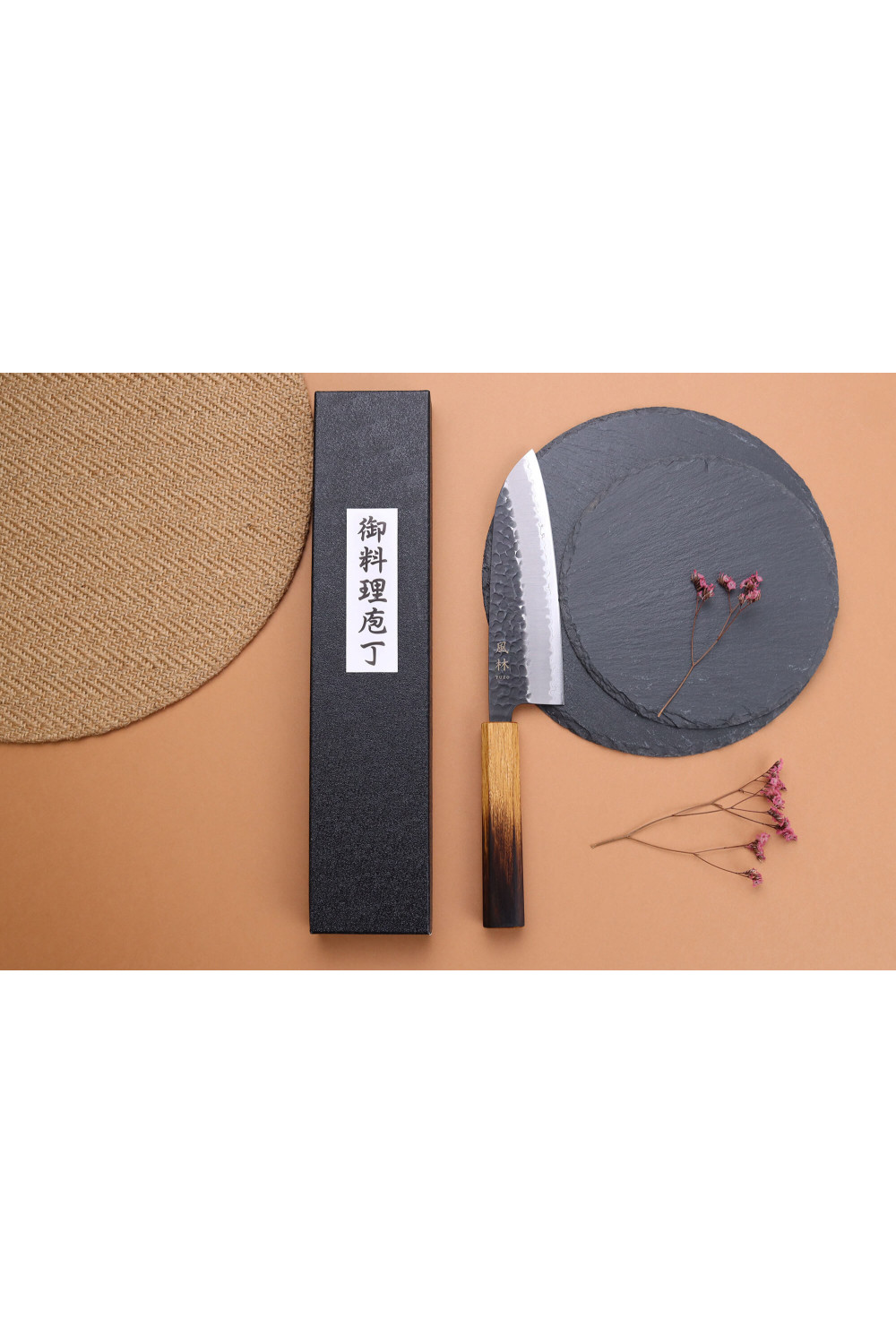
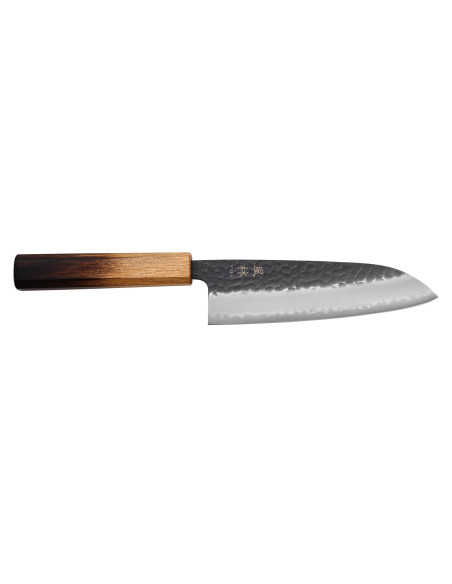
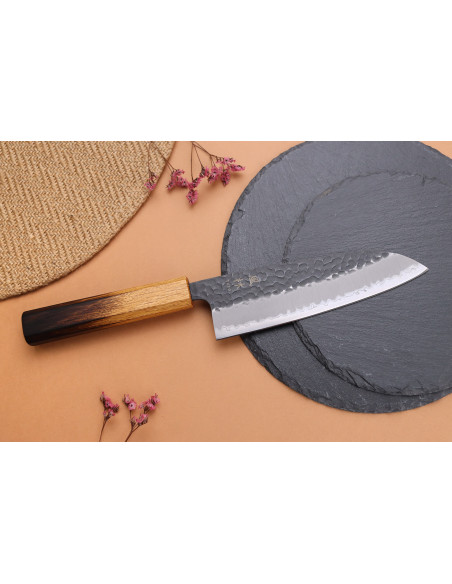
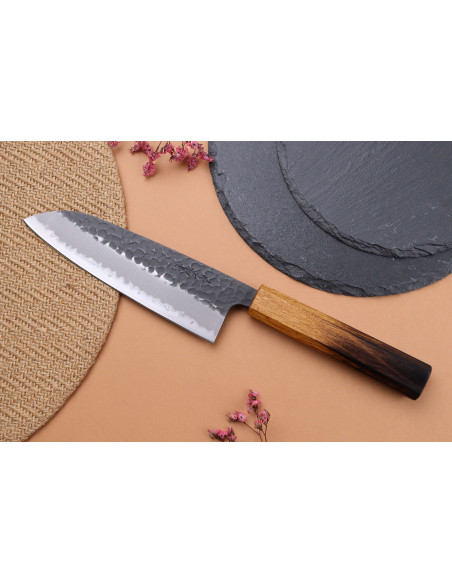
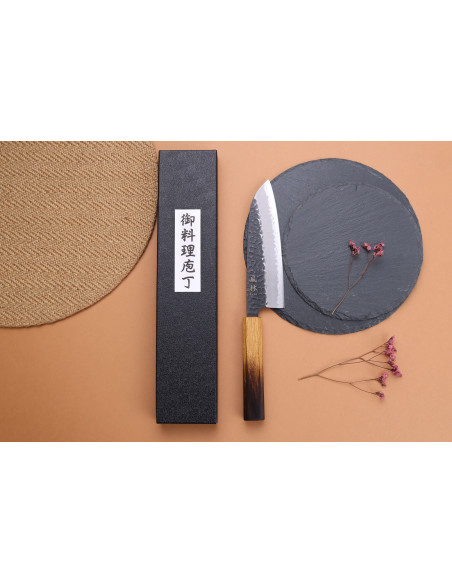
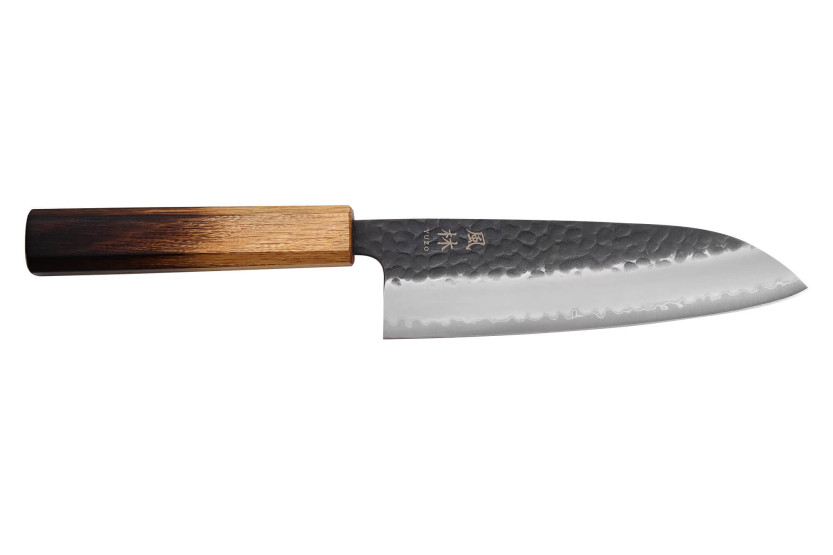
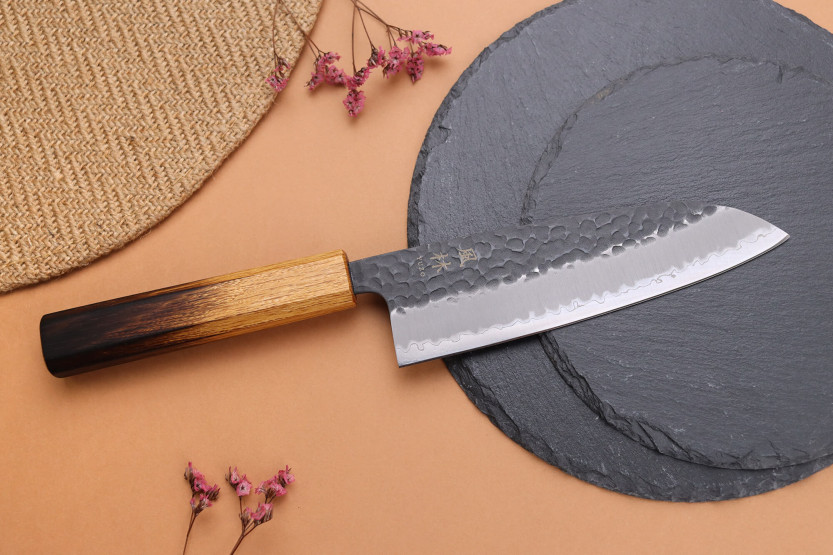
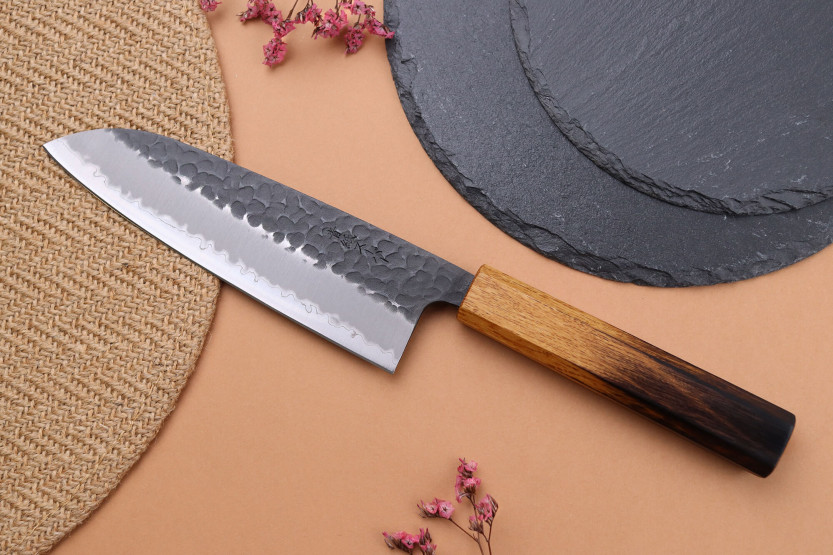
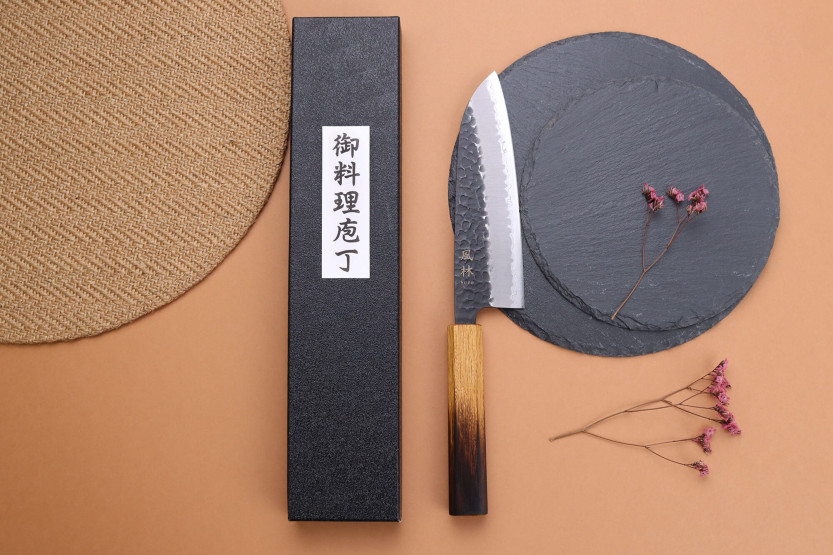
The Yuzo Hamono Black AS 16.5cm santoku knife knife is an all-purpose knife! Its blade is slightly more curved than a chef knife (to which it is often compared), making it ideal for chopping all kinds of foods. Do not use on hard foods such as squash, cheese wheels or bones.
The knives in the range are made by Tsunehisa cutlery, directly in Japan.
An original, comfortable handle
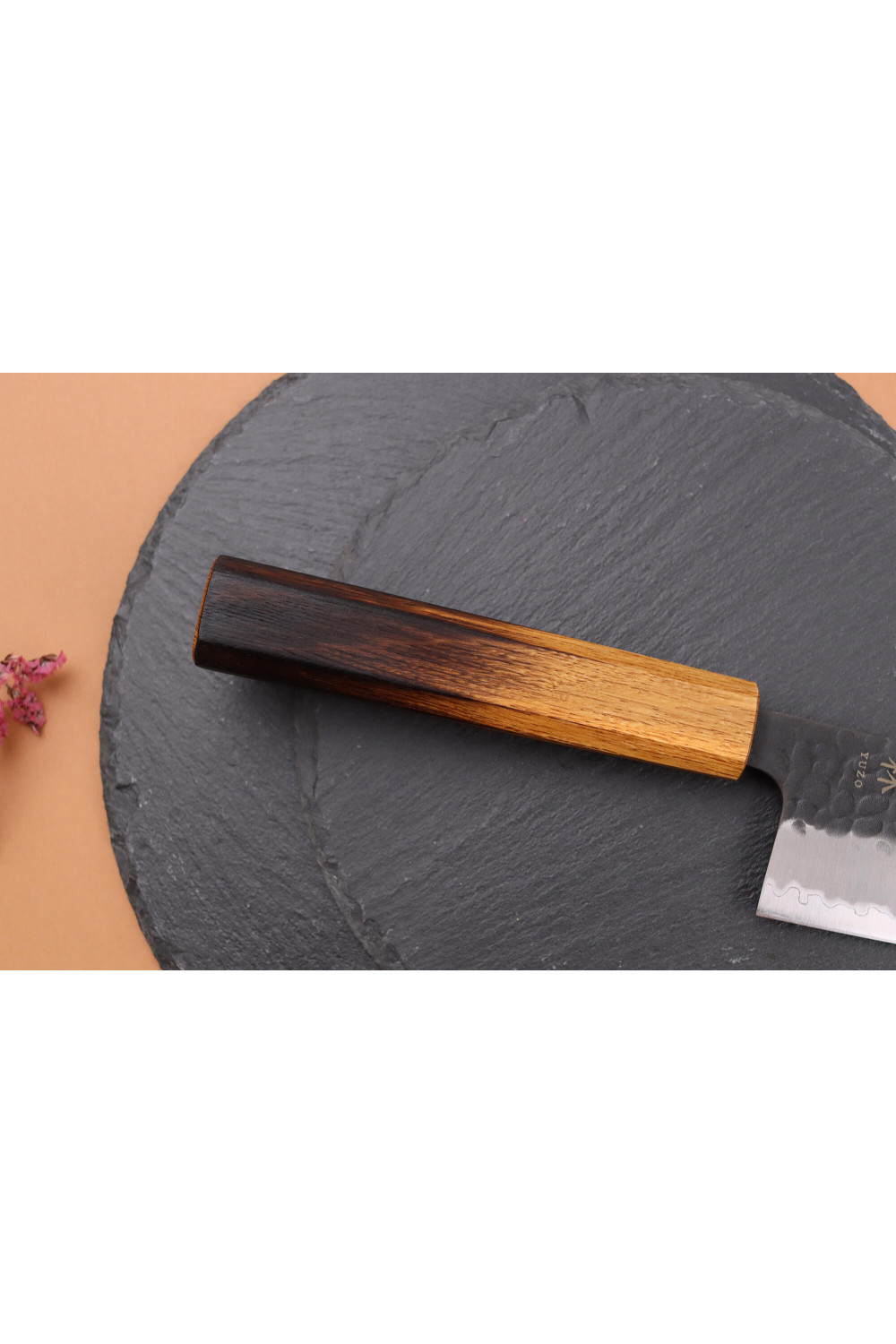
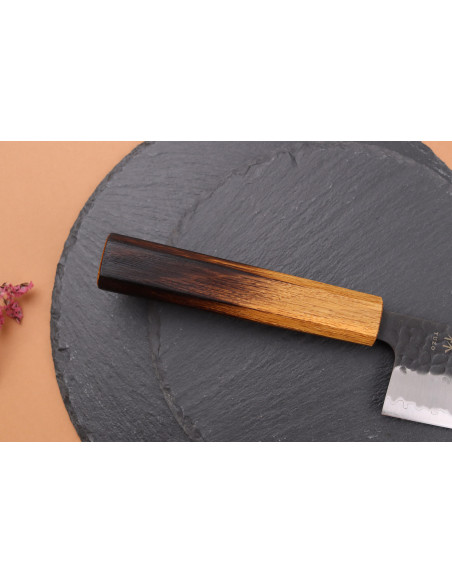
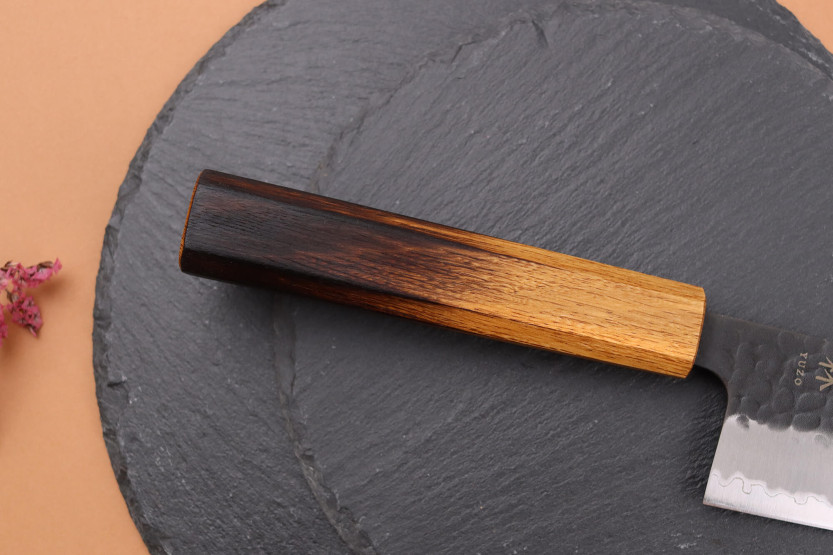
Oak wood from the island of Kyūshū was chosen to design the handle of the yuzo hamono Japanese knife. This durable wood has stood the test of time (which is why it is often used in furniture design). Oak is resistant to moisture, shock and vibration (so it retains its original shape over the long term).
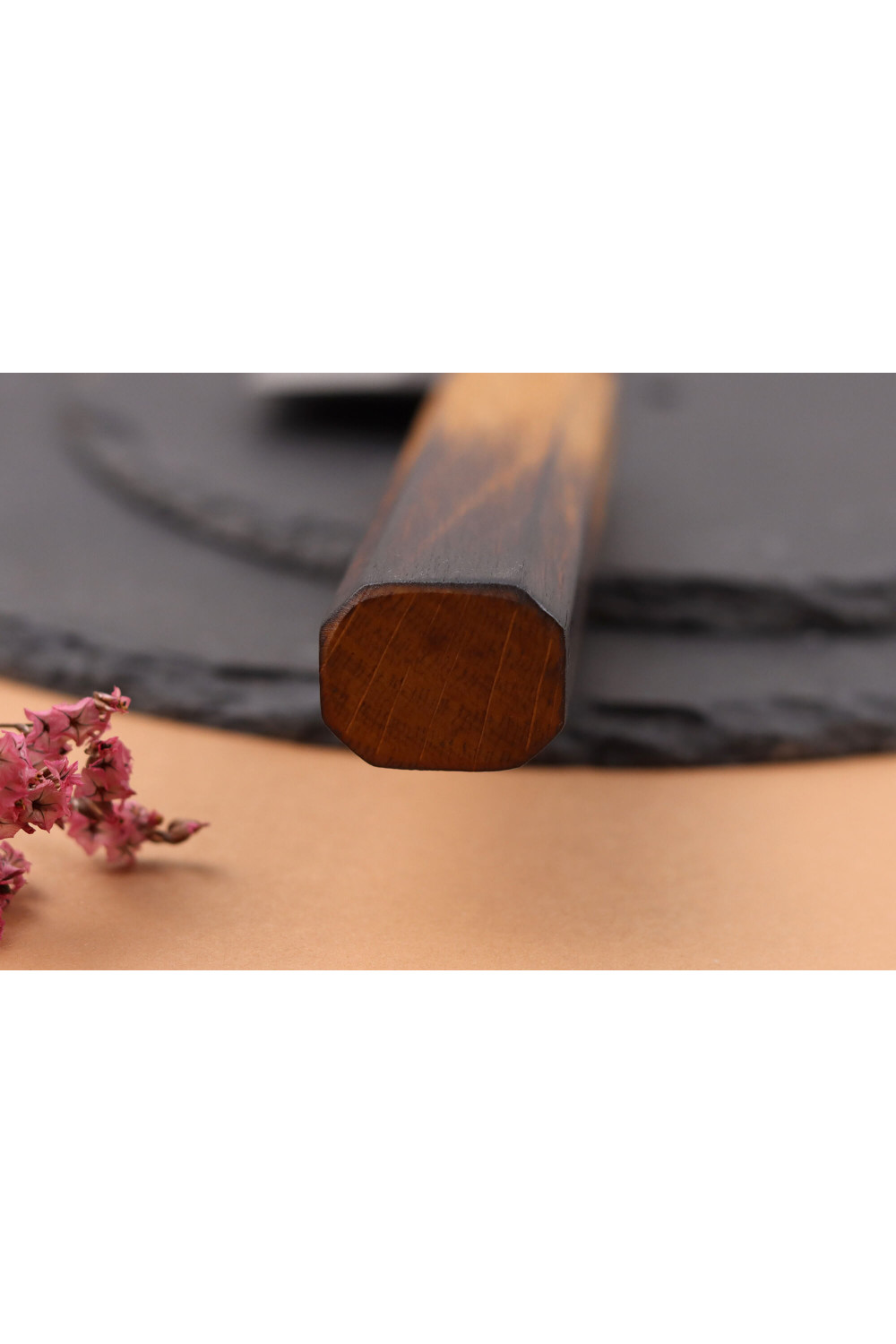
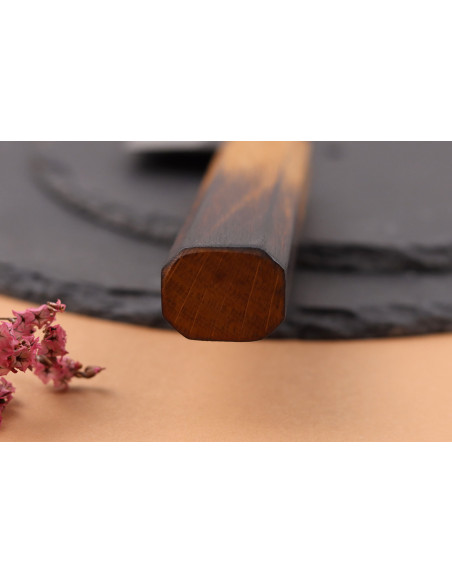
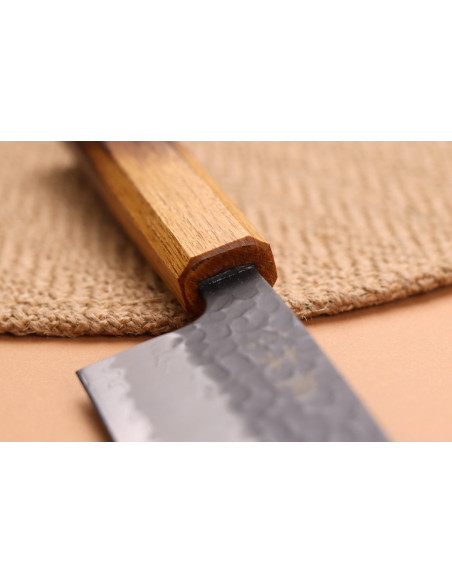
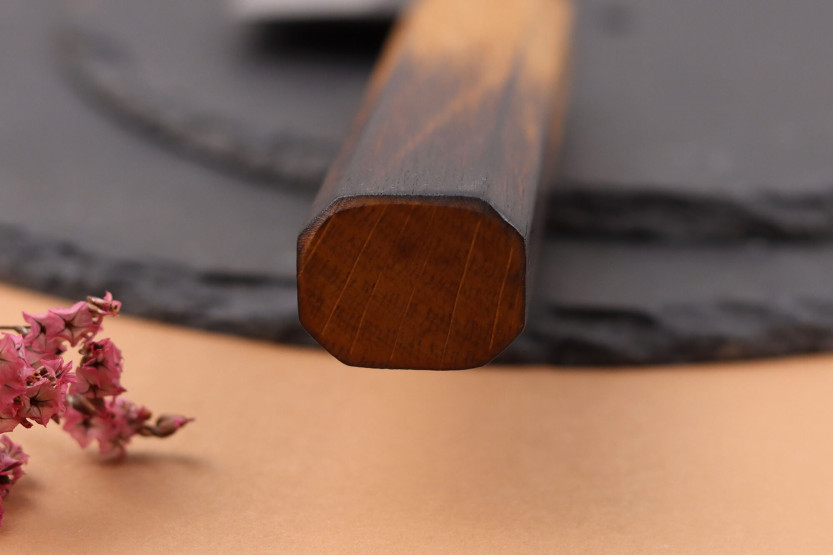
The end of the handle has been burnt (the darker part). This makes it even more resistant, while giving it a distinctive style that will delight cooks. The color contrast is impeccable.
Octagonal in shape, its 8 sides are suitable for both right- and left-handed cooks. Lightweight and easy to handle, it's a pleasure to use, even for long cuts.
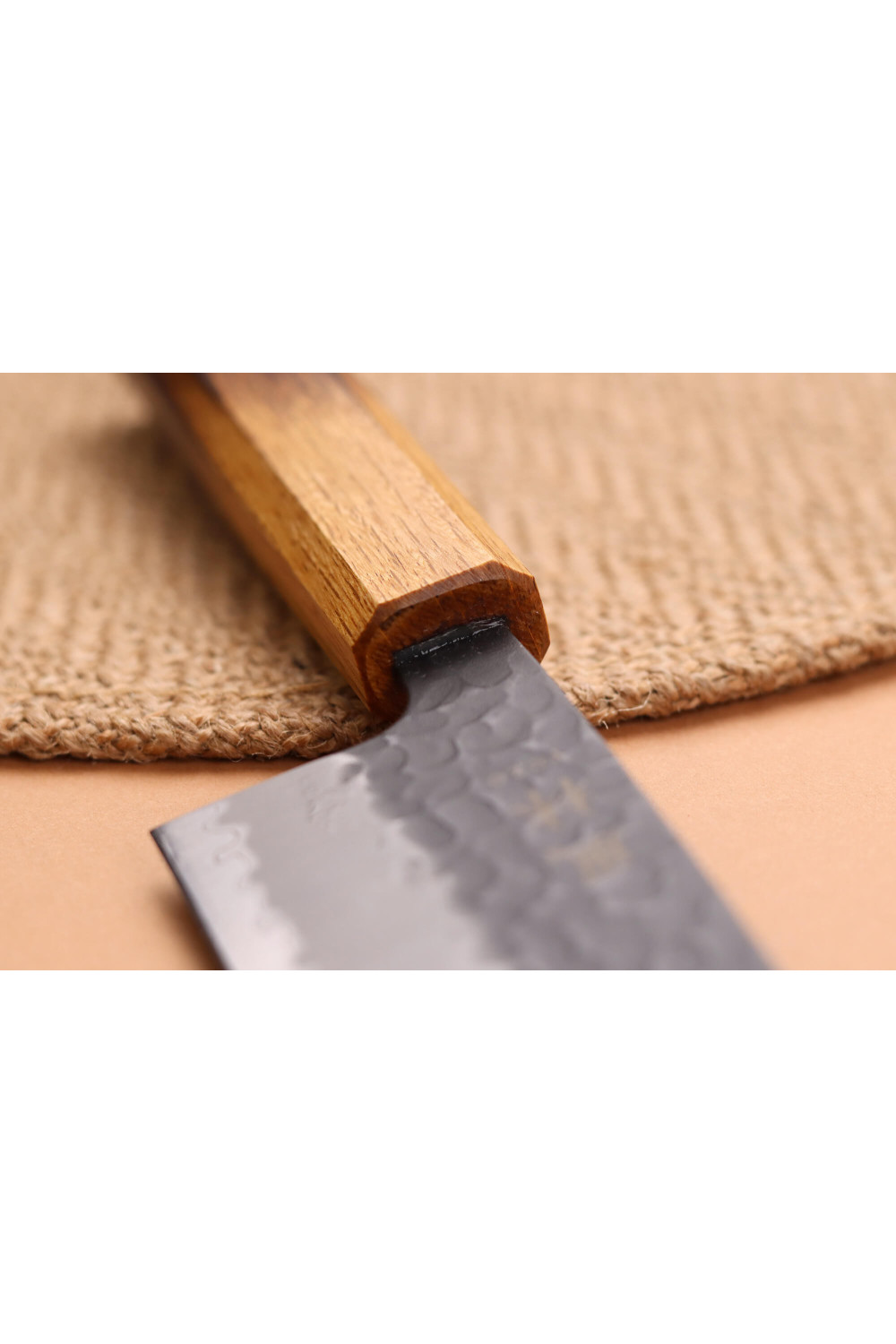
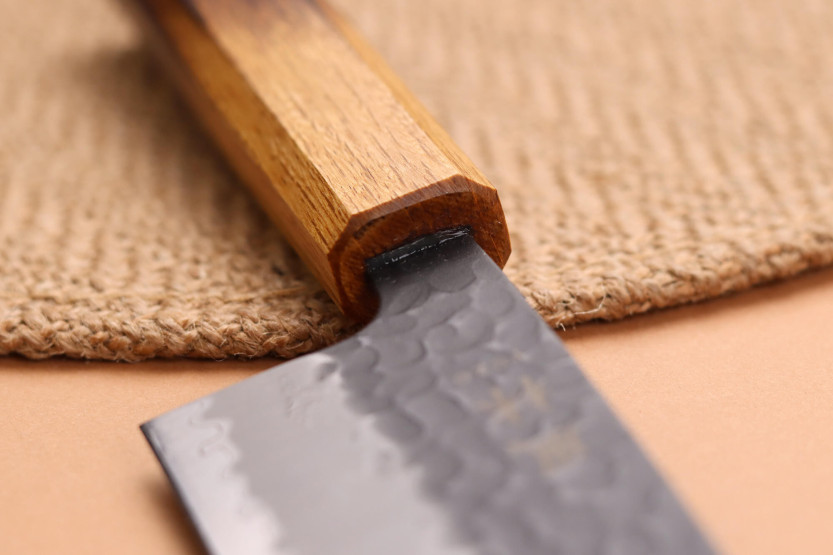
Wood putty is used to fill the gaps between the two materials, making them watertight against moisture or small foodstuffs that may find their way in.
A Japanese santoku knife with character
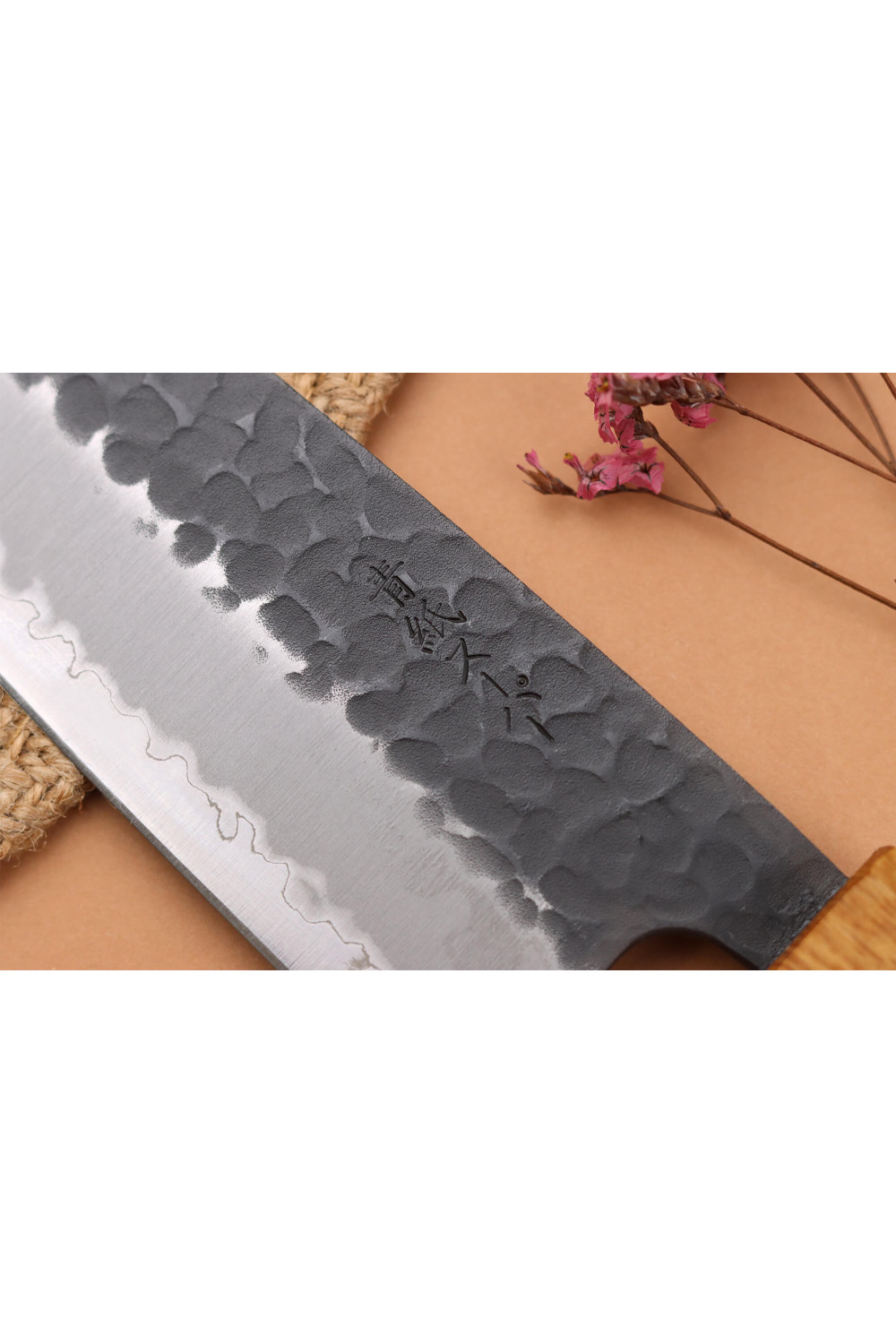
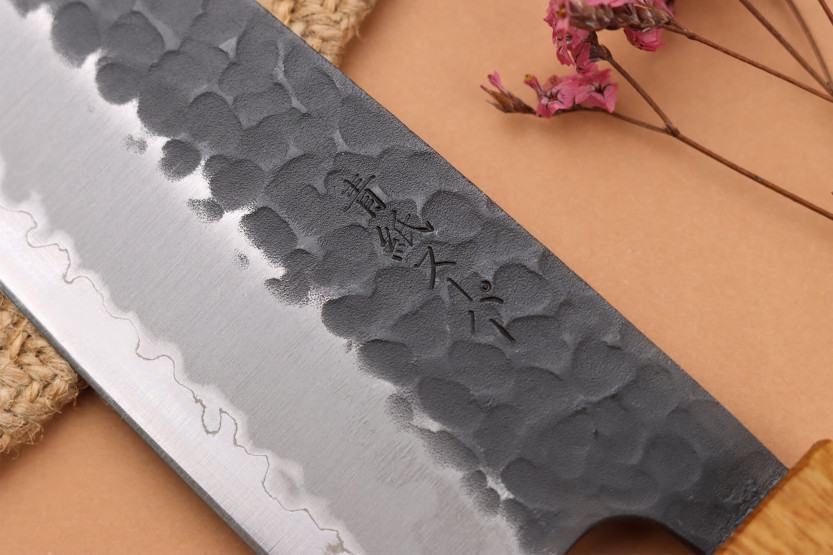
Your santoku knife features a typically Japanese blade structure called San Mai. To create it, 3 interlocking layers of steel are assembled. A hard core acts as the core, and is surrounded by a layer of softer steel that protects it and gives it greater strength. The result is a balanced blade that combines the advantages of both alloys.
Here, the blade core is made of Japanese Aogami Super steel, also known as Blue Super Steel. It is created by the famous steelmaker Hitachi, internationally renowned for its many innovations in relation to different alloys.
Aogami Super (AS) is highly enriched in carbon, up to 1.5%. This is a real advantage, as carbon provides the rigidity necessary for a blade to hold its shape. What's more, a hard alloy has better edge retention over time. With this high carbon content, it achieves a hardness of 65HRC on the Rockwell scale. This index shows you just how hard an alloy is made to cut without tiring.
Despite its obvious hardness, this alloy remains pleasant to sharpen when the need arises. A real advantage.
As previously mentioned, to create the San Maï, the core is coated with a layer of stainless steel, which provides better resistance to corrosion while giving it more "flexibility". This knife does not become flexible, but it is a little more resistant to shocks than steel that is too hard and becomes breakable on its own.
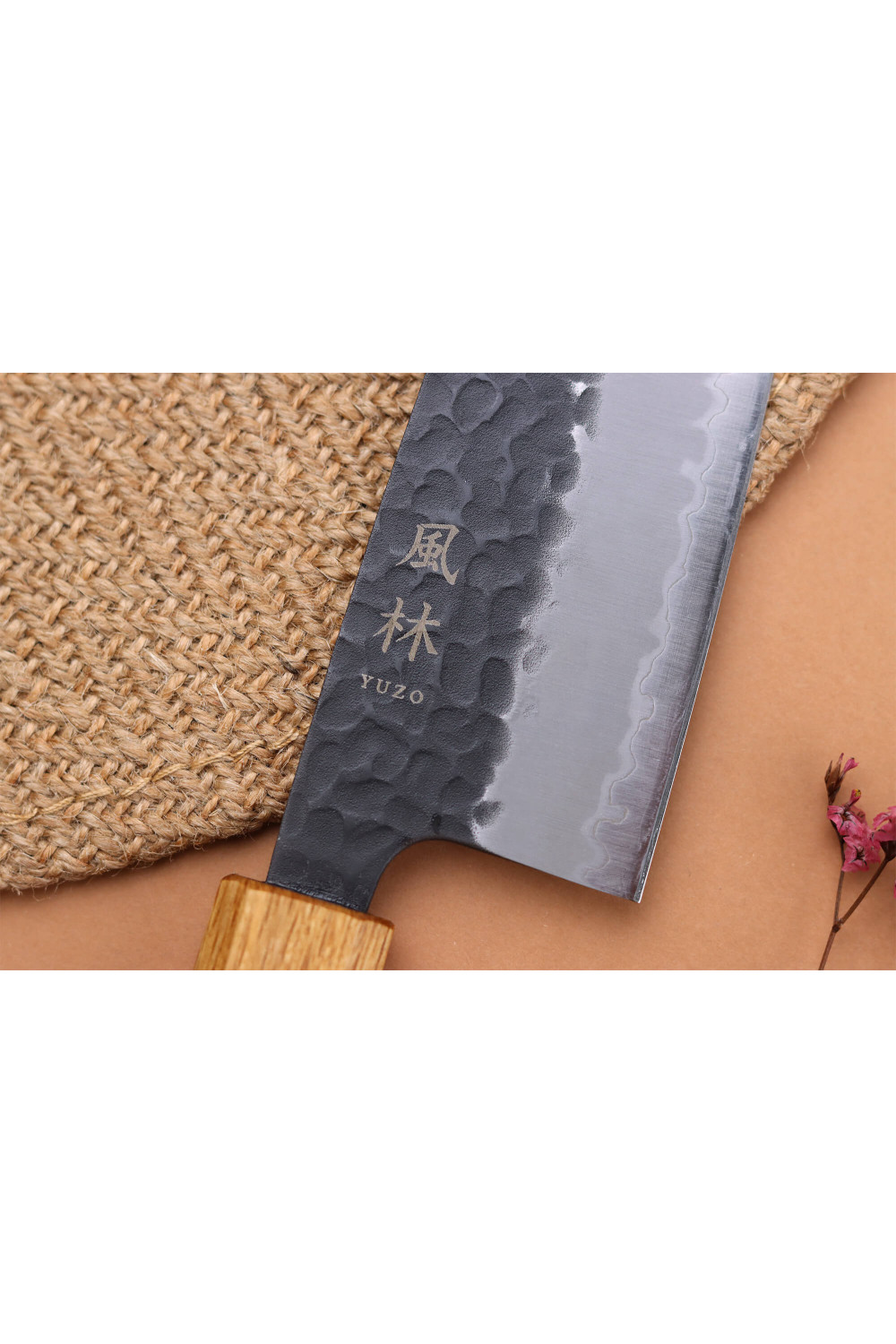
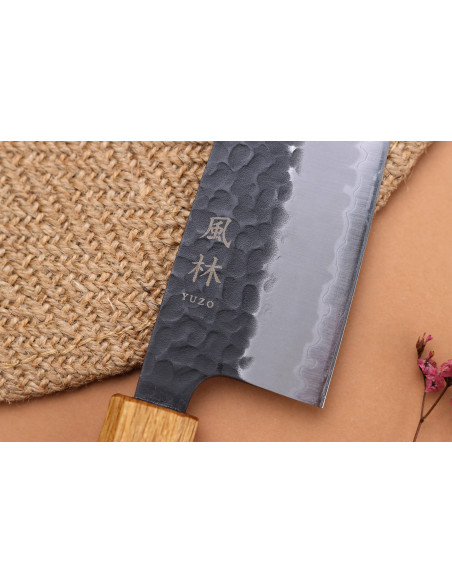
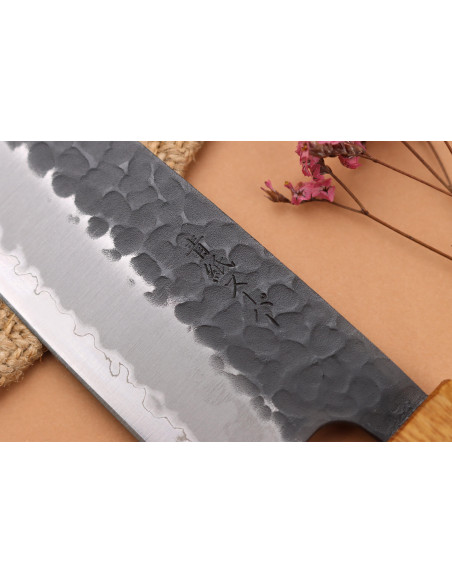
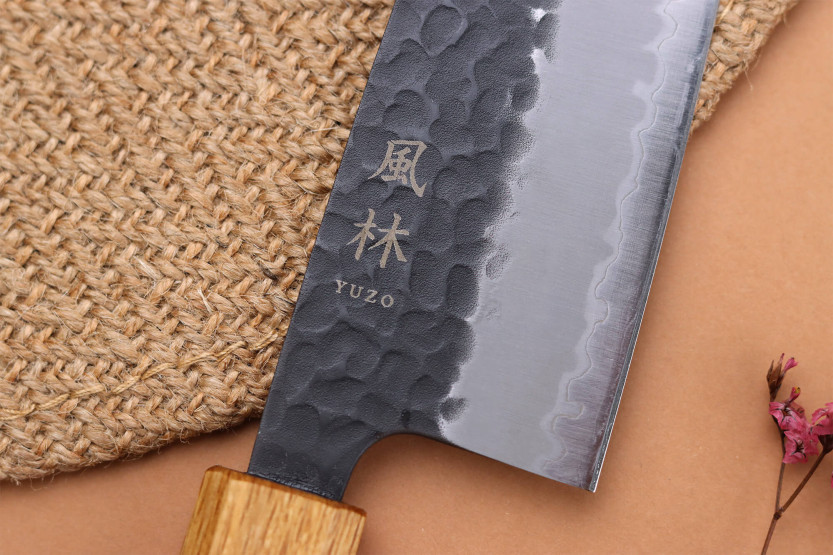
Finally, this blade has a rough forged finish that gives it a very traditional feel. It is not polished, which gives it its dark appearance. The blade is also hammered, for added character.
Caring for your Japanese knife
Your kitchen knife should be washed by hand, using a sponge and a mild detergent. Do not soak it in the sink, nor put it through the dishwasher. As the knife is oxidizable (mainly due to its carbon content), it must be kept away from moisture. Avoid getting the handle too wet.
When you use it, wipe the blade regularly to prevent it coming into contact with the acidity of food for too long.
Over time, the blade may change color: this is normal! This is due to the acidity of the food and the humidity in the air: it's a natural reaction.
Find out more about our Yuzo Hamono knives!




 By buying this product you can collect up to