
Your cart
There are no more items in your cart
In a butcher’s shop, it is difficult to do everything with just one knife. Boning a piece of meat, separating a joint, cutting through a carcass or slicing clean portions do not require the same amount of force, precision or blade shape. This is why professionals use several complementary butcher knives and cutting tools.
Among all the equipment available, five tools are particularly important: the boning knife, the butcher’s cleaver, the bleeding knife, the slicing knife and the butcher’s saw. Each one is used at a different stage of meat preparation and helps professionals work with greater precision, efficiency and comfort.
1. The boning knife: for precise work around bones
The boning knife is probably one of the most characteristic tools used by butchers. Its blade is generally short, narrow and pointed so that it can easily slide along bones, work around joints and separate meat while limiting waste.
Depending on the model, the blade can be stiff, semi-flexible or flexible. A stiff blade provides greater control when working on larger cuts, while a more flexible blade can follow the shape of bones more easily. The right choice therefore depends largely on the type of meat being prepared and the butcher’s working habits.


Fischer SWE-STEEL knives
Fischer SWE-STEEL 13cm semi-flexible boning knife with ultra-comfortable handle

Awaiting Manufacturing


A good example is the MAC Chef Japanese boning knife 15.5cm. Its thin, narrow and slightly curved blade is made from Japanese AUS-8 stainless steel. It is relatively stiff for a boning knife, providing excellent control when working around bones while maintaining a high level of precision. Its edge is sharpened by hand on whetstones, in keeping with Japanese knife-making tradition.
What is it used for? Removing meat cleanly from around bones, working around joints and carrying out precise boning tasks.
2. The butcher’s cleaver: power for working on carcasses
With its wide rectangular blade and substantial weight, the butcher’s cleaver clearly belongs to a different category from a standard kitchen knife. Its purpose is to provide enough power to work on large cuts of meat, portions of carcasses and certain joints.
Unlike a knife, which mainly cuts through a slicing motion, a cleaver also makes use of its weight. The momentum of the blade assists the butcher’s movement and generates additional cutting force without requiring excessive effort.


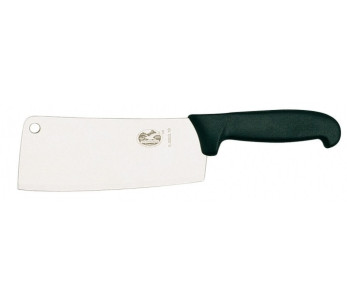


The Pradel Excellence butcher’s cleaver 22cm is a perfect example. It features a large 22cm stainless steel blade with a full tang construction, combined with a bubinga wood handle secured by three rivets. Weighing approximately 970g, it offers significant cutting power for demanding butchery work.
What is it used for? Working on large cuts of meat and carcasses whenever more power is required than a standard knife can provide.
3. The bleeding knife: a narrow pointed blade for precise work
The bleeding knife features a relatively narrow blade ending in a pronounced point. This shape allows it to penetrate meat easily and perform precise movements at greater depth.
It is traditionally used for bleeding operations, but this type of knife is also useful for a range of butchery tasks requiring a narrow, highly manoeuvrable blade. In a professional environment, the handle must also offer a secure grip, including when hands are wet or greasy.


Arcos Colour Prof
Arcos Colour Prof 241400 professional sticking knife 13cm blade with PP handle
In stock
The Giesser 9117 professional bleeding knife 15cm is specifically designed for meat professionals. Its 15cm blade offers an excellent balance between penetration capacity and manoeuvrability. Giesser is a well-established brand in professional butchery and food-processing equipment.
What is it used for? Tasks requiring precise penetration into meat, particularly professional bleeding and meat preparation work.
4. The slicing knife: for clean and even portions
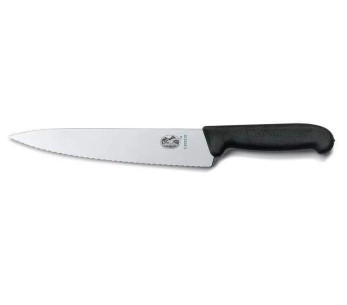
Once the meat has been boned and prepared, it still needs to be portioned. This is where the butcher’s slicing knife becomes essential. Its blade is considerably longer than that of a boning knife, allowing long, even cuts to be made with as few movements as possible.
This additional length is especially useful for slicing steaks, roasts and other large cuts of meat with a smooth motion. A long, sharp blade limits unnecessary sawing movements that could damage the meat fibres and helps achieve cleaner, more regular slices.

Fischer SWE-STEEL knives
Fischer SWE-STEEL 30cm rigid slicing knife with ultra-comfortable handle
In stock

Fischer SWE-STEEL knives
Fischer SWE-STEEL 23cm slicing knife with ultra-comfortable blue handle
In stock
Victorinox
Victorinox Professional Carving Knife black fibrox serrated blade 22cm 5.2033.22
In stock
The Fischer SWE-STEEL slicing knife 23cm features a blade made from Swedish Sandvik 12C27 stainless steel, with a hardness of approximately 56 to 57 HRC. Its blue polypropylene handle is designed to provide a secure grip and includes a pronounced guard for improved safety during intensive professional use.
What is it used for? Portioning large cuts of meat and producing clean, even and consistent slices.
5. The butcher’s saw: essential when a knife is no longer enough
There comes a point when even a very good butcher’s cleaver reaches its limits. For cutting through larger bones or working on substantial pieces of meat, professionals therefore turn to a butcher’s saw.
Its operation is similar to that of a conventional saw, but its blade and overall construction are specifically designed for working with meat and bones. It allows cleaner and more controlled cuts than attempting to force a knife or cleaver through material that is too hard.


Butchers' saws
Dick 35cm freezer saw with stainless steel blade and ergonomic black polymer handle
In stock


The Fischer Standard butcher’s saw 35cm features a 35cm serrated stainless steel blade. Its frame is made from carbon steel with an epoxy coating, while the synthetic handle helps make cleaning easier after use. The blade can also be replaced when necessary, which is particularly useful for a tool intended for regular professional use.
What is it used for? Cutting bones and large pieces that cannot be handled effectively with a knife or butcher’s cleaver.
Bonus: how can a butchery student get equipped easily? Choose a butcher knife case!
When starting a butchery course, buying each knife separately can quickly become complicated. You need to choose the right blade shapes, make sure the knives are suitable for professional use and also think about how to transport them safely. One of the easiest solutions is therefore to choose a butcher knife case containing the essential tools needed for training and everyday work.

Butcher's knife case
Butcher knife case 4 FISCHER knives sandvik steel SWE-STEEL
In stock
116,30€
€124.90
The Fischer SWE-STEEL butcher case with 4 knives is particularly well suited to students and apprentices. It includes several professional Fischer knives equipped with blades made from Swedish Sandvik 12C27 stainless steel, known for its good cutting performance, resistance and ease of maintenance.
The knives also feature professional synthetic handles designed to offer a comfortable, hygienic and secure grip. Everything is stored together in a practical case, making it much easier to carry the equipment between school, practical training sessions and the workplace.
Why is it a good choice for a butchery student? Because a knife case provides a coherent selection of professional tools right from the start, while making them easier to organise and transport. It is also a practical way to begin with reliable equipment and gradually complete the set as skills and experience develop.
So, which butcher knives should you really choose?
These five tools are not competitors: they are above all complementary. The boning knife provides precision around bones, the butcher’s cleaver supplies the power required for heavier work, the bleeding knife is designed for narrow and precise movements, the slicing knife produces clean portions, and the butcher’s saw takes over when the bones become too large or hard for a knife.
Choosing professional butchery equipment therefore depends first and foremost on the task you need to perform. The shape of the blade, its length, its stiffness, as well as the comfort and grip of the handle are all essential factors, especially when knives are used for several hours every day. For professionals, using several specialised tools is generally much more efficient than trying to perform every task with the same knife.


